Go Back

Lin
Weekly Market Update: Big Tech Divergence
Sentiment around AI continues to get worse.
The Financial Times reported that OpenAI's annualized revenue was approaching $50B, well below the $70B figure previously circulating. The market took this as a major disappointment, triggering a sell-off across AI stocks.
But the difference largely comes down to accounting. Anthropic includes revenue generated through cloud partners, while OpenAI reports those sales differently. Investors had adjusted OpenAI's numbers to make the 2 companies more comparable.
What’s more interesting is how the market reacted. When sentiment around AI was strong, almost every headline was treated as good news. Now, even the smallest bit of uncertainty is enough to trigger a sell-off. This tells you a lot about the current state of the market for tech and AI.
The broader market isn't making things easier either. Despite major indexes hitting record highs, relatively few stocks are doing well. In an environment like this, simply protecting your capital, holding your ground, and wait until the window of opportunity opens up is critical.

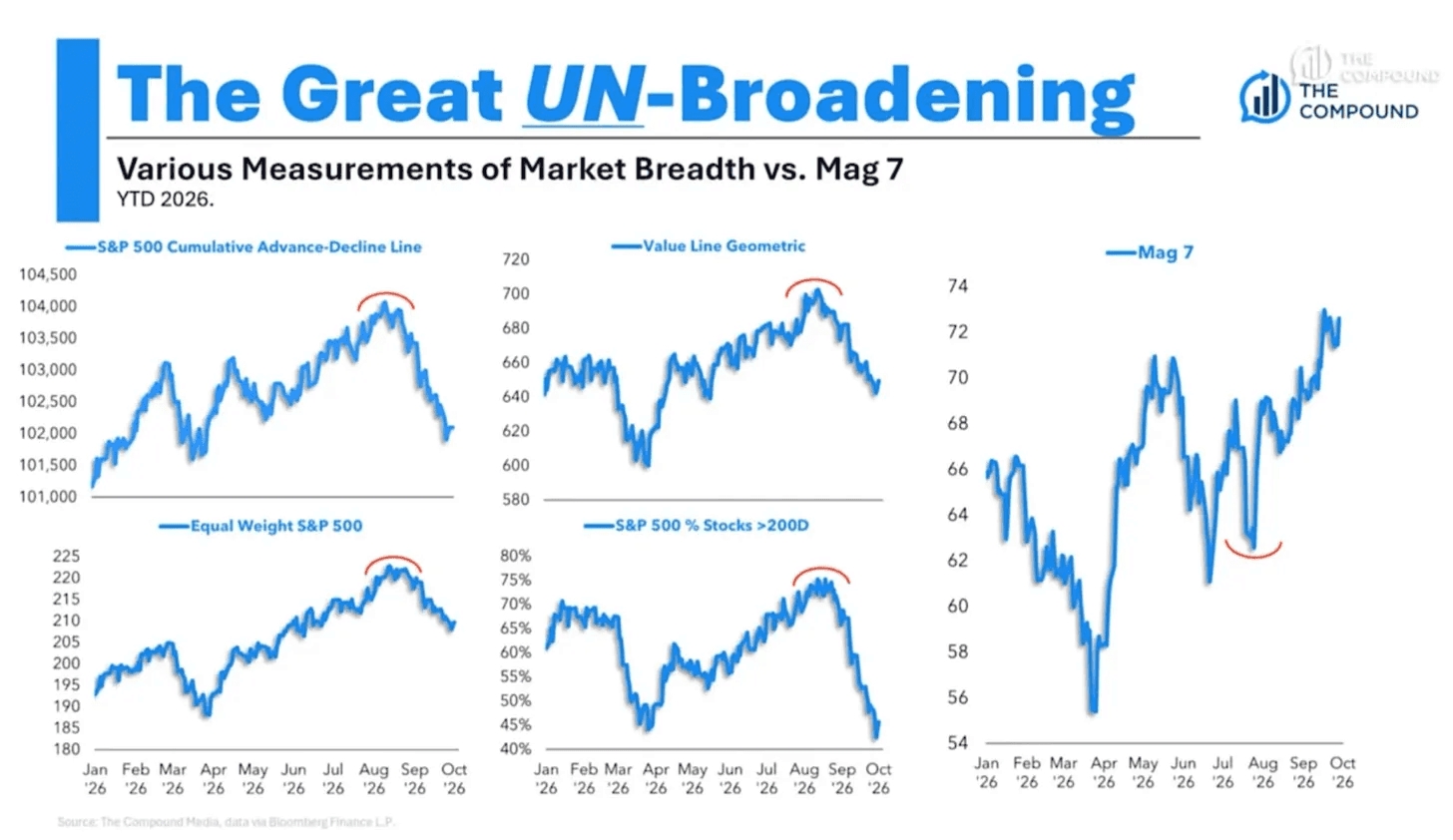
The weakness in the broader market has been there since August.
Pretty much every measure of market breadth has been getting worse. Whether you look at the advance-decline line, the equal-weight S&P 500, or the percentage of stocks above their 200-day moving average, they all peaked in August and have been declining since.
The percentage of S&P 500 stocks above their 200-day moving average has dropped from around 75% to the mid-40s.
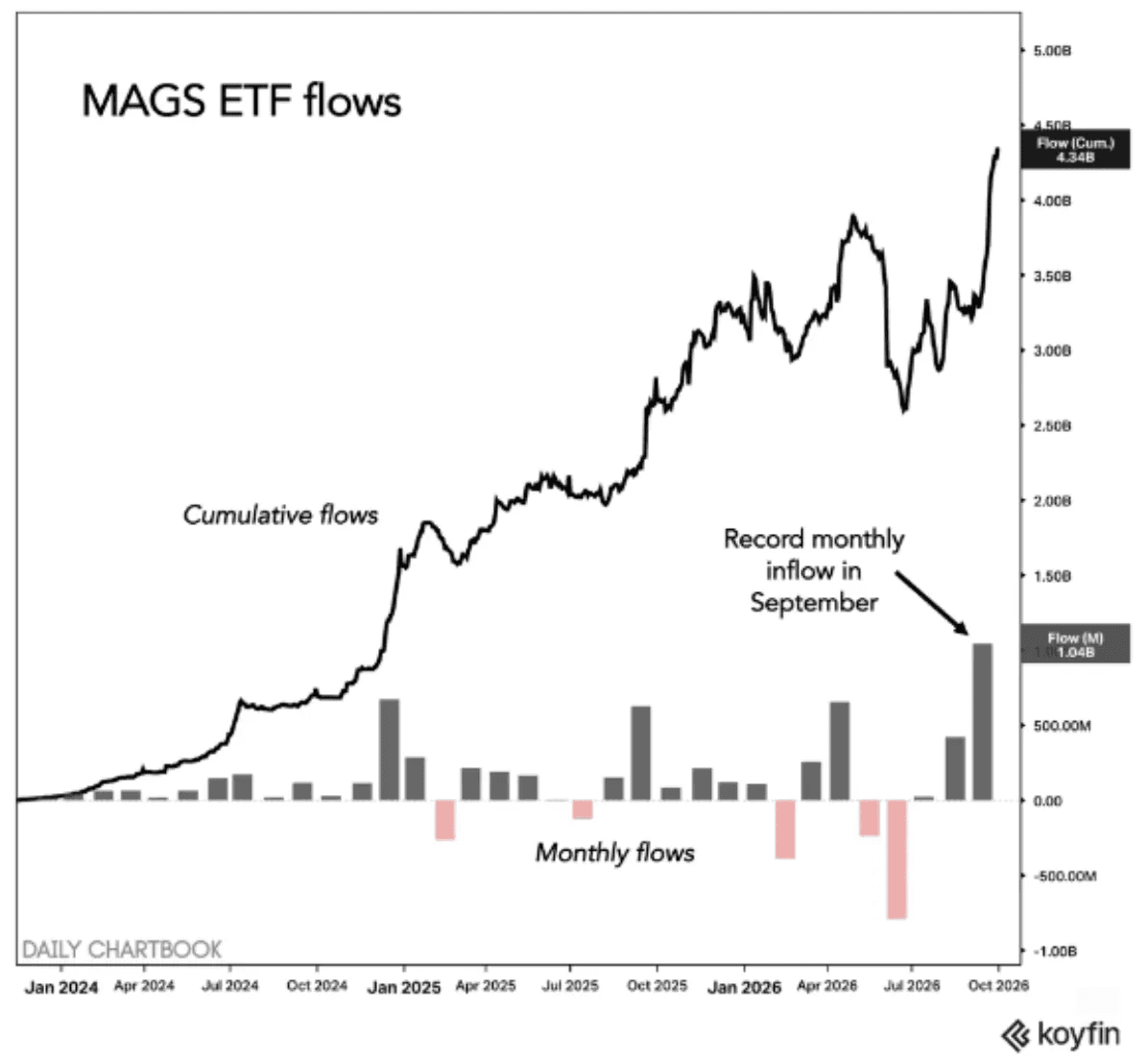
Fewer and fewer stocks are actually doing well. The main exception is the Mag 7, which are pretty much the only thing holding up the market right now.
Hence, it’s not surprising that the MAGS ETF, which invests exclusively in the Magnificent 7, had its biggest month of inflows ever. More and more money continues to flow into a small group of stocks, while most of the market is struggling.
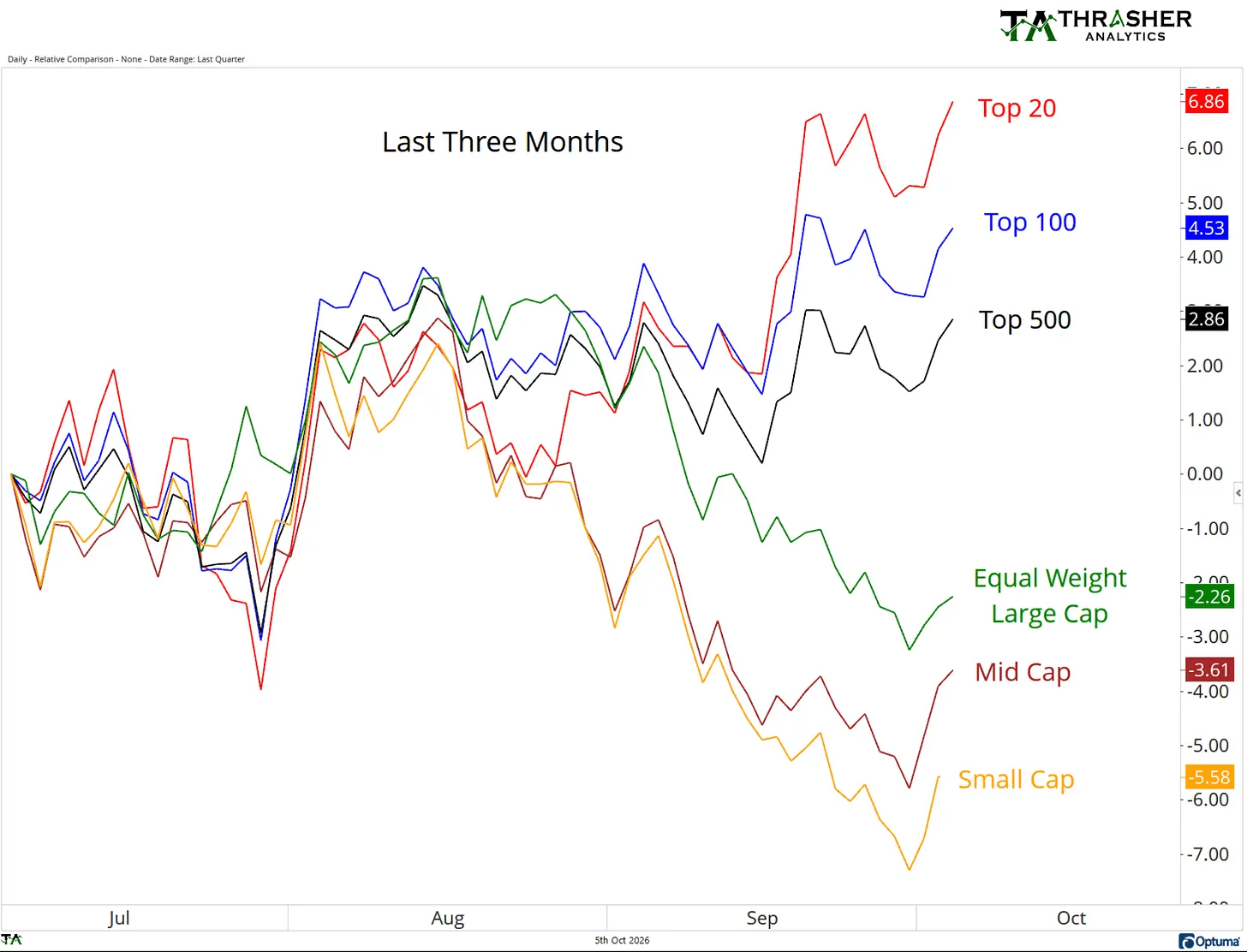
The bigger the stock, the better it performed.
The 20 largest stocks are up almost 7%, the top 100 are up 4.5%, and the full S&P 500 is up less than 3% over the last 3 months.
On the other hand, the equal-weight S&P 500 is down 2%, mid caps are down 3.6%, and small caps are down 5.6%.
The smaller the stocks, the worse they've performed.
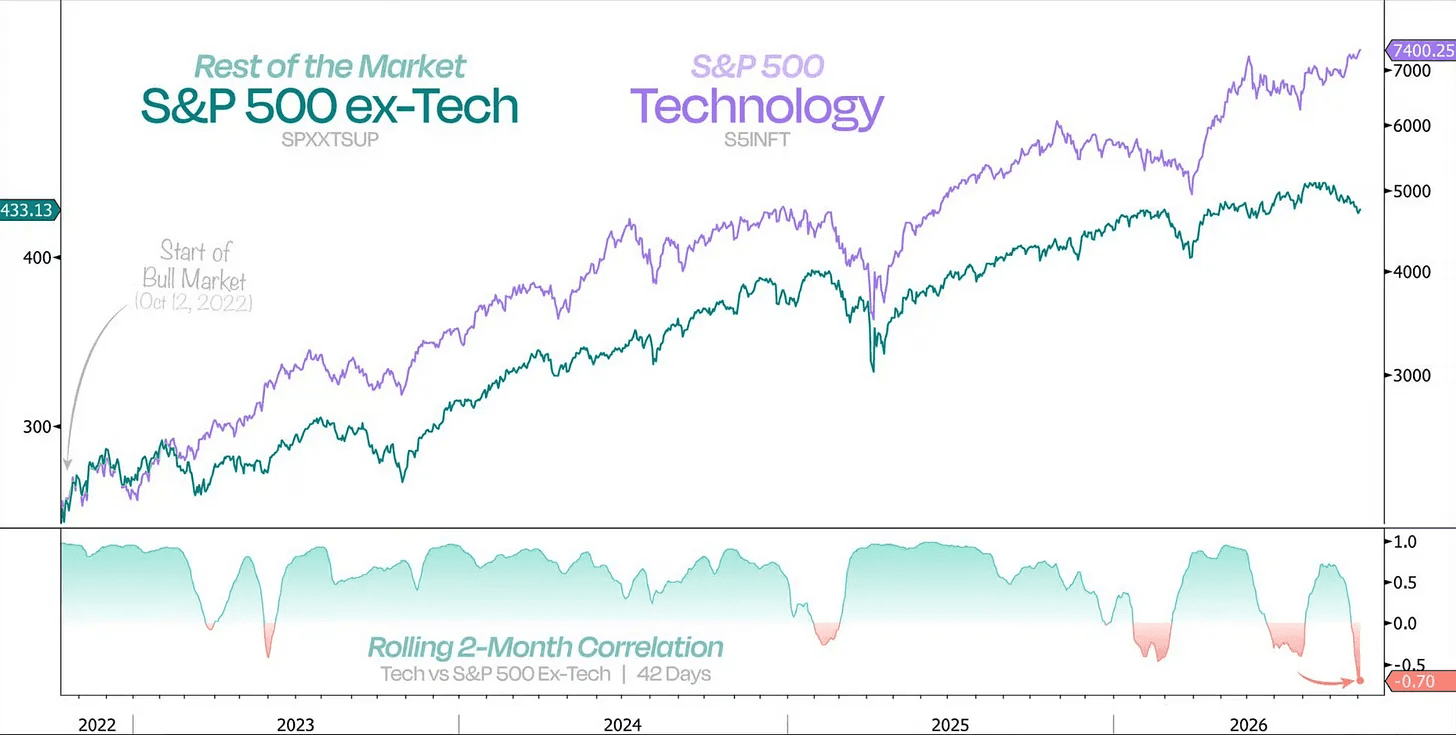
You can see the same weakness when comparing tech stocks with the rest of the market.
For most of this bull market, tech and the rest of the S&P 500 moved in the same direction. That's no longer the case.
The 2-month correlation between them has dropped to -0.70, the lowest level since the bull market started in October 2022.
In simple terms, tech stocks and the rest of the market used to move together. Now, they tend to move in opposite directions.
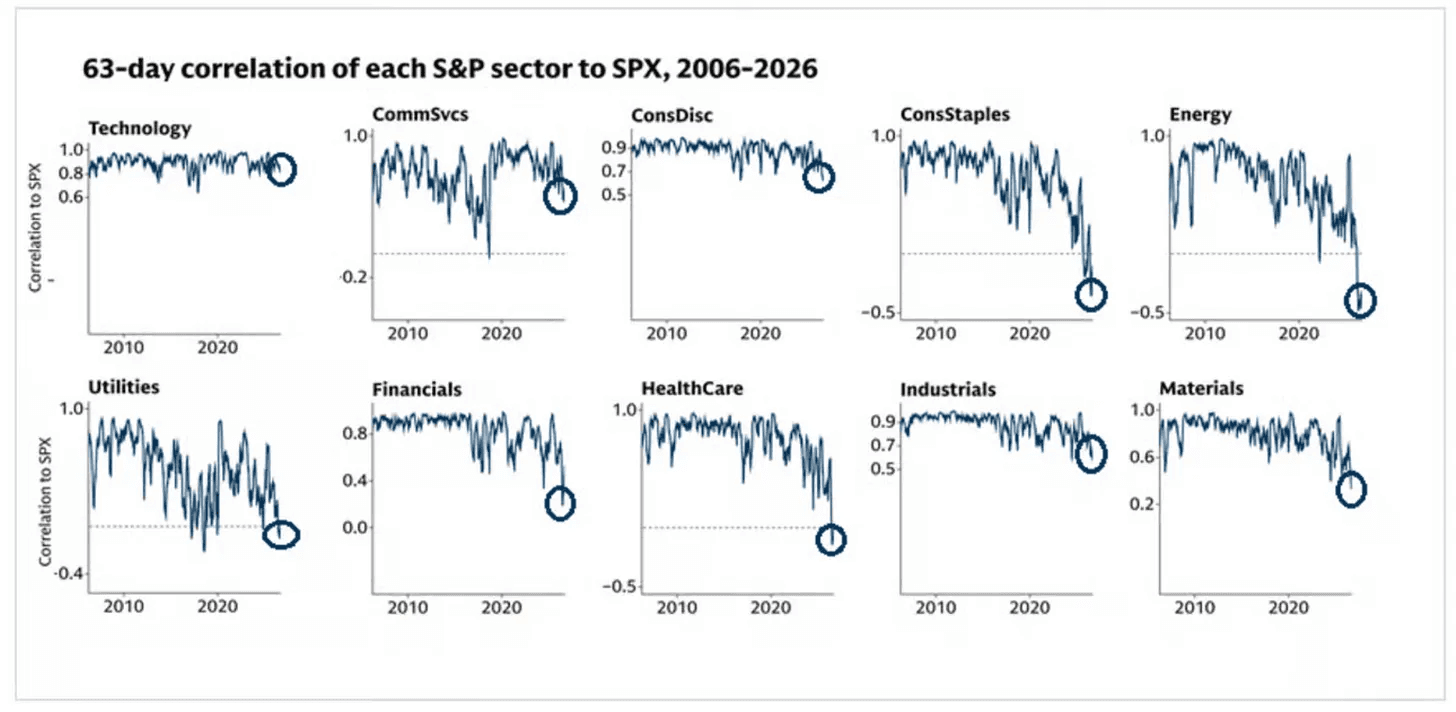
It's not just tech moving differently from the rest of the market. Other sectors are also starting to move independently of the S&P 500.
Over the last 3 months, the correlation between the S&P 500 and sectors like Consumer Staples, Energy, Utilities, and Health Care has dropped to around zero or even turned negative. Consumer Staples and Energy have reached their lowest correlation levels in 20 years.
On top of that there is a ton of volatility hidden behind the index.
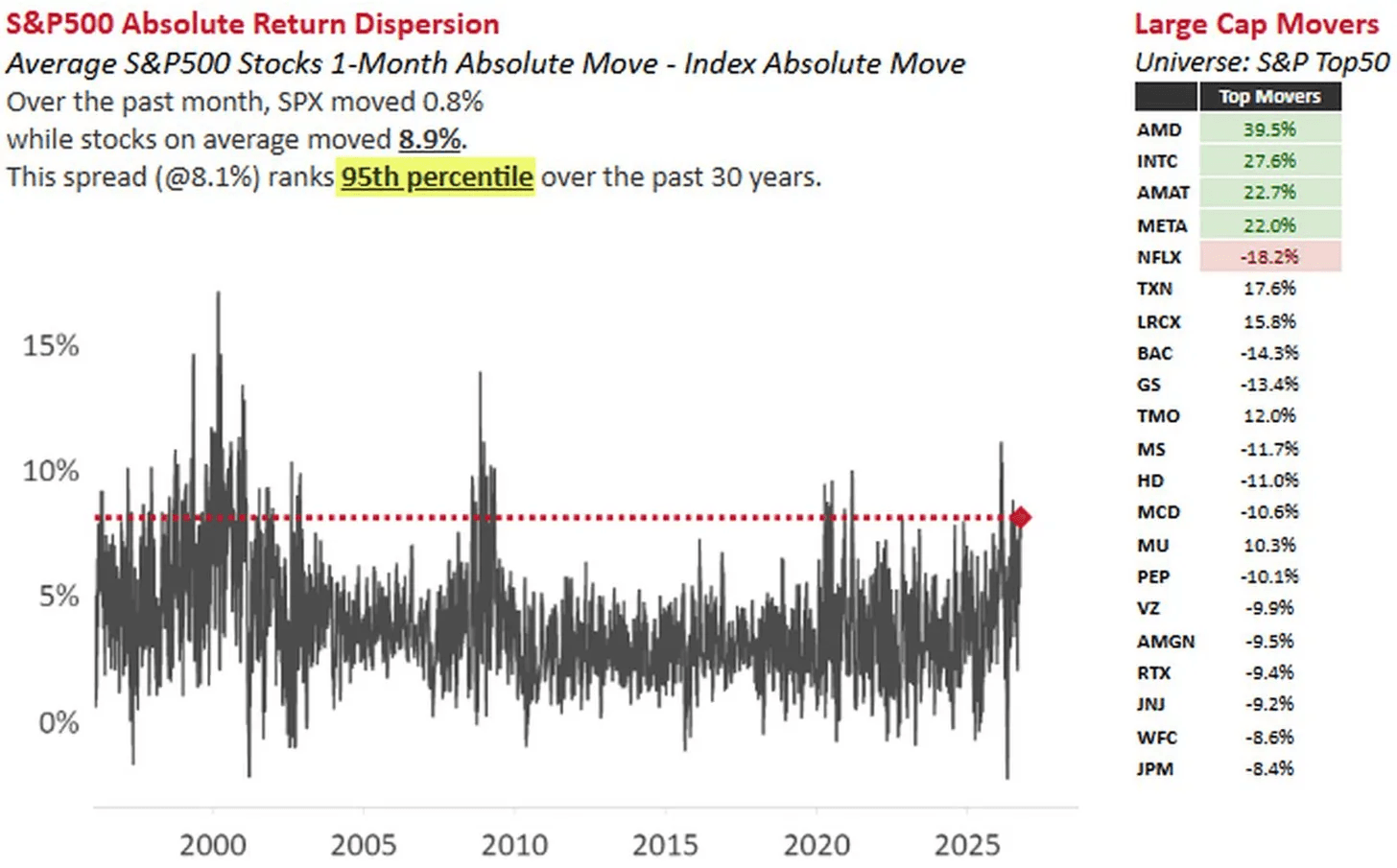
Over the past month, the S&P 500 has barely moved. It’s up just 0.8%. But the average stock inside the index has moved 8.9% in either direction.
Just look at some of the individual stocks. AMD is up almost 40%, Meta has gained 22%, while Netflix is down 18%. Bank of America, Goldman Sachs, and McDonald's have all fallen by more than 10%.
So we're seeing some pretty big moves in both directions, but they're largely canceling each other out.
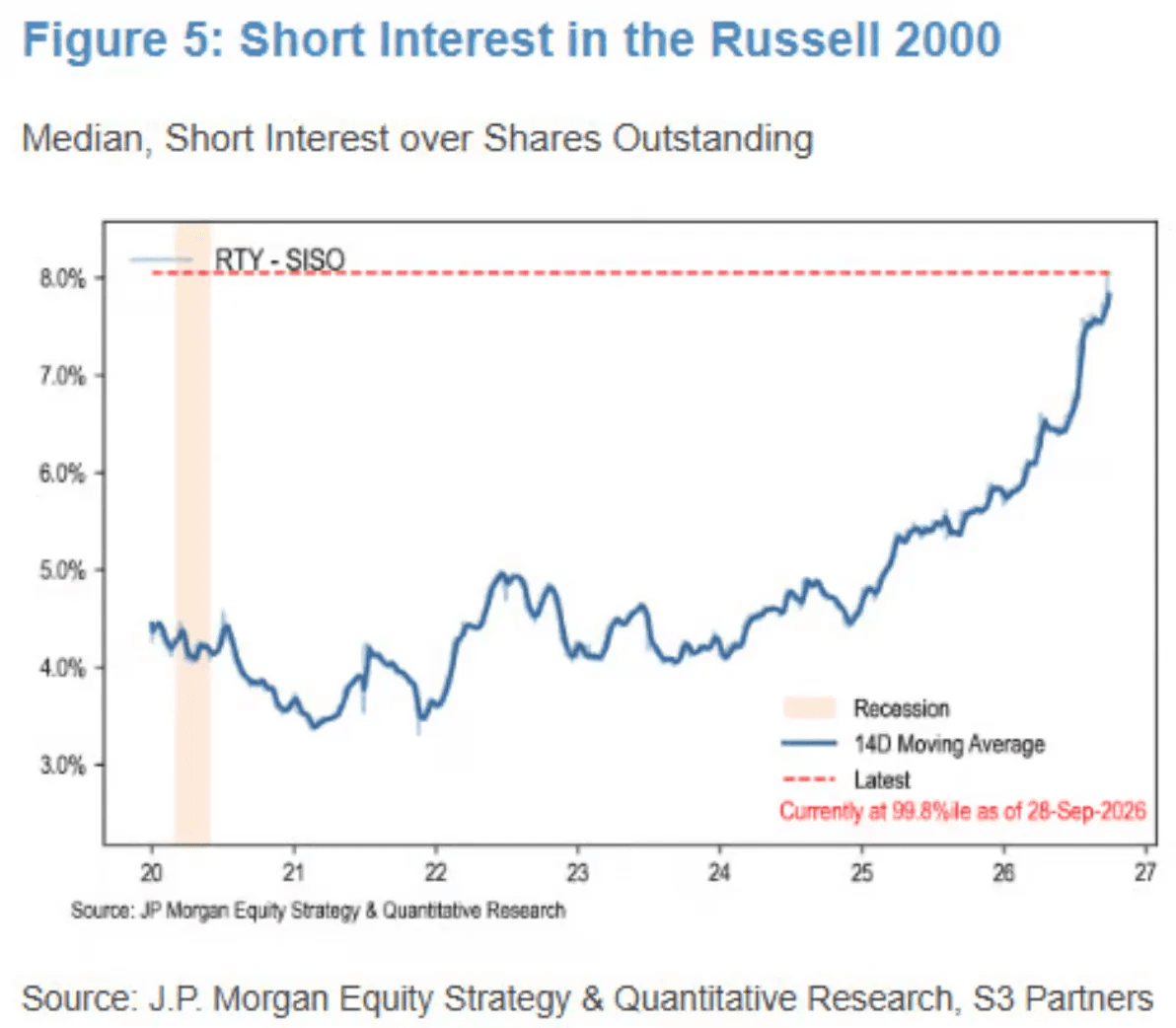
So we have a pretty unusual situation. Hedge funds, wealthy investors, and retail traders are all piling into the same handful of big tech stocks, while short interest in the Russell 2000 is near their highest levels on record. That kind of divergence typically doesn’t last forever. Either small caps have to catch up or big tech might have to go through a period of consolidation first.
One sector that has attracted investor attention outside of big tech is healthcare.
Company executives and other insiders have been buying healthcare stocks at levels we haven't seen since 2019 and 2020.
And we all know that insiders sell shares for all kinds of reasons, but when they buy with their own money, it's usually because they believe the stock is undervalued or has room to grow. And historically, they've had a pretty good track record. When insider buying in healthcare has been this strong, the healthcare ETF XLV has gained over 15% over the following 12 months, with positive returns 97% of the time.

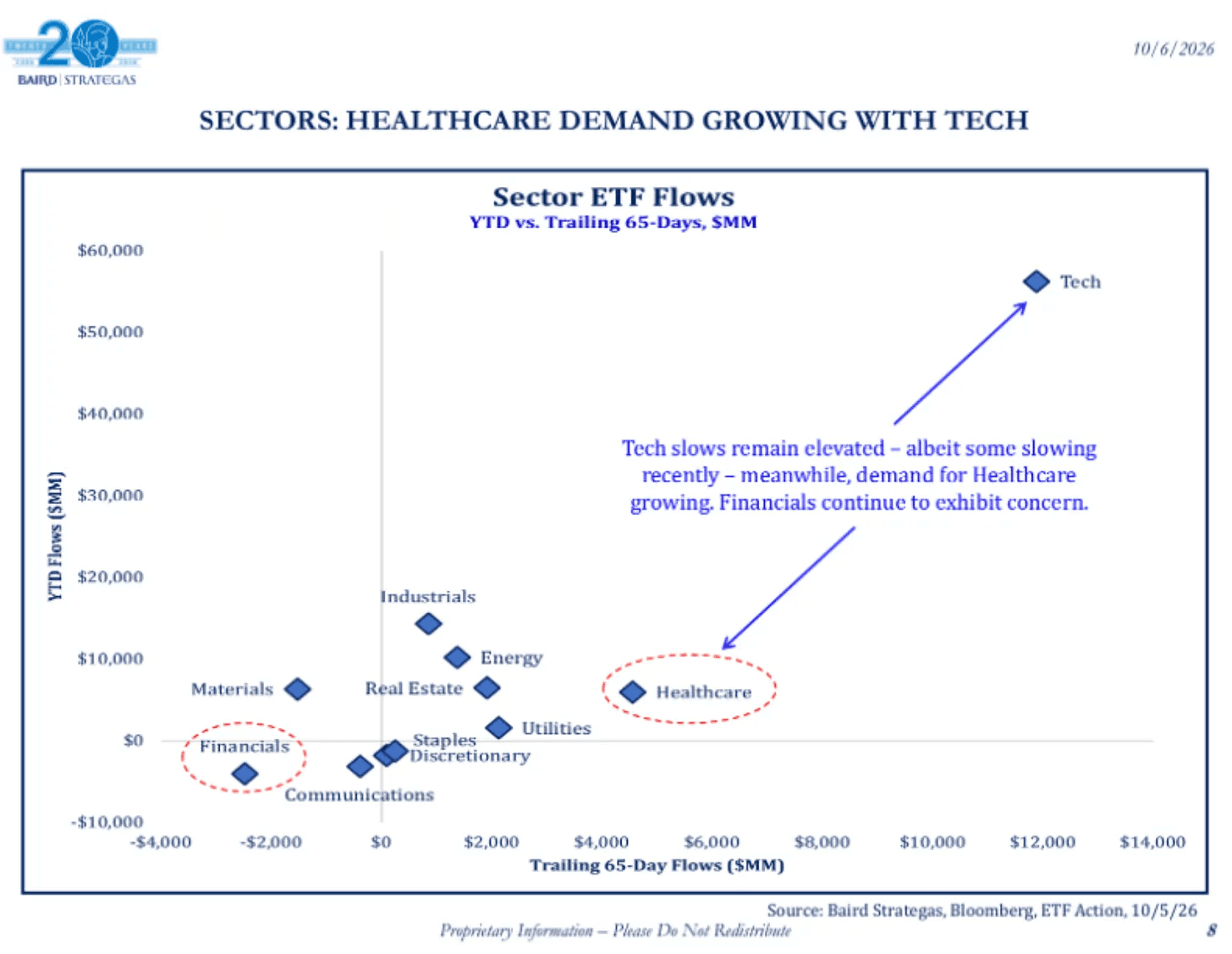
Hence, it’s not surprising that healthcare is the second most bought sector except tech. Over the last 65 trading days, healthcare ETFs attracted around $4.5B. So, if the market starts to recover and more stocks join the rally, healthcare could be one of the sectors leading the way.
Q3 earnings season is officially getting started, with some of the biggest banks and AI companies reporting this week.
The banks will give us a good look at how the US economy and consumers are holding up. I'll be watching consumer spending, loan defaults, and whether banks are starting to see more people falling behind on payments.
If consumers are still doing well, that would be a positive sign for the broader market. We'll also get important updates on the AI trade from ASML and TSMC, giving us a better idea of how strong demand for AI infrastructure really is.
But this week is just the beginning. Around 7% of the S&P 500 by market cap is expected to report, with the biggest wave coming the week of October 26, when roughly 44% is scheduled to release earnings.
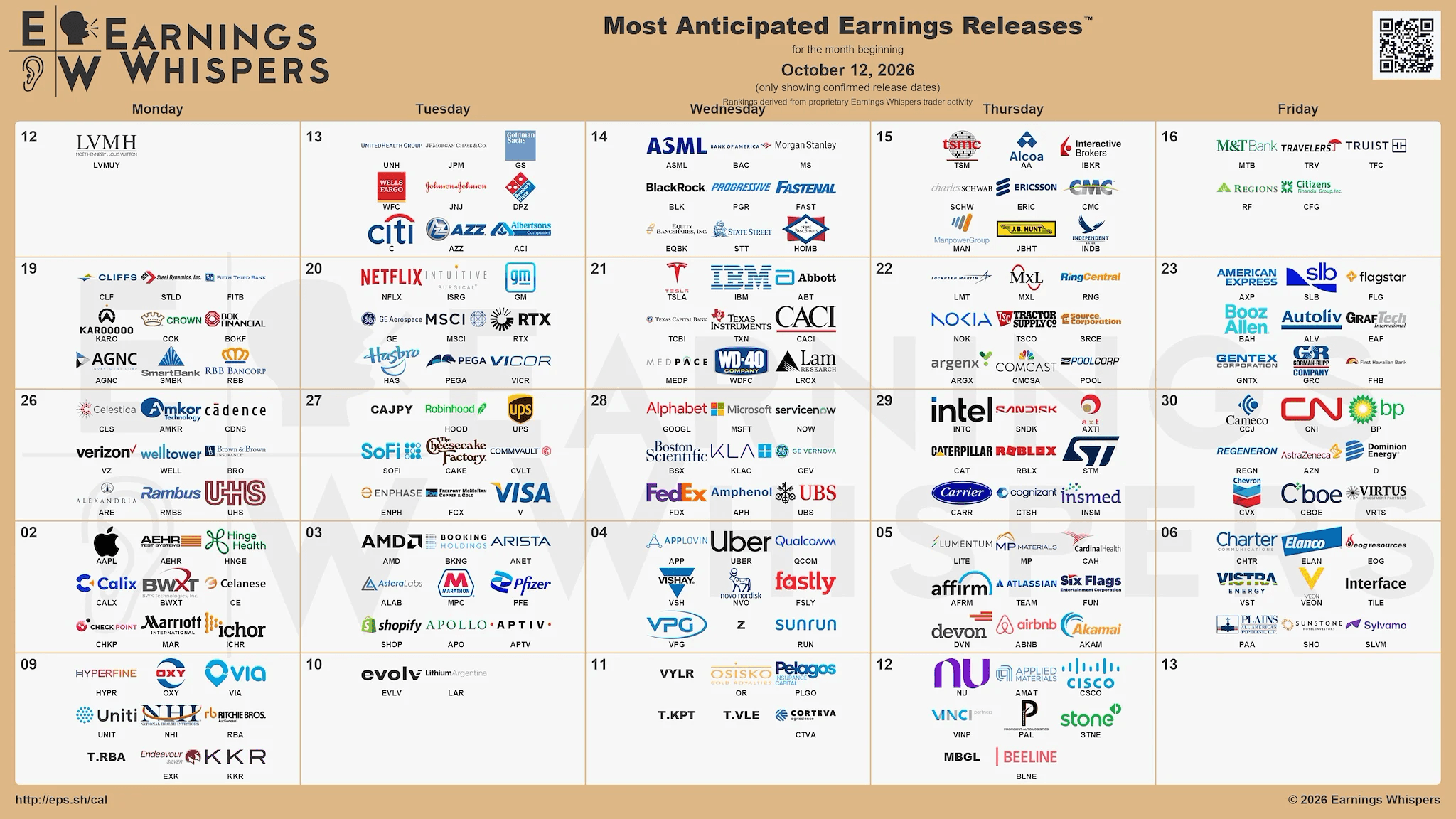
Overall, this wasn't a bad week for the market. The S&P 500 and Nasdaq both closed at new all-time highs, so it's hard to be too negative.
But there are definitely some warning signs worth paying attention to.
The weakness we saw on Thursday, especially in AI and semiconductor stocks, is something worth watching closely. These stocks have been driving most of the market's gains, so any weakness in this group will affect the general market. I still think the market overreacted to the OpenAI headlines, but ultimately, price matters more than opinions. But if the Nasdaq and semiconductor stocks continue to weaken and market leaders start breaking down, it might be time to become more cautious at least temporarily.
The market has been difficult to trade lately, and there's no reason to force trades when opportunities aren't particularly attractive. With earnings season getting started, the next few weeks will be especially important.
So, I think it's best to stay positive but remain flexible as market conditions change. Be ready to get more aggressive when opportunities improve and more defensive when the market starts showing signs of weakness.
Previous Updates
View All
- Weekly Market Update: Big Tech Divergence
- Weekly Market Update: Accumulation
- Weekly Market Update: The Best Quarter
- Weekly Market Update: Rate Hikes
- Weekly Market Update: AI is Not Slowing Down
- Market Update: Has AGI Arrived?
- Weekly Market Update: Consolidation
- Weekly Market Update: September is Here
- Market Update: Nvidia Crushes Earnings
- Weekly Market Update: Yields
- Market Update: The Future of Biotech
- Weekly Market Update: Earnings Acceleration
- Market Update: The Next Generation of AI Infrastructure