Go Back

Lin
Market Update: The Future of Biotech
Many diseases today still have no effective treatment, let alone a cure. One of the main reasons is that drug discovery is extremely expensive.
The human body is incredibly complex. A disease can involve thousands of genes, proteins, cells, signaling pathways, and environmental factors interacting at the same time. Scientists first need to understand what is actually causing the disease, identify a biological target that could change its course, find a molecule that can affect that target, and then prove that the drug is both safe and effective. That process can take many years and cost billions of dollars. Most drug candidates never make it to patients.
AI could help make this process faster and more efficient. The biggest opportunity comes from combining AI with biology and chemistry. Drug discovery is in many ways a search problem. Researchers are trying to find the right disease mechanism and the right molecule among a huge number of possibilities. AI works well here because it can process massive datasets and find patterns that would be very difficult for humans to detect manually.
This could improve the earliest stages of drug development. Researchers often spend years trying to understand which genes or proteins actually matter for a disease. AI models can analyze relationships across biological data and existing research much faster. That helps scientists identify better drug targets earlier and avoid spending time on ideas that are unlikely to work.
Once a target is found there is still the problem of finding a molecule that can interact with it. The number of possible drug-like molecules is gigantic. Scientists cannot test more than a tiny fraction of them in a laboratory. AI narrows that search by predicting which molecules are most likely to work and which ones are likely to fail because of problems such as toxicity or poor stability.
AI can also generate completely new molecules instead of only searching through compounds that already exist. Researchers define the properties they want and let a model propose structures that fit those requirements. The most promising candidates can then be tested in the lab. Those results go back into the model so it can generate better versions. This creates a much faster loop.
Instead of starting with what already exists and trying to modify it researchers could increasingly design molecules around a specific biological problem from the beginning. Drug discovery becomes more like engineering. Scientists define the function they need and AI searches for structures that could produce that function.
Clinical trials are expensive partly because researchers need to test a drug across large groups of patients without knowing exactly who will benefit. AI could help identify better patient groups before a trial begins.
Today it is hard to justify spending billions of dollars on a treatment for a very small patient population. There are thousands of diseases today for which medicine has little to offer. If AI reduces the cost of discovery then more rare diseases become commercially viable.
Wall Street is starting to discount that as well. That’s Biotech has been one of the strongest sectors right now. It’s difficult to track this sector and the individual companies fundamentally. Many of these companies are binary bets which means they can move rapidly either way over night because they announced a successful or a failed trial. But this is where using technical indicators paired with proper risk management shine.
So, here are some of the leading Biotech names currently. Of course, there are many more in the Biotech basket.
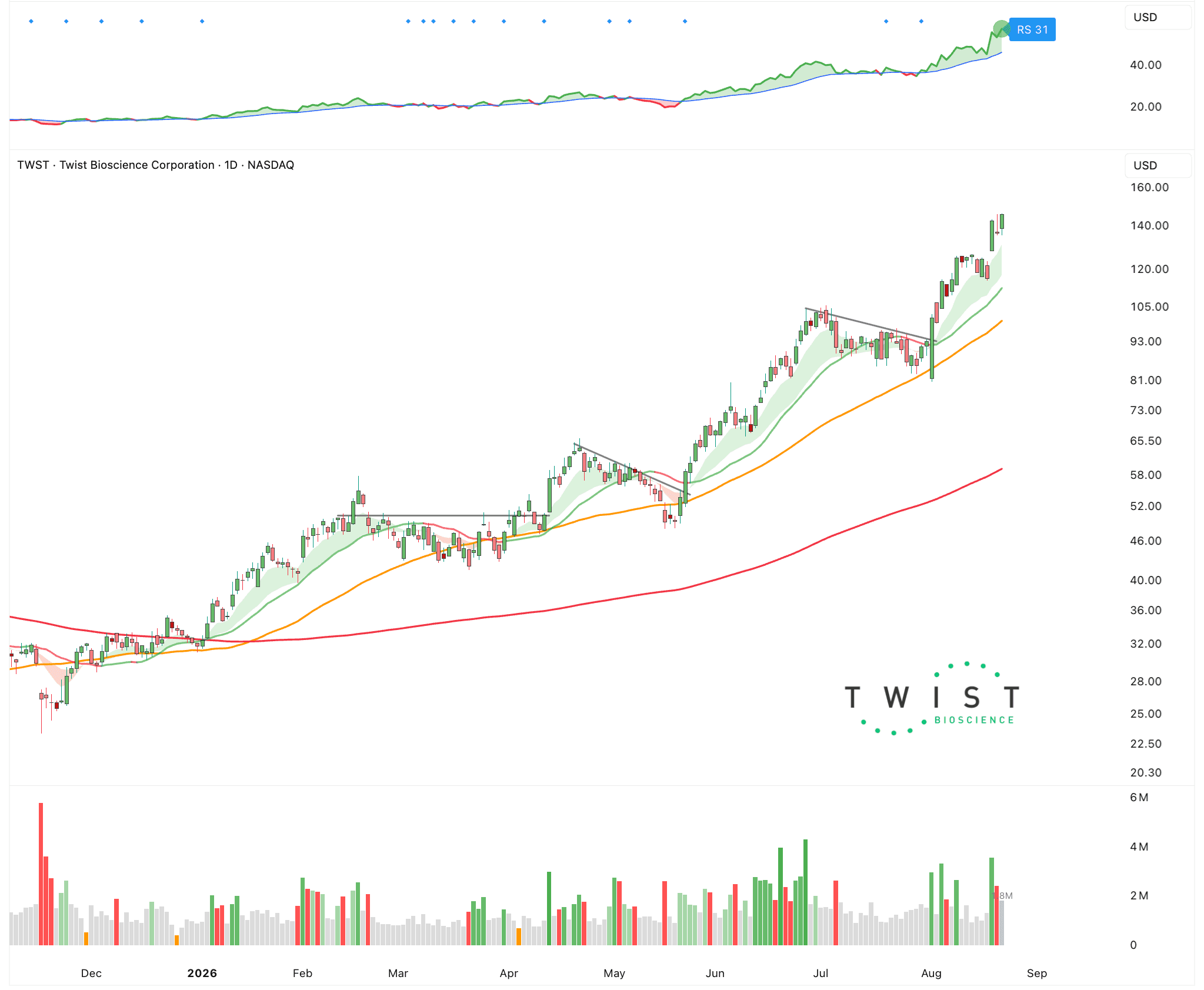
Twist Bioscience $TWST
This is definitely the leading name to watch.
Twist is much closer to an AI infrastructure company for biology than a traditional biotech.
AI models can increasingly design proteins, antibodies, enzymes, and DNA sequences. But eventually those digital designs have to become actual biological material so researchers can test them.
Its core technology uses semiconductor-style manufacturing to synthesize DNA at very high density. Think about it roughly as printing huge numbers of custom DNA sequences onto silicon instead of manufacturing them individually using traditional methods. That lowers cost and increases throughput.
There’s a reason Anthropic selected Twist to independently test 1260 AI-designed protein binders across 15 targets.
AbCellera $ABCL
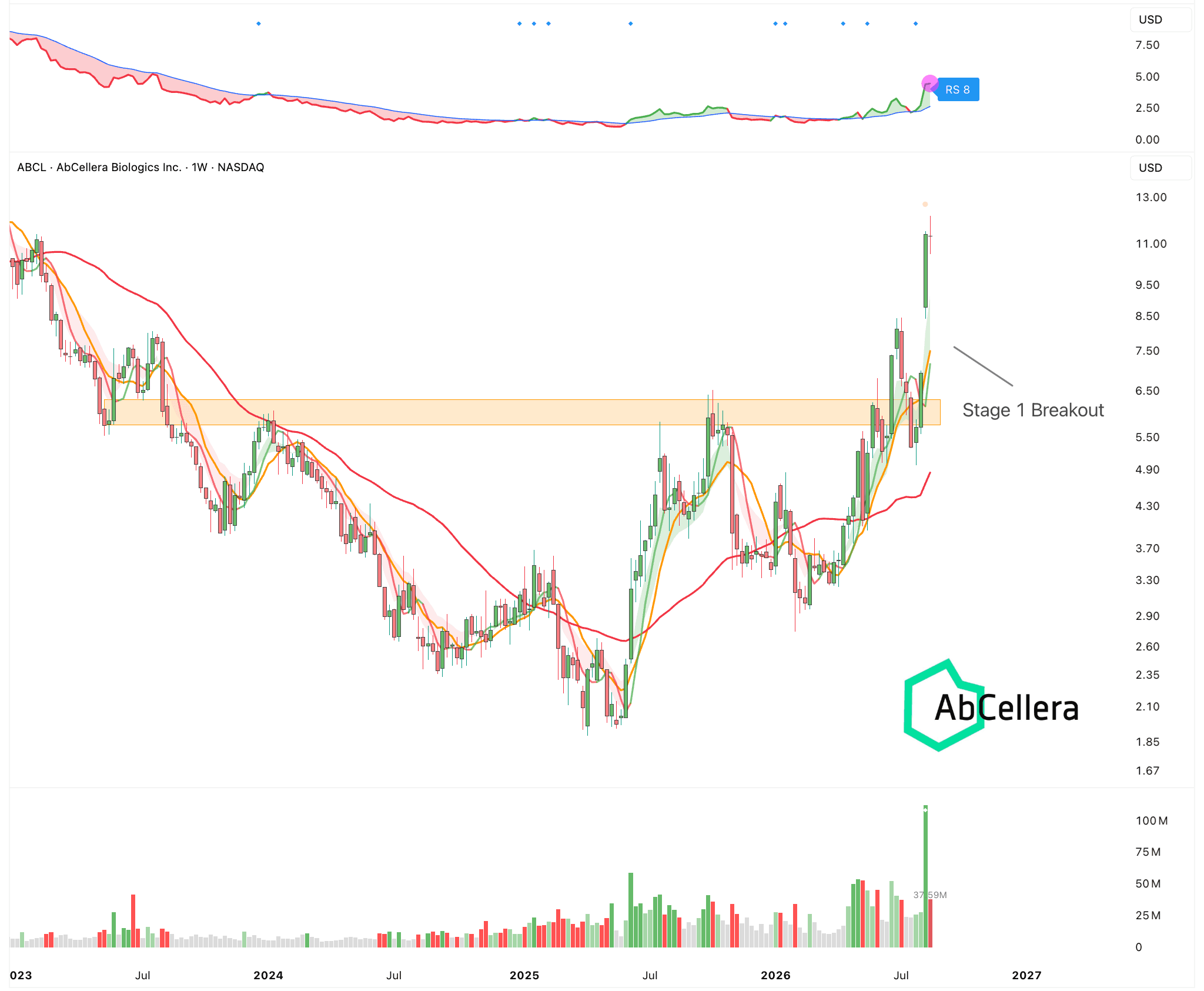
AbCellera started as an antibody-discovery platform, basically using computation, automation, and large-scale biological screening to find antibodies faster. But it is becoming a real drug developer rather than just collecting fees and royalties from partners.
The biggest example is ABCL635, a long-acting antibody designed to treat menopausal hot flashes by blocking NK3R. Phase 2 data released on August 10 were positive. The company said a single dose produced strong reductions in both the frequency and severity of hot flashes while also improving sleep
Its internal pipeline gives ABCL much more upside if individual drugs work.
10x Genomics $TXG
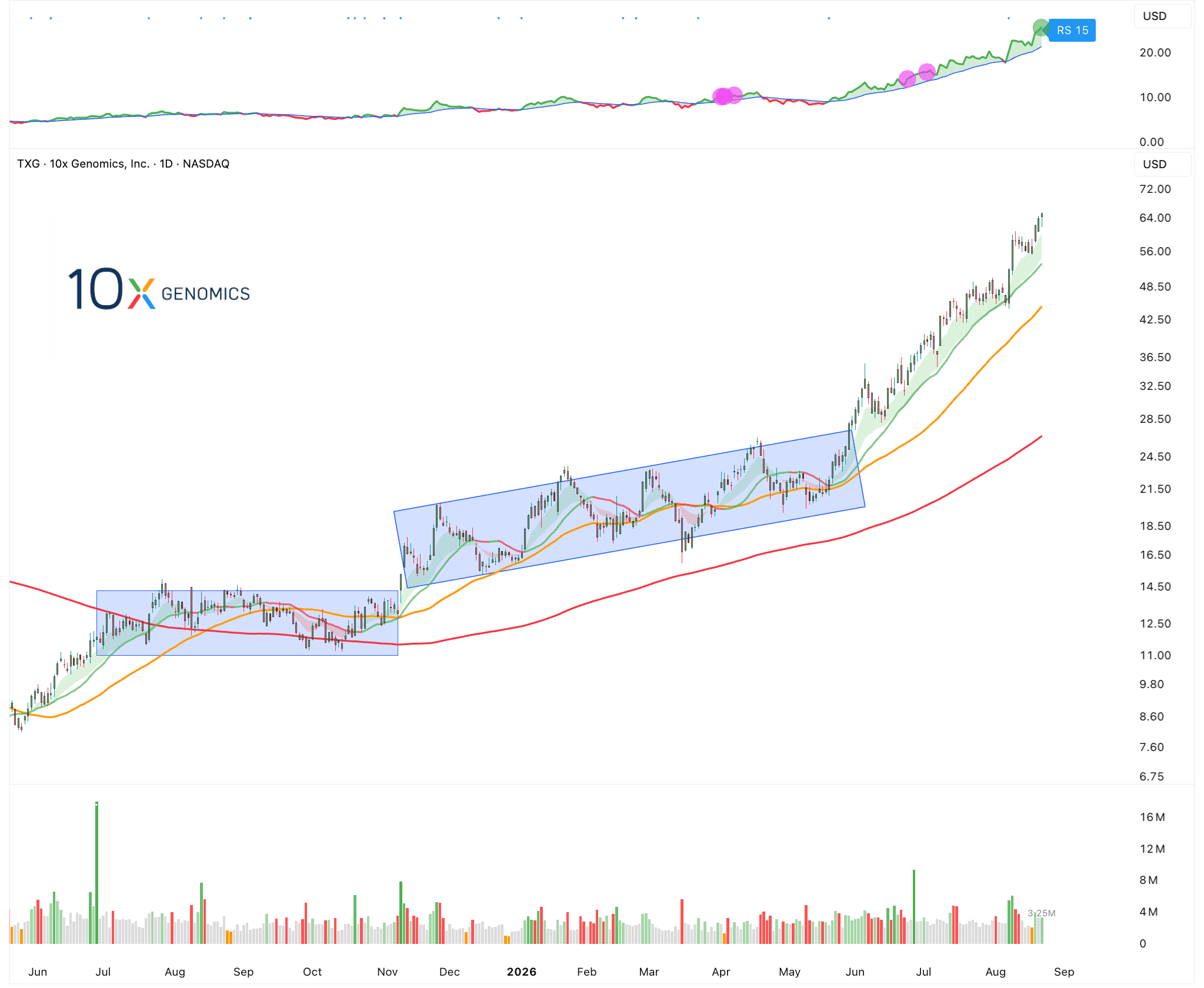
10x is essentially building instruments that let scientists inspect biology at much higher resolution.
Normal sequencing can tell you what genes exist in a sample. Single-cell sequencing lets researchers see what individual cells are doing. Spatial biology adds another dimension by showing where those cells and genes are physically located inside tissue.
This is particularly interesting in cancer research. Because a tumor is really an ecosystem containing different cancer cells, immune cells, blood vessels, and surrounding tissue.
10x already has major platforms in single-cell analysis through Chromium and spatial biology through Xenium and Visium. And its big new product is Atera. Atera is designed to perform very large-scale spatial whole-transcriptome analysis while maintaining single-cell resolution.
Revolution Medicine $RVMD
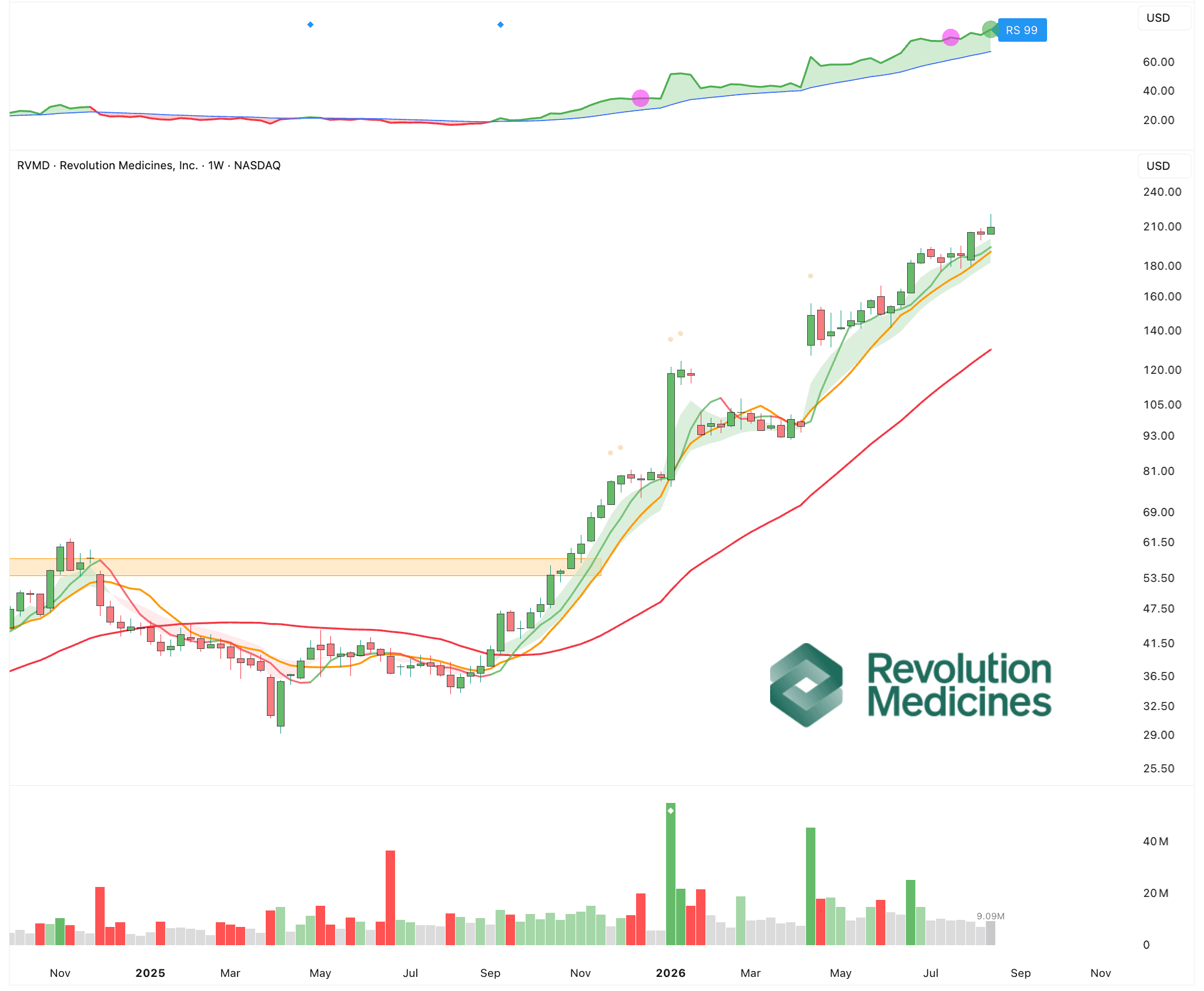
Revolution Medicines is attacking RAS-driven cancers. RAS mutations are among the most important cancer-driving mutations, but historically they have been extremely difficult to target.
RVMD developed a class of drugs called RAS(ON) inhibitors, which attack RAS while it is in its active state. The centerpiece is daraxonrasib, which can target multiple RAS mutations rather than just 1 specific mutation.
The major breakthrough already happened earlier this year. In the Phase 3 RASolute 302 study in previously treated metastatic pancreatic cancer, daraxonrasib produced exceptionally strong survival results. That moved RVMD from speculative clinical biotech toward potential commercial-stage oncology company.
The FDA has now accepted the NDA for daraxonrasib, while the EMA has started an accelerated phased review.
Previous Updates
View All
- Weekly Market Update: Accumulation
- Weekly Market Update: The Best Quarter
- Weekly Market Update: Rate Hikes
- Weekly Market Update: AI is Not Slowing Down
- Market Update: Has AGI Arrived?
- Weekly Market Update: Consolidation
- Weekly Market Update: September is Here
- Market Update: Nvidia Crushes Earnings
- Weekly Market Update: Yields
- Market Update: The Future of Biotech
- Weekly Market Update: Earnings Acceleration
- Market Update: The Next Generation of AI Infrastructure
- Weekly Market Update: New Highs