Go Back

Lin
Weekly Market Update: Earnings Acceleration
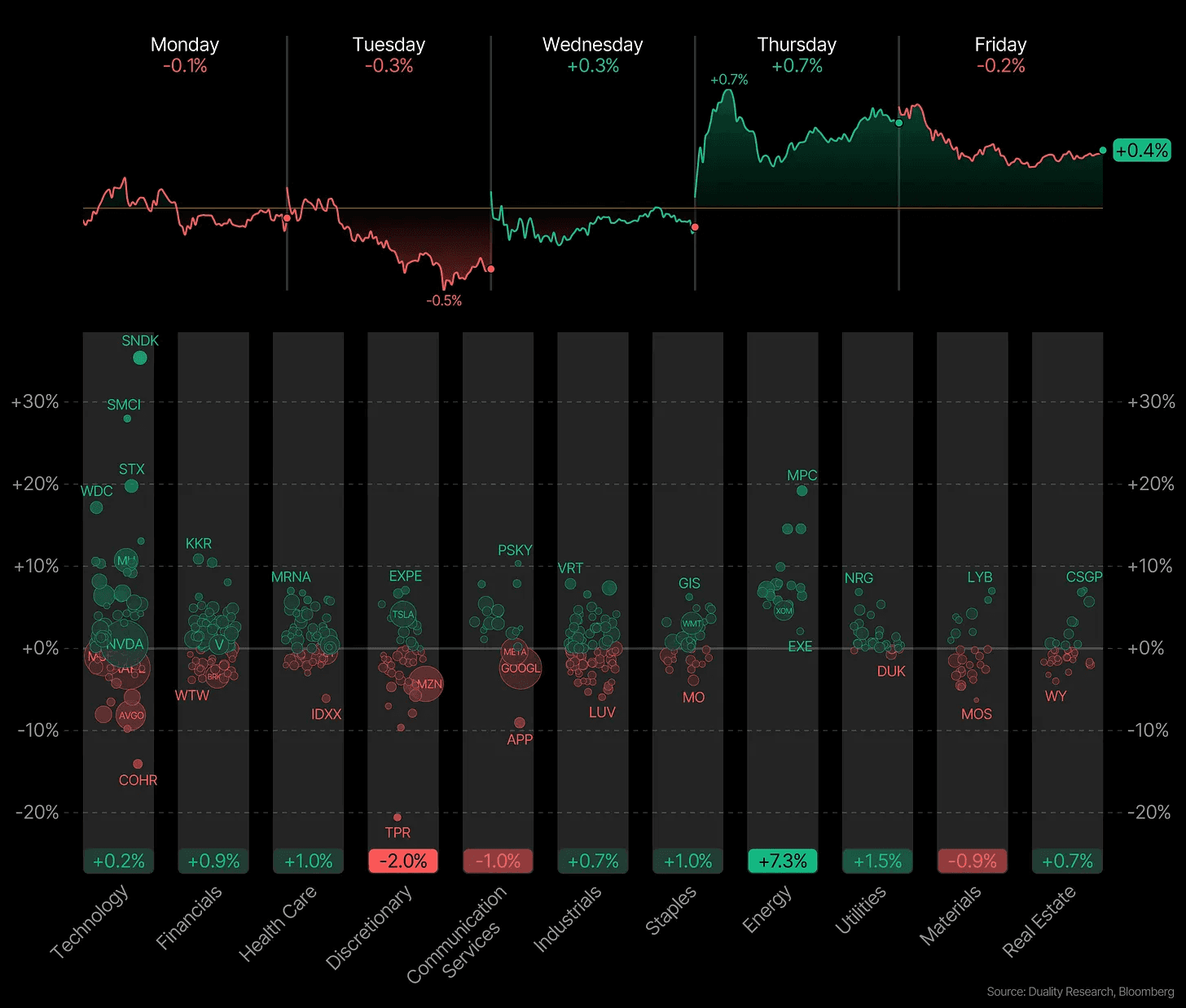
The AI bull market is still moving full steam ahead, but there is a strange disconnect between what is happening fundamentally and how investors seem to feel about it.
Earnings remain strong across much of the AI ecosystem. The biggest technology companies are still spending enormous amounts of money on GPUs, networking, data centers, power, and cooling. Governments are also putting more money behind domestic chip production, energy infrastructure, and AI-related investment.
At the same time, the majority market still feels rather skeptic.
The Nasdaq has not made a new high yet, and many AI stocks are still well below their all-time highs. The recent selloff also cleared out a lot of leverage. There were liquidations, margin calls, and plenty of investors who got burned badly enough to become much more cautious.
You can see that caution in the way people talk about the market. There has been much more discussion around shorting stocks, selling everything, and turning bearish.
But there is absolutely no reason to aggressively short in this environment. During a major bull run, the upside in the strongest companies is several times larger than the downside you are trying to capture with a short.
But some of the strongest markets happen when the fundamentals continue to improve while investors remain cautious. Prices continue to rise, but people keep expecting the next big drop, just to give in and buy a lot higher.
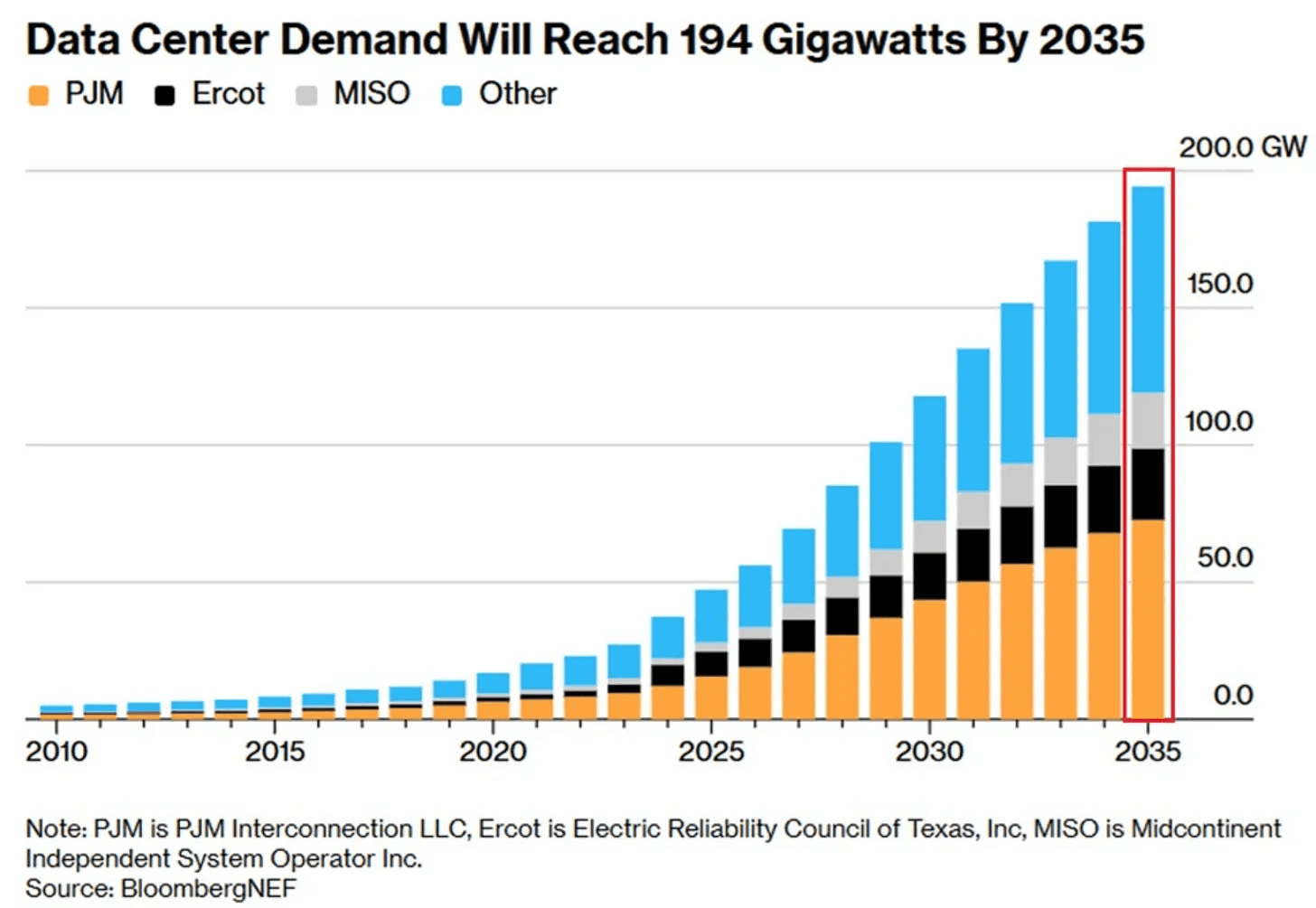
The entire industry is trying to build fast enough to meet demand.
The demand for compute keeps growing exponentially. It’s not just memory, networking, cooling, and data center capacity that are being pushed harder as companies try to deploy larger AI systems. Power availability is becoming increasingly important. There’s a gigantic power need on the horizon. Data centers are estimated to consume roughly 12% of U.S. electricity by 2030.
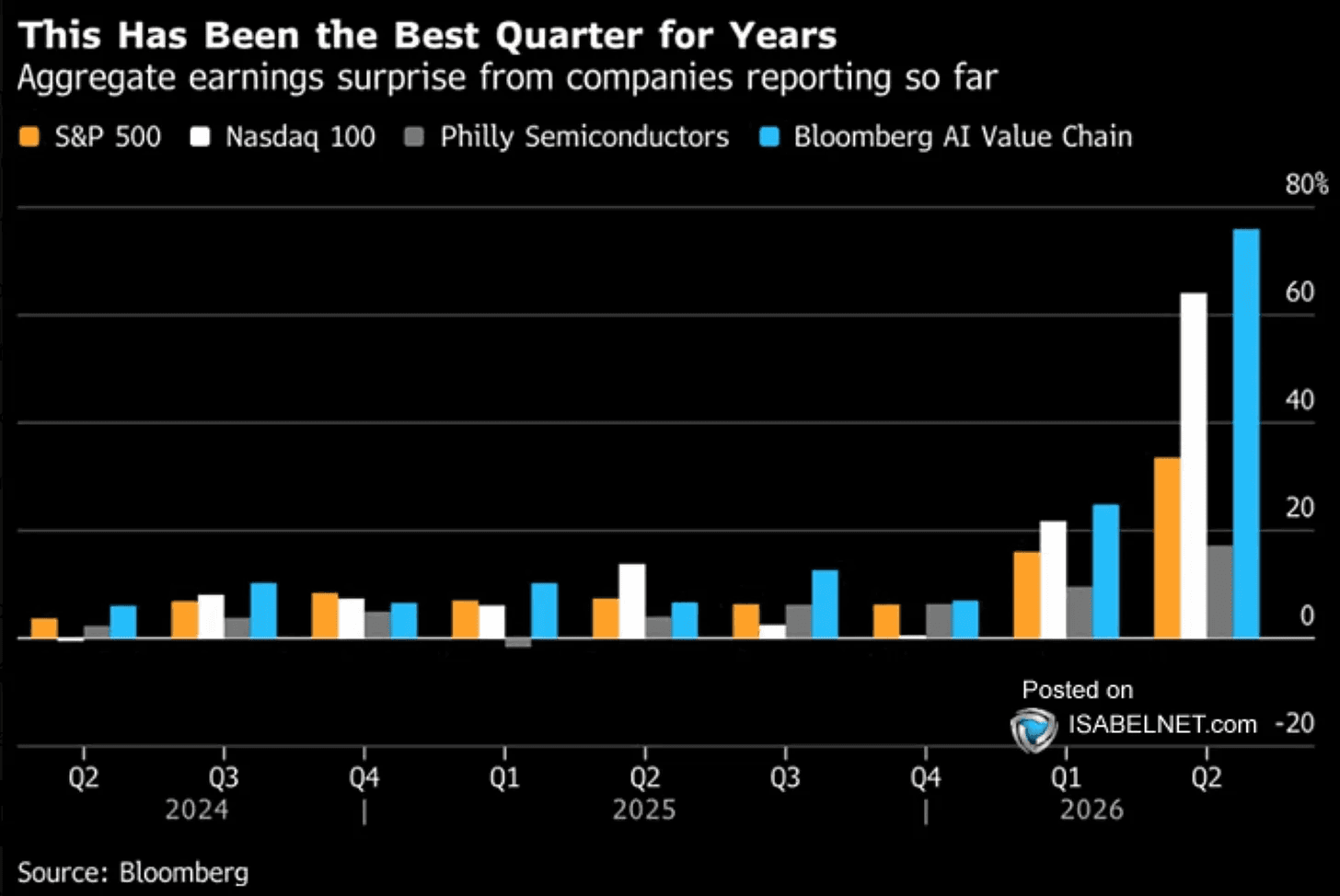
And we’re seeing AI show up in earnings already.
Earnings across the market were much stronger than expected. Nasdaq 100 companies earned about 60% more than analysts had forecast, while S&P 500 companies came in roughly 30% above estimates.
This recent has been the quarter for years.
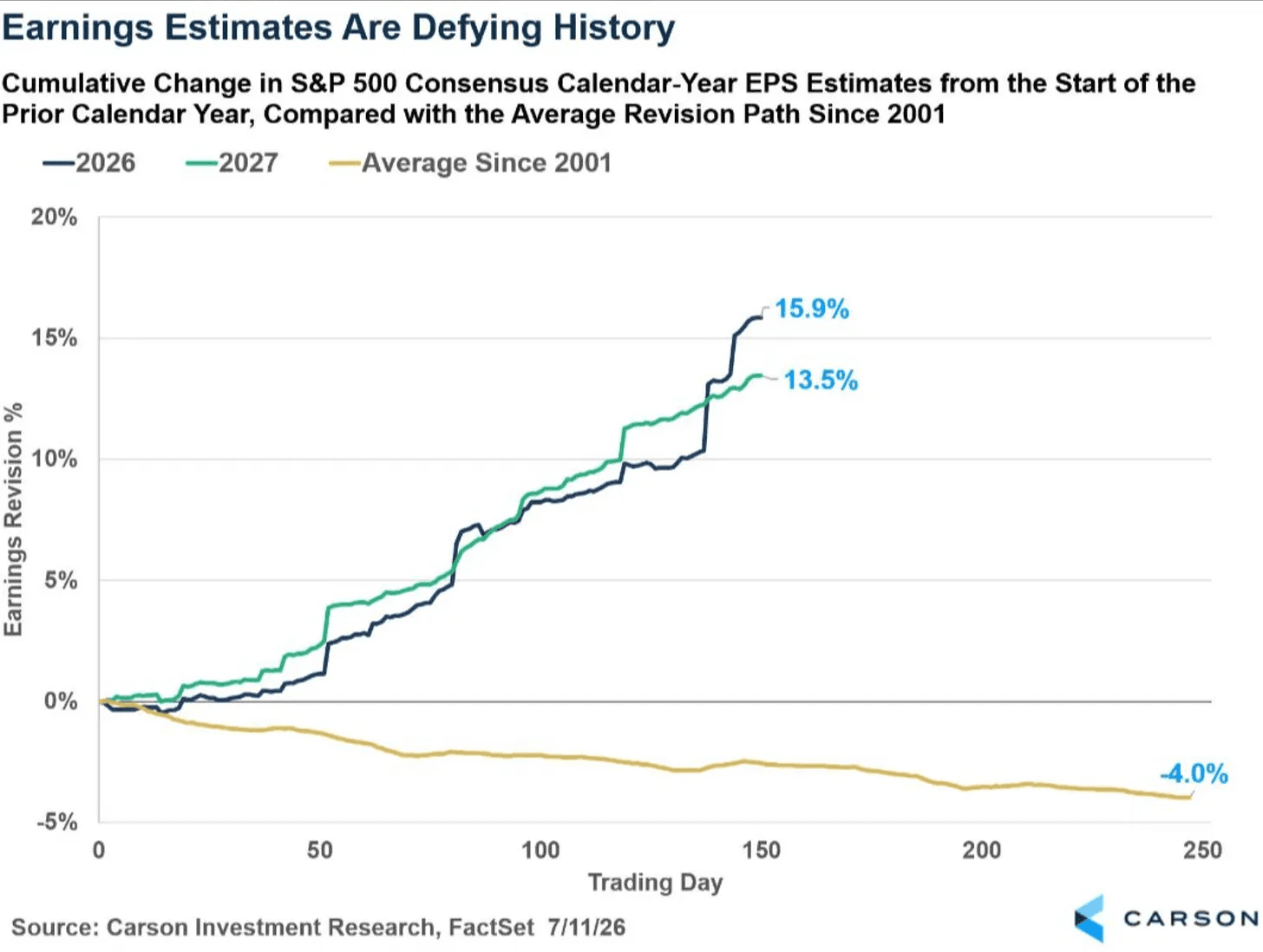
And future earnings estimates continue to blow away any historical norms, even outside of AI infrastructure.
This another good example of how quickly AI demand is starting to show up in actual revenue.
Combined cloud revenue growth across Amazon, Google, and Microsoft was running around 24% to 26% through most of 2024. It then started accelerating through 2025, reaching 33% in Q4 and 39% in Q1 2026.
For Q2 2026, growth is expected to reach 48% year over year.
That is a massive acceleration for businesses this large. These are already some of the biggest cloud platforms in the world, yet their growth rates are even accelerating thanks to AI.

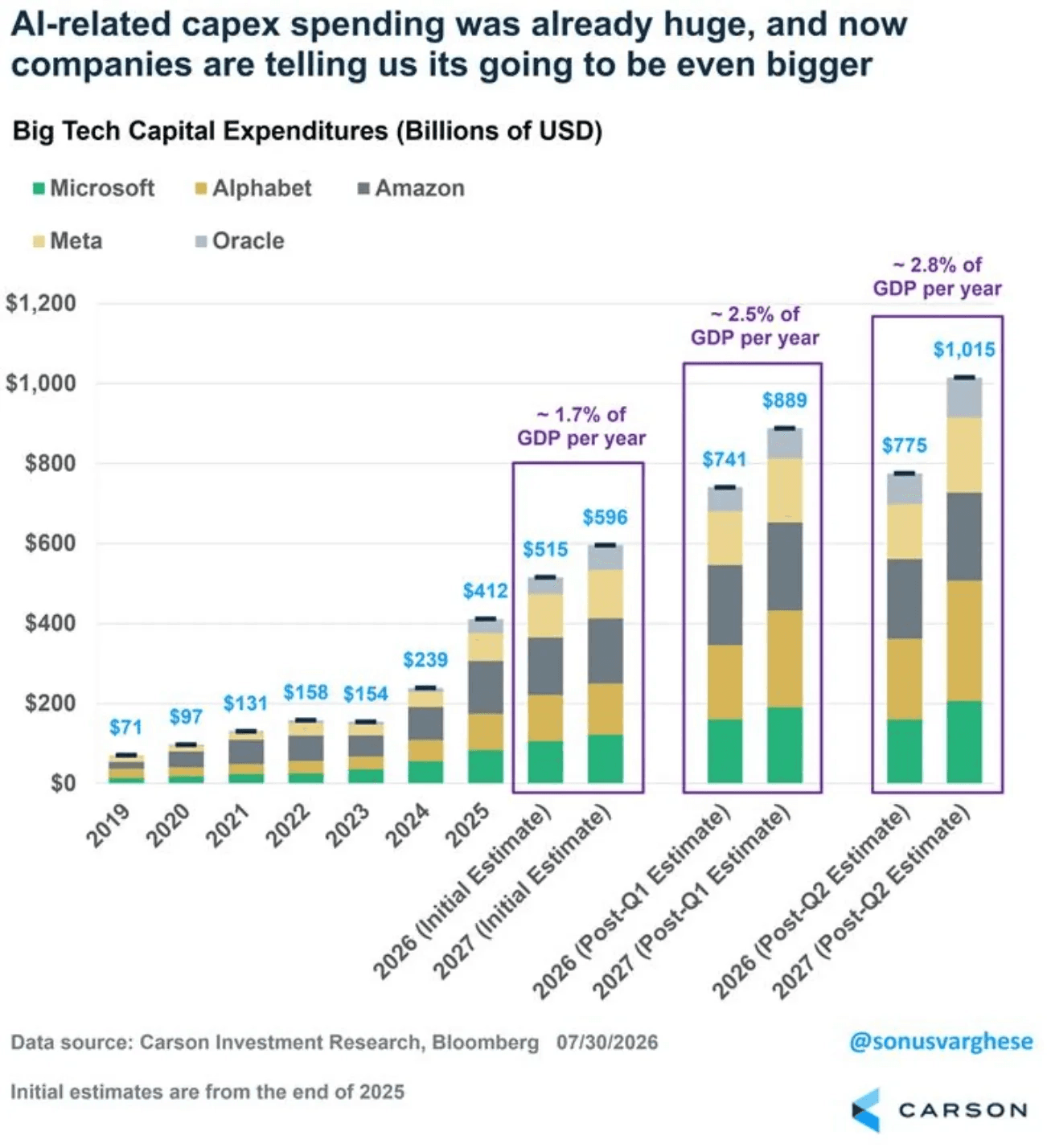
Big Tech is spending this much on AI capex because it is starting to see real returns from AI. And there’s no sign of slowing down. Microsoft, Alphabet, Amazon, Meta, and Oracle are now expected to spend roughly $775 billion in 2026 and more than $1 trillion in 2027.
Just to put that into perspective: $1 trillion would be close to 3% of US GDP.
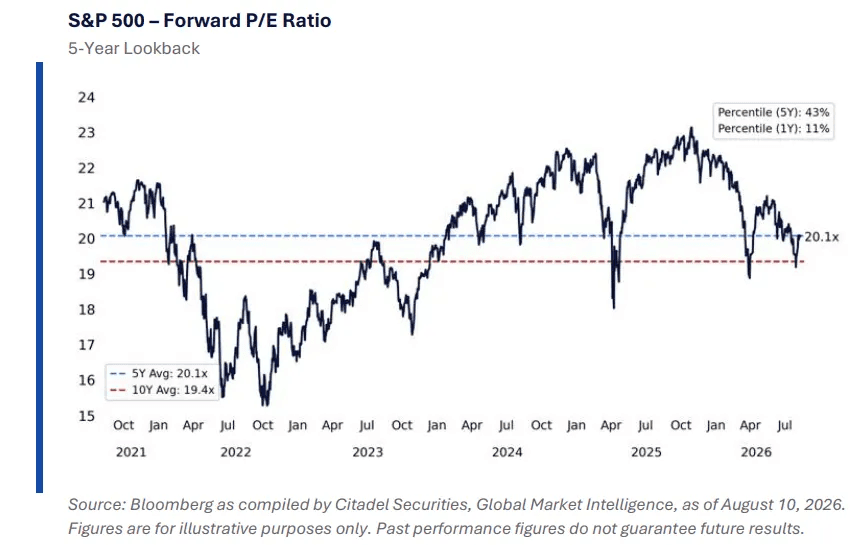
Does this look like an expensive or bubbly market? Not really. The S&P 500 is trading at about 20.1x forward earnings, almost exactly in line with its 5-year average of 20.1x and only modestly above its 10-year average of 19.4x. That is pretty normal valuation territory for a market that is supposedly in a massive bubble.
Here’s interesting way to look at where we are in the cycle:
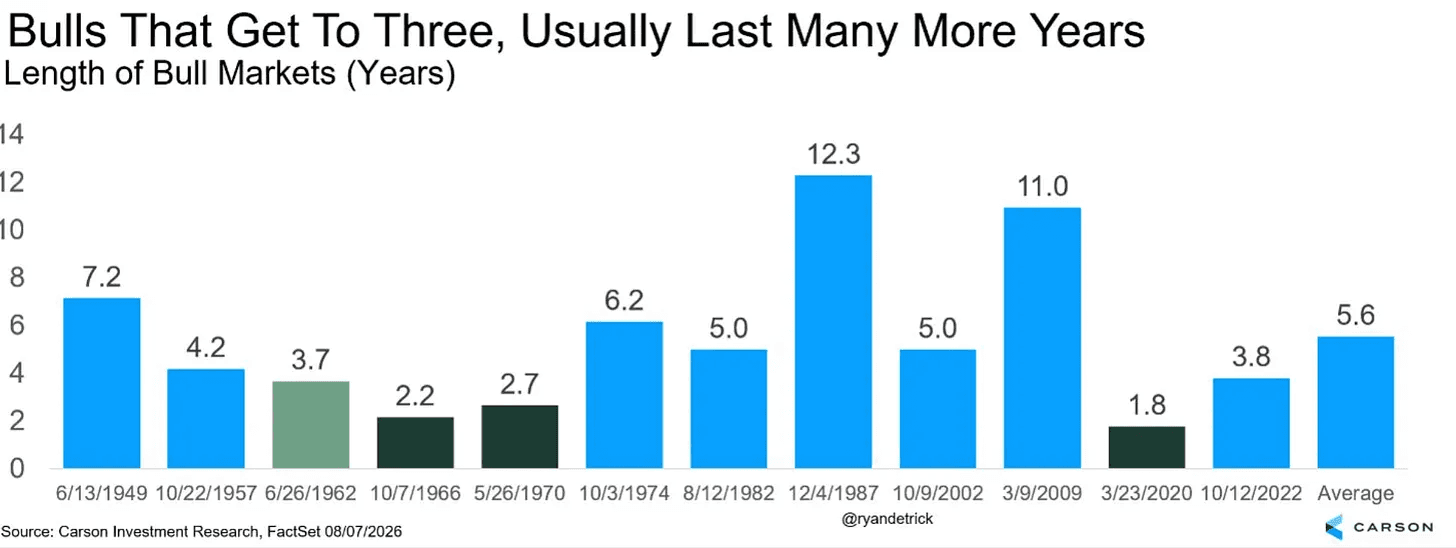
The current bull market started in October 2022 and is now about 3.8 years old. Historically, bull markets that make it past the 3-year mark have often continued for several more years.
The average bull market in this dataset lasted about 5.6 years, while several of the longer cycles ran for 7, 11, or even 12 years. So purely based on age, this market does not look unusually mature yet.
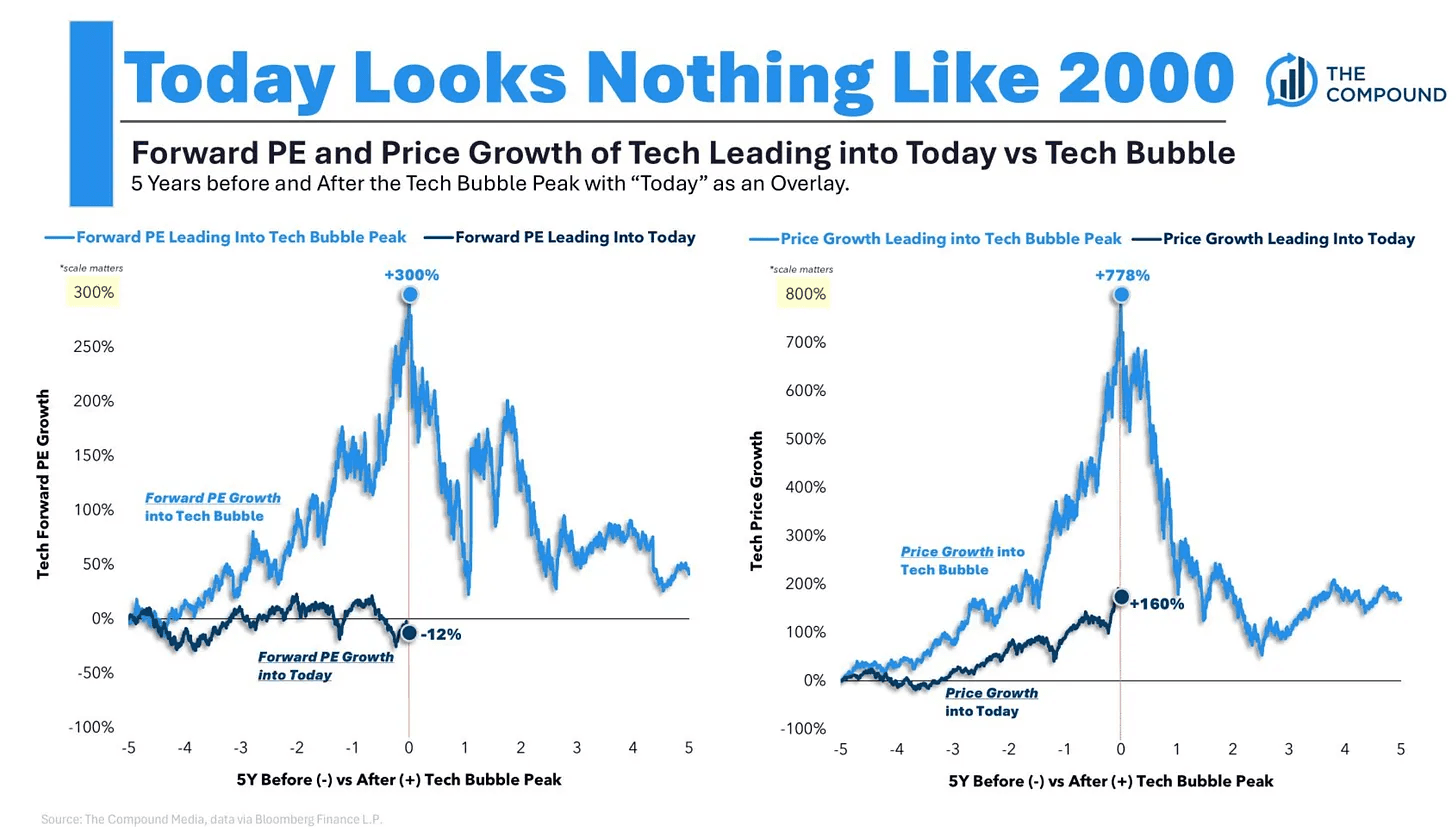
And then there’s the simple fact that, right now, this market still looks very different from 1999. Tech stocks have gone up a lot, but valuations have not exploded alongside them. Most of the move has come from earnings growth rather than paying higher multiples.
So, overall the market continues to look healthy. There is broad participation, semis are acting well again, small caps are doing well, and the Nasdaq looks like it will eventually follow the S&P 500 to new highs.
Inflation data came in supportive, and several of the bigger headwinds from a few weeks ago have started to fade. At least for now, there is less pressure coming from the macro side. And earnings season is mostly finished expect for Nvidia.
What I like most is that this is not a market being carried by one theme.
AI is working again. Memory is still one of the biggest bottlenecks in the entire AI buildout. Robotics has a potentially important catalyst with Unitree preparing to go public. Software has also been strong. Several different groups are participating at the same time, which usually makes the overall market action healthier.
This looks like a market where being active and taking advantage of them makes sense.
Previous Updates
View All
- Weekly Market Update: The Best Quarter
- Weekly Market Update: Rate Hikes
- Weekly Market Update: AI is Not Slowing Down
- Market Update: Has AGI Arrived?
- Weekly Market Update: Consolidation
- Weekly Market Update: September is Here
- Market Update: Nvidia Crushes Earnings
- Weekly Market Update: Yields
- Market Update: The Future of Biotech
- Weekly Market Update: Earnings Acceleration
- Market Update: The Next Generation of AI Infrastructure
- Weekly Market Update: New Highs
- Market Update: Nvidia’s Way Around Memory