Live Feed
Live Feed
Real-Time Market Updates
Real-Time Market Updates
Turn on notifications to stay updated in real time
here.
Market Opportunities
View All

Lin
LITE
Bullish
Lumentum $LITE
AI infrastructure is becoming increasingly constrained by networking.
Lumentum builds the optical components that allow massive AI clusters to move data fast enough to keep those systems working efficiently.
A modern AI cluster can contain tens of thousands of GPUs. Those GPUs constantly exchange enormous amounts of data with each other. As clusters get larger and bandwidth requirements rise, electrical connections become less practical over distance because they consume more power and lose signal quality.
Lumentum makes high-speed optical transceivers, laser transmitters, photonic integrated circuits, photodiodes, coherent components, and high-power laser sources used inside data centers and between data centers. These products convert electrical signals into light, transmit that data over fiber, and then convert it back again.
Basically, Lumentum provides the optical technology that allows those networks to move enormous amounts of data at extremely high speeds. And the amount of optics required per AI cluster keeps increasing.
Lumentum is already moving from 800G products toward 1.6T optical modules, with 3.2T becoming the next step. Its current 1.6T DR4 design uses 4 x 400G EML lasers and is specifically targeted at hyperscale AI data centers.
Every time hyperscalers add more GPUs, they also need more switches, more fiber, more transceivers, and more lasers.
Today, optical transceivers generally sit at the front of a switch and connect back to the switch chip electrically. As bandwidth moves toward 3.2T and beyond, those electrical connections become increasingly inefficient. Co-packaged optics moves the optical engine much closer to the switch or accelerator itself. That reduces electrical distance and can lower power consumption, which is becoming extremely important as AI clusters consume more power.
But those optical engines still need lasers.
Lumentum is developing external laser source modules for these architectures, including ultra-high-power lasers designed specifically for CPO and near-packaged optics. The company recently demonstrated an 8-wavelength external laser module aimed at next-generation AI scale-up infrastructure, with initial availability expected in the first half of 2027.
The financial acceleration already shows how powerful that demand has become.
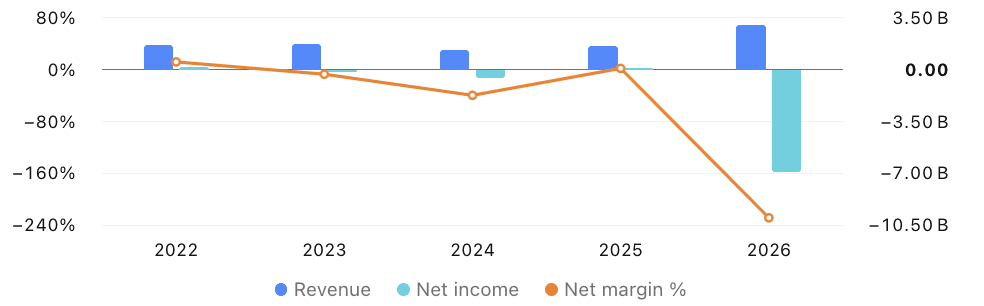
Fiscal 2026 revenue reached $3.0 billion, up 83% from $1.65 billion the year before.
In Q4 alone, revenue reached $1.01 billion, up 109% year over year and 25% sequentially.
Non-GAAP gross margin expanded from 37.8% to 50.4% year over year.
Non-GAAP operating margin went from 15.0% to 36.6%.
For fiscal 2026, Lumentum reported a GAAP net loss of $6.94B, but that was driven by a $7.76B non-cash loss on debt extinguishment related to convertible notes. So that does not reflect the underlying operating performance of the business.
The better number is non-GAAP net income.
Lumentum generated $782.3M of non-GAAP net income in FY2026, up from $146.4M in FY2025. That is more than a 5x increase in 1 year. Non-GAAP EPS increased from $2.06 to $8.67.
For the next quarter, management guided to $1.225 billion to $1.275 billion of revenue and roughly 40% non-GAAP operating margins.
And the current numbers are still relatively early in the product cycle.
Capacity is just starting to expand. Lumentum is building out a new 240,000-square-foot manufacturing facility in North Carolina for advanced indium phosphide optical products, including CW and ultra-high-power lasers used in large AI data centers.
You don’t add major manufacturing capacity for a temporary 1 or 2 quarter spike.
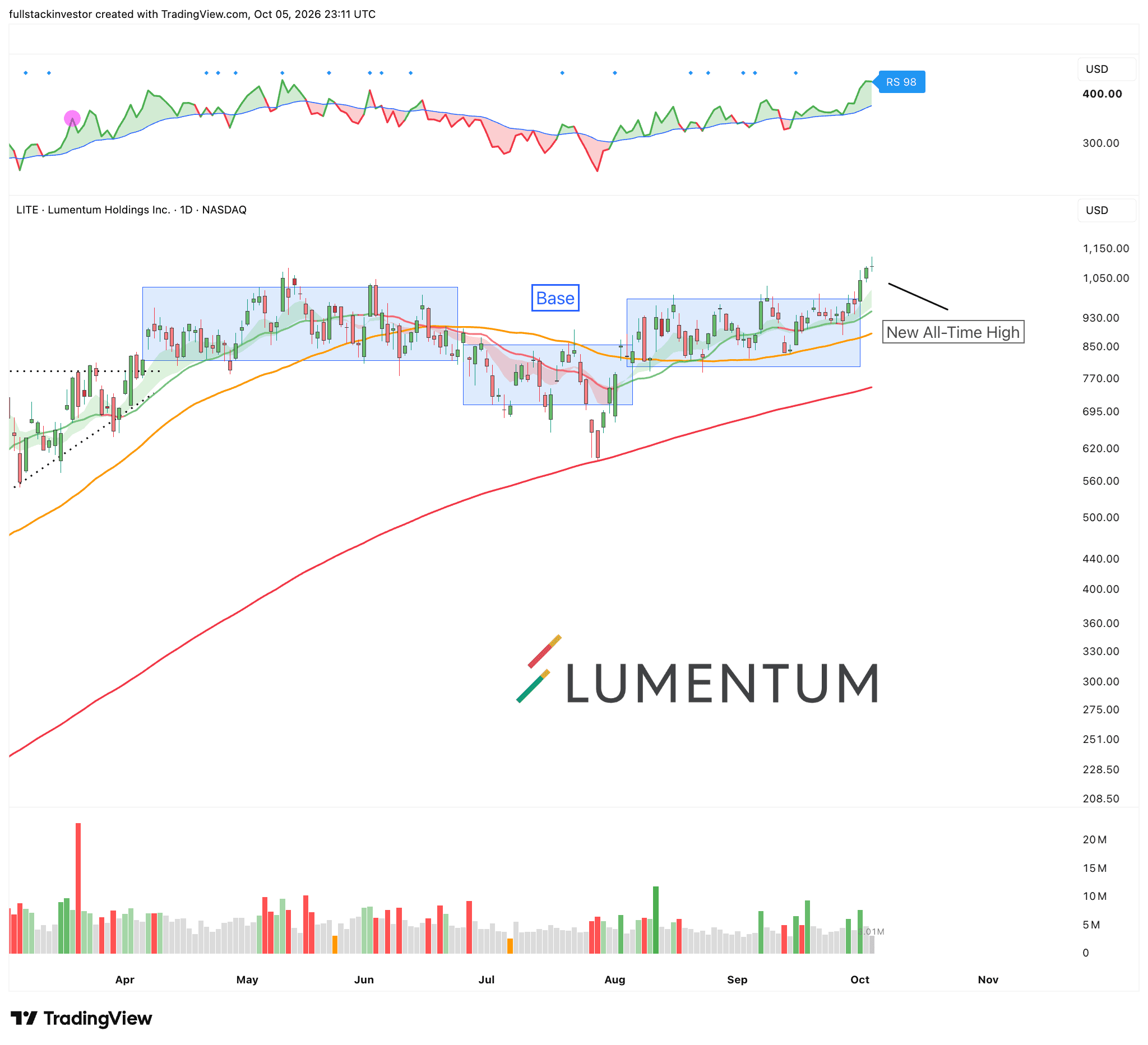
It’s been consolidating since March and now just broke out to new all-time highs. It’s still light on volume but if the general market is supportive this could be an incredible setup.
Company
Lumentum
Sector
AI Infrastructure
Grade
A-
Setup
Base
Volatility
Moderate
Timeframe
Mid-Term
Read More
Lin
LITE
Bullish
Lumentum $LITE
AI infrastructure is becoming increasingly constrained by networking.
Lumentum builds the optical components that allow massive AI clusters to move data fast enough to keep those systems working efficiently.
A modern AI cluster can contain tens of thousands of GPUs. Those GPUs constantly exchange enormous amounts of data with each other. As clusters get larger and bandwidth requirements rise, electrical connections become less practical over distance because they consume more power and lose signal quality.
Lumentum makes high-speed optical transceivers, laser transmitters, photonic integrated circuits, photodiodes, coherent components, and high-power laser sources used inside data centers and between data centers. These products convert electrical signals into light, transmit that data over fiber, and then convert it back again.
Basically, Lumentum provides the optical technology that allows those networks to move enormous amounts of data at extremely high speeds. And the amount of optics required per AI cluster keeps increasing.
Lumentum is already moving from 800G products toward 1.6T optical modules, with 3.2T becoming the next step. Its current 1.6T DR4 design uses 4 x 400G EML lasers and is specifically targeted at hyperscale AI data centers.
Every time hyperscalers add more GPUs, they also need more switches, more fiber, more transceivers, and more lasers.
Today, optical transceivers generally sit at the front of a switch and connect back to the switch chip electrically. As bandwidth moves toward 3.2T and beyond, those electrical connections become increasingly inefficient. Co-packaged optics moves the optical engine much closer to the switch or accelerator itself. That reduces electrical distance and can lower power consumption, which is becoming extremely important as AI clusters consume more power.
But those optical engines still need lasers.
Lumentum is developing external laser source modules for these architectures, including ultra-high-power lasers designed specifically for CPO and near-packaged optics. The company recently demonstrated an 8-wavelength external laser module aimed at next-generation AI scale-up infrastructure, with initial availability expected in the first half of 2027.
The financial acceleration already shows how powerful that demand has become.
Fiscal 2026 revenue reached $3.0 billion, up 83% from $1.65 billion the year before.
In Q4 alone, revenue reached $1.01 billion, up 109% year over year and 25% sequentially.
Non-GAAP gross margin expanded from 37.8% to 50.4% year over year.
Non-GAAP operating margin went from 15.0% to 36.6%.
For fiscal 2026, Lumentum reported a GAAP net loss of $6.94B, but that was driven by a $7.76B non-cash loss on debt extinguishment related to convertible notes. So that does not reflect the underlying operating performance of the business.
The better number is non-GAAP net income.
Lumentum generated $782.3M of non-GAAP net income in FY2026, up from $146.4M in FY2025. That is more than a 5x increase in 1 year. Non-GAAP EPS increased from $2.06 to $8.67.
For the next quarter, management guided to $1.225 billion to $1.275 billion of revenue and roughly 40% non-GAAP operating margins.
And the current numbers are still relatively early in the product cycle.
Capacity is just starting to expand. Lumentum is building out a new 240,000-square-foot manufacturing facility in North Carolina for advanced indium phosphide optical products, including CW and ultra-high-power lasers used in large AI data centers.
You don’t add major manufacturing capacity for a temporary 1 or 2 quarter spike.
It’s been consolidating since March and now just broke out to new all-time highs. It’s still light on volume but if the general market is supportive this could be an incredible setup.
Company
Lumentum
Sector
AI Infrastructure
Grade
A-
Setup
Base
Volatility
Moderate
Timeframe
Mid-Term
Read More
Lin
ZETA
Bullish
Zeta $ZETA
Zeta helps large companies use customer data to decide who to target, what message to send, where to spend marketing dollars, and increasingly, which actions should be handled automatically by AI agents.
At the center of the business is the Zeta Marketing Platform.
The platform combines customer data, identity resolution, analytics, campaign management, media activation, and AI inside one system. Companies can use it to build customer profiles, predict behavior, create audiences, run campaigns across channels like email, social, CTV, display, and mobile, and then measure which campaigns actually drove revenue.
Enterprise marketing is still incredibly fragmented.
A large company may have customer data sitting across CRM systems, websites, apps, loyalty programs, ad platforms, email tools, and offline transactions.
Connecting all of that data to one person and then deciding what to do with it, is incredibly difficult.
Zeta’s advantage is that it tries to own that entire loop.
Data comes in. Zeta identifies the customer. Its models predict what that customer is likely to do. The platform decides what action to take. Then it activates the campaign and measures the result.
Zeta’s biggest AI product is Athena.
Athena acts as an intelligent interface on top of the platform. Instead of marketers manually digging through dashboards, building segments, and testing campaigns, they can ask questions in natural language and let Athena turn those questions into actions.
Zeta says Athena can analyze customer signals, identify opportunities, recommend what to do next, and help execute campaigns. It became generally available in March 2026.
Traditional marketing software mostly helps humans do work faster.
Agentic marketing software can start doing parts of the work itself.
Zeta already offers agents for tasks such as audience building, campaign creation, customer analysis, content optimization, and workflow automation. Its agentic workflows can chain multiple agents together so an entire marketing process can run with much less manual work.
The company has also started building around some very strong partners. OpenAI models are powering parts of Athena’s conversational and agentic capabilities.
And in June, Zeta announced a strategic partnership with Palantir. Zeta plans to rearchitect its Data Cloud on Palantir Foundry, combining customer intelligence from Zeta with Palantir’s broader enterprise data infrastructure.
Zeta’s SuperGraph contains signals across roughly 245 million U.S. individuals. That gives its models a large identity and behavioral dataset to work with when customers are trying to understand audiences or predict behavior.
And the financials are now starting to reflect the product momentum.
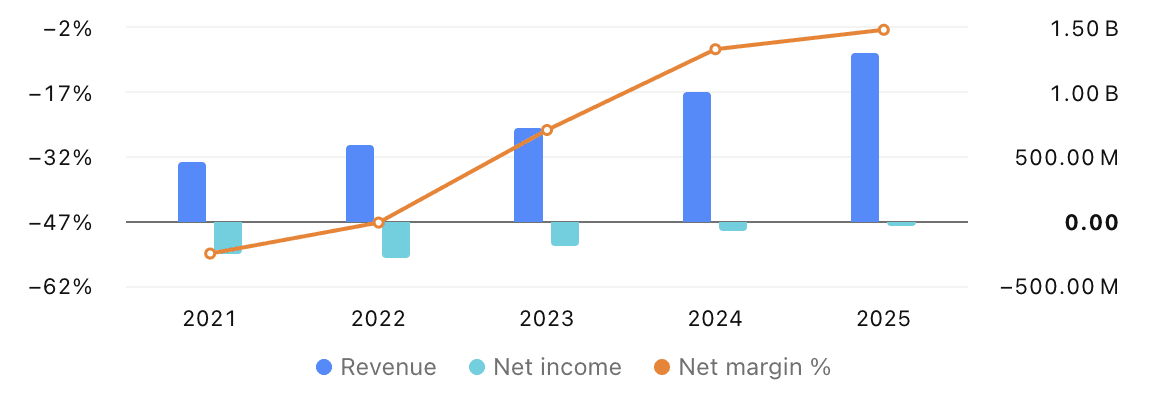
Revenue reached $443 million in Q2 2026, up 44% year over year. That was Zeta’s 20th consecutive quarter of beating and raising expectations.
Its largest customer cohort is also expanding. Super-Scaled Customers reached 197, up 17%, while average revenue per Super-Scaled Customer increased another 17% to $1.8 million.
Profitability is improving quickly as well. Adjusted EBITDA reached $92 million in Q2, up with an adjusted EBITDA margin of 20.7%, expanding 170 basis points year over year.
Free cash flow increased 73% to $58 million.
And for the first time, Zeta generated positive quarterly GAAP net income.
Management now expects around $1.82 billion of 2026 revenue at the midpoint, representing roughly 39% reported growth. Some of that comes from the Marigold acquisition, so the underlying growth rate could be faster, but still very strong.
Zeta can become much more valuable if Athena successfully automates enterprise marketing.
The moat has to come from data, identity resolution, workflow integration, customer relationships, and measurable performance, not simply from adding an AI chatbot to the product. The stronger Zeta becomes as a data and decision layer, the harder it becomes to replace.
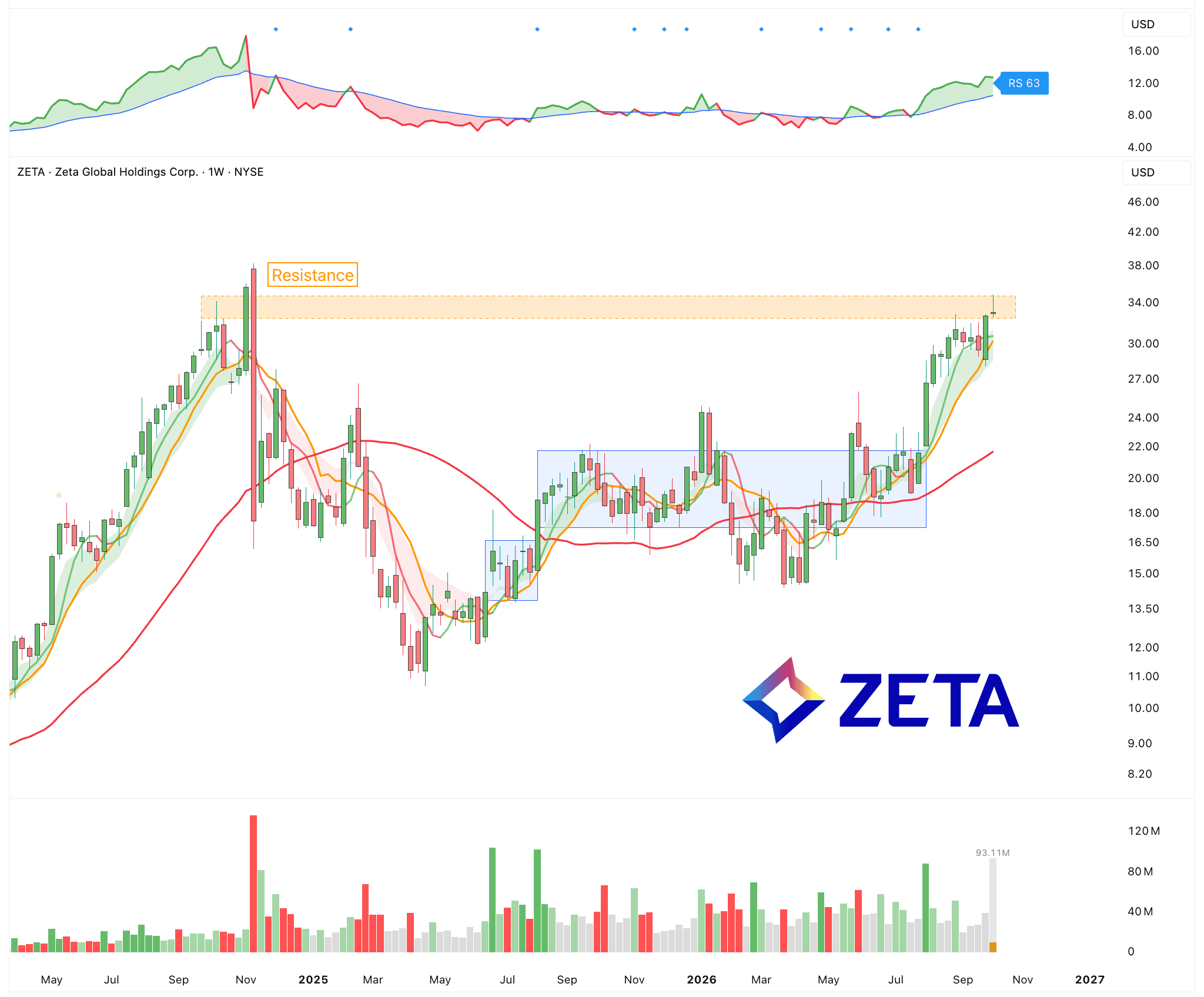
It’s trying to break out to new all-time highs. Right now, it’s consolidating nicely just below its highs from last year. If it can break out here that would be an attractive buying opportunity.
Company
Zeta
Sector
AI Software
Grade
B
Setup
Base
Volatility
Moderate
Timeframe
Mid-Term
Read More
Lin
ZETA
Bullish
Zeta $ZETA
Zeta helps large companies use customer data to decide who to target, what message to send, where to spend marketing dollars, and increasingly, which actions should be handled automatically by AI agents.
At the center of the business is the Zeta Marketing Platform.
The platform combines customer data, identity resolution, analytics, campaign management, media activation, and AI inside one system. Companies can use it to build customer profiles, predict behavior, create audiences, run campaigns across channels like email, social, CTV, display, and mobile, and then measure which campaigns actually drove revenue.
Enterprise marketing is still incredibly fragmented.
A large company may have customer data sitting across CRM systems, websites, apps, loyalty programs, ad platforms, email tools, and offline transactions.
Connecting all of that data to one person and then deciding what to do with it, is incredibly difficult.
Zeta’s advantage is that it tries to own that entire loop.
Data comes in. Zeta identifies the customer. Its models predict what that customer is likely to do. The platform decides what action to take. Then it activates the campaign and measures the result.
Zeta’s biggest AI product is Athena.
Athena acts as an intelligent interface on top of the platform. Instead of marketers manually digging through dashboards, building segments, and testing campaigns, they can ask questions in natural language and let Athena turn those questions into actions.
Zeta says Athena can analyze customer signals, identify opportunities, recommend what to do next, and help execute campaigns. It became generally available in March 2026.
Traditional marketing software mostly helps humans do work faster.
Agentic marketing software can start doing parts of the work itself.
Zeta already offers agents for tasks such as audience building, campaign creation, customer analysis, content optimization, and workflow automation. Its agentic workflows can chain multiple agents together so an entire marketing process can run with much less manual work.
The company has also started building around some very strong partners. OpenAI models are powering parts of Athena’s conversational and agentic capabilities.
And in June, Zeta announced a strategic partnership with Palantir. Zeta plans to rearchitect its Data Cloud on Palantir Foundry, combining customer intelligence from Zeta with Palantir’s broader enterprise data infrastructure.
Zeta’s SuperGraph contains signals across roughly 245 million U.S. individuals. That gives its models a large identity and behavioral dataset to work with when customers are trying to understand audiences or predict behavior.
And the financials are now starting to reflect the product momentum.
Revenue reached $443 million in Q2 2026, up 44% year over year. That was Zeta’s 20th consecutive quarter of beating and raising expectations.
Its largest customer cohort is also expanding. Super-Scaled Customers reached 197, up 17%, while average revenue per Super-Scaled Customer increased another 17% to $1.8 million.
Profitability is improving quickly as well. Adjusted EBITDA reached $92 million in Q2, up with an adjusted EBITDA margin of 20.7%, expanding 170 basis points year over year.
Free cash flow increased 73% to $58 million.
And for the first time, Zeta generated positive quarterly GAAP net income.
Management now expects around $1.82 billion of 2026 revenue at the midpoint, representing roughly 39% reported growth. Some of that comes from the Marigold acquisition, so the underlying growth rate could be faster, but still very strong.
Zeta can become much more valuable if Athena successfully automates enterprise marketing.
The moat has to come from data, identity resolution, workflow integration, customer relationships, and measurable performance, not simply from adding an AI chatbot to the product. The stronger Zeta becomes as a data and decision layer, the harder it becomes to replace.
It’s trying to break out to new all-time highs. Right now, it’s consolidating nicely just below its highs from last year. If it can break out here that would be an attractive buying opportunity.
Company
Zeta
Sector
AI Software
Grade
B
Setup
Base
Volatility
Moderate
Timeframe
Mid-Term
Read More
Market Updates
View All
Lin
Weekly Market Update: Earnings Season is Back
The sentiment around AI is pretty sour right now. CoreWeave, Oracle, Anthropic’s IPO valuation getting cut. There’s plenty to choose from. And until some of these clouds clear, it’s probably going to stay choppy.
And it’s been a divergent market. On the surface the indices look fine, and the S&P 500 is sitting just below all-time highs. But underneath, it’s been ugly. A lot of the AI boom’s biggest winners are deep in drawdowns.
Hence, This week, the S&P 500 fell 2.0% and the Nasdaq dropped 4.5%, ending a four-week winning streak. Tech got hit hardest, and Friday was the worst day of the bunch.
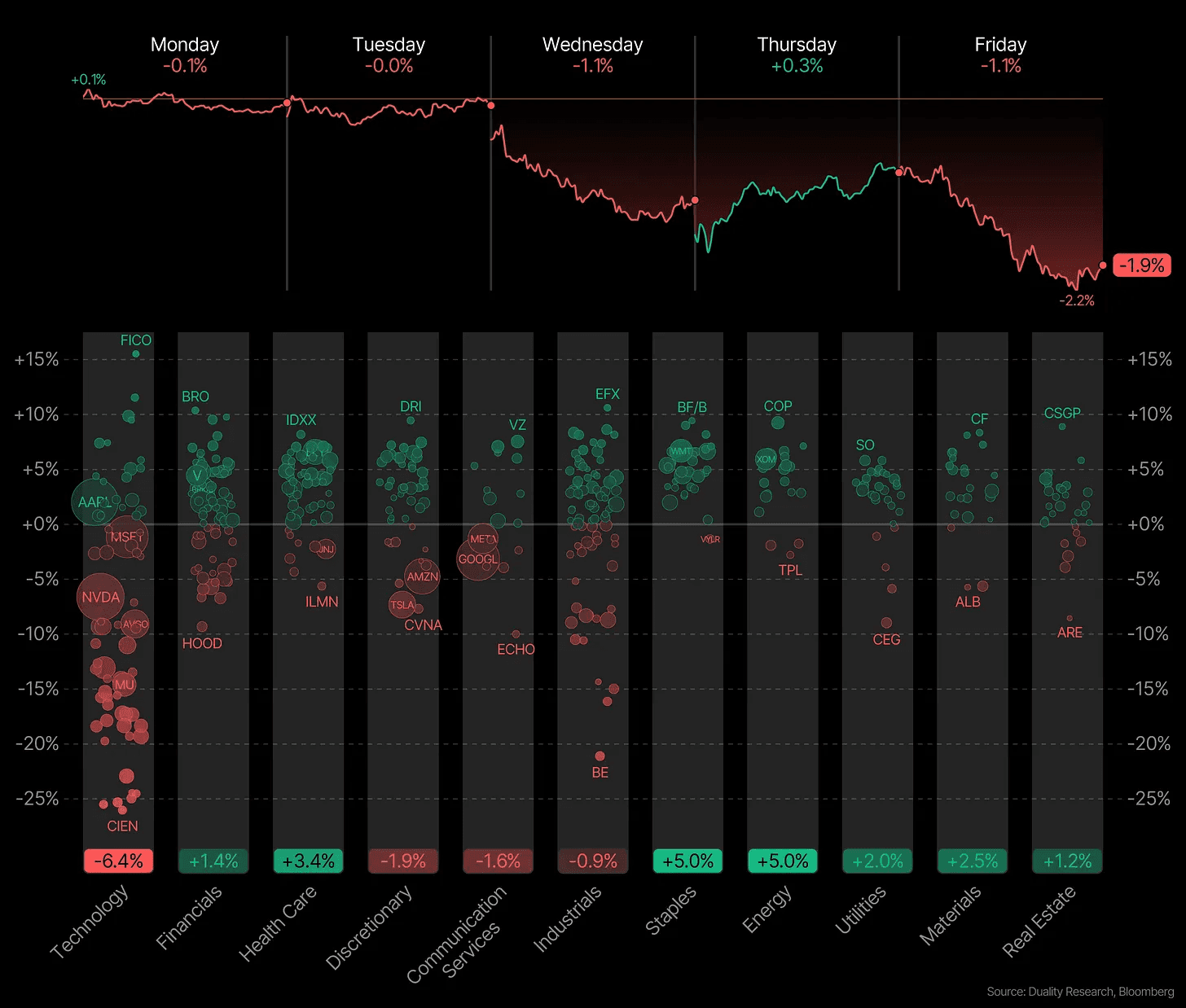
If you look beyond the major indexes, many individual stocks are getting hit pretty hard. Many have already suffered significant losses, and the selling pressure is starting to spread across the market.
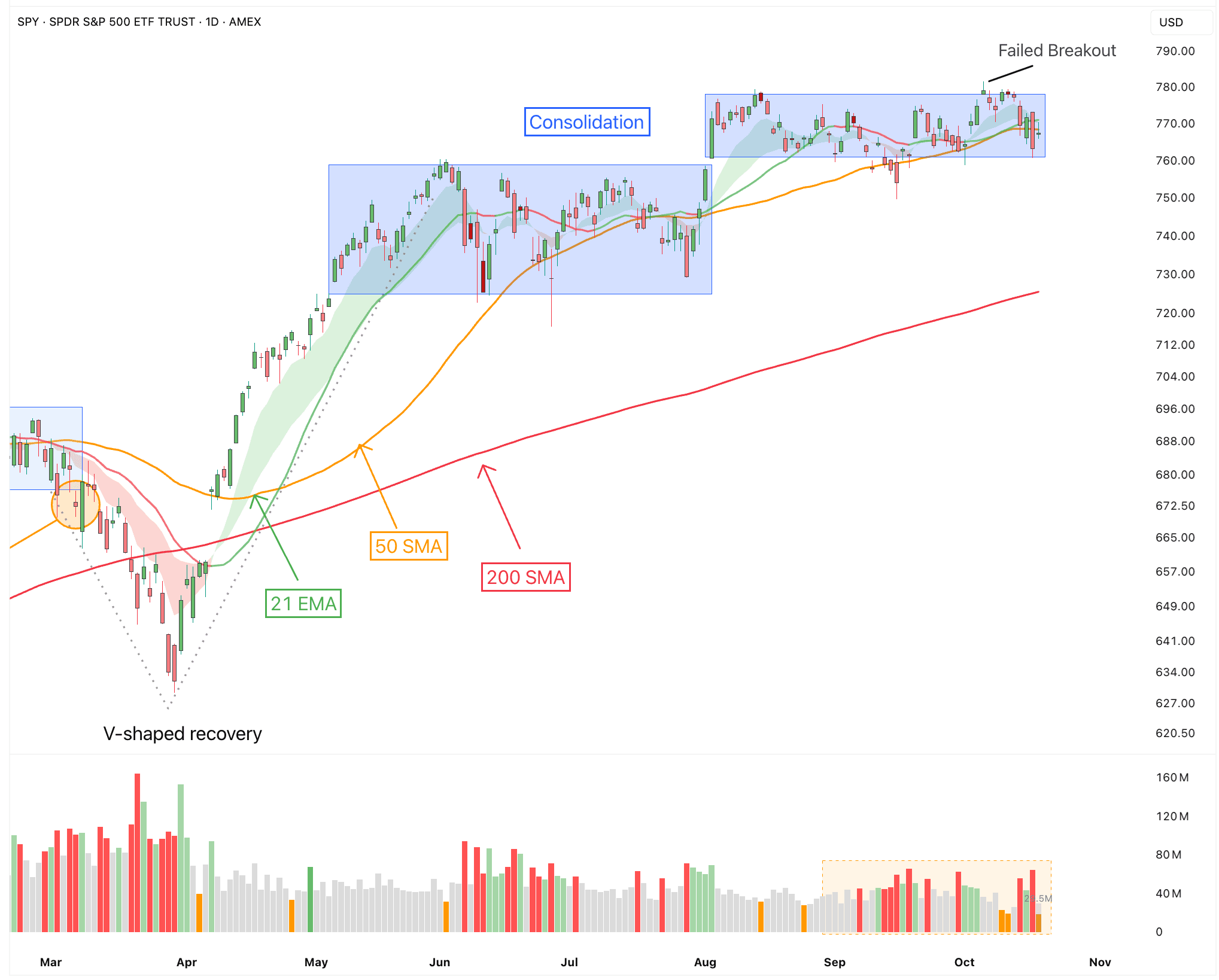
One encouraging sign from last week was that we didn't see a major spike in selling volume. So, investors weren't rushing to sell at any price, at least not yet. Still, the selling pressure was significant, and a 2% decline in the S&P 500 in a single week is something I take seriously.
The index is still trading within a large consolidation range. The broader uptrend hasn't broken down yet. But what’s happening underneath the surface is becoming harder to ignore and now is definitely not the time to be aggressive.
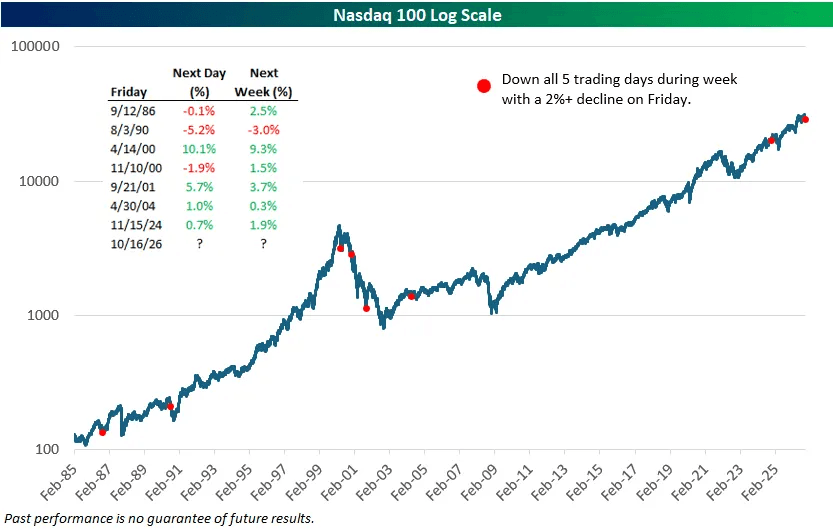
It’s been a while since the Nasdaq dropped 2% or more on a Friday, but looking at how the market reacted to similar selloffs in the past, a rebound next week wouldn’t be surprising.
The last 7 times this happened, the Nasdaq closed higher the following Monday 4 out of 7 times. More interestingly, it finished the following week in the green 6 out of 7 times. Of course, it’s important to keep in mind that 7 occurrences are a very small sample.
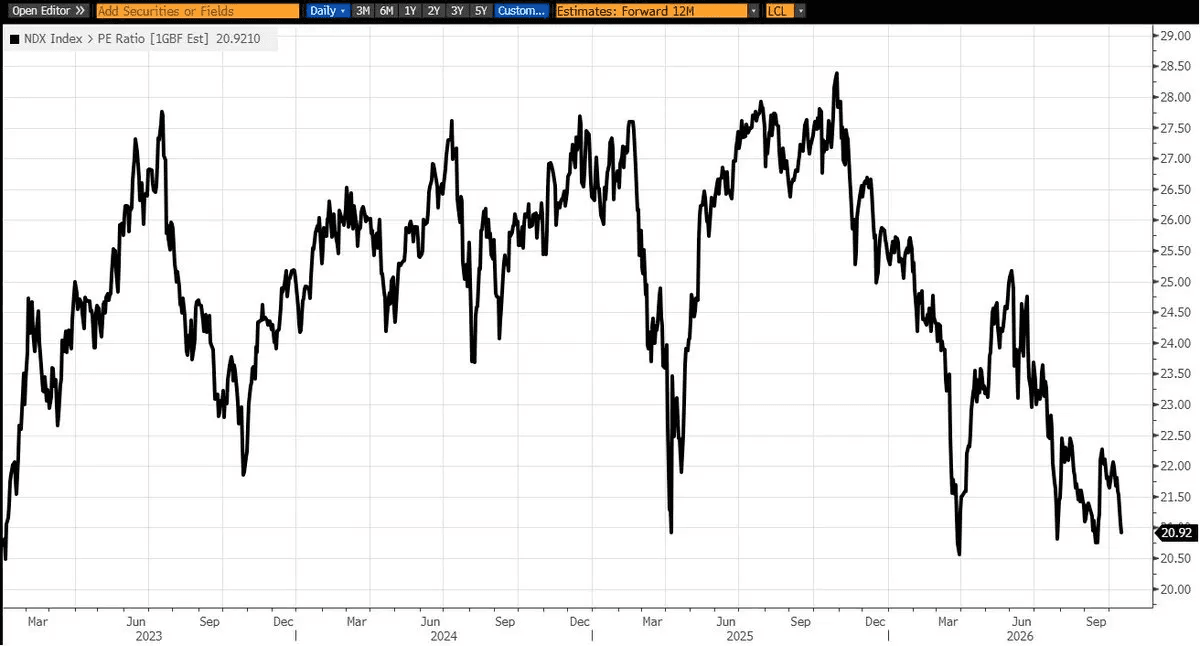
I know that lower valuations don’t automatically lead to better returns. But with stocks now trading at around 20x earnings, valuations have come down significantly. That’s a much more reasonable price to pay, especially for companies that are still growing earnings. I find it hard to call this a bubble when valuations have already come down this much.
But even if this isn’t the end of the AI trade, it’s completely normal to expect some rough patches along the way. Market corrections are a healthy part of any long-term bull market. They help cool down excessive optimism, bring valuations back to more reasonable levels, and create better opportunities for investors to build positions. No bull market just moves up in a straight line.
The current bull market turned 4 years old last week.
Since bottoming on October 12, 2022, the S&P 500 has gained around 118%, making this the 3rd strongest bull market at the 4-year mark since 1949. Only the bull markets that started in 1982 and 2009 performed better over their first 4 years.
That puts the current rally among some of the strongest bull markets in modern history. And while 4 years might sound like a long time, we’ve seen that strong bull markets can continue for years after reaching this milestone.
Bull markets don't simply end because they get old.

So what can we expect in year 5?
Since 1950, the 6 previous bull markets that completed their fifth year all delivered positive returns. The average gain was 18.9%. So, bull markets can definitely continue to deliver strong returns even after several years of gains. Some of the biggest gains have come well after the first few years. And a bull market that’s a few years in doesn't automatically mean it's running out of steam.

Over the past weeks, I’ve been pointing out how weak market breadth had become. Fewer and fewer stocks were participating in the rally, even as the major indexes held up relatively well. A healthy bull market needs broad participation to keep moving higher.
But we’re finally starting to see some improvement.
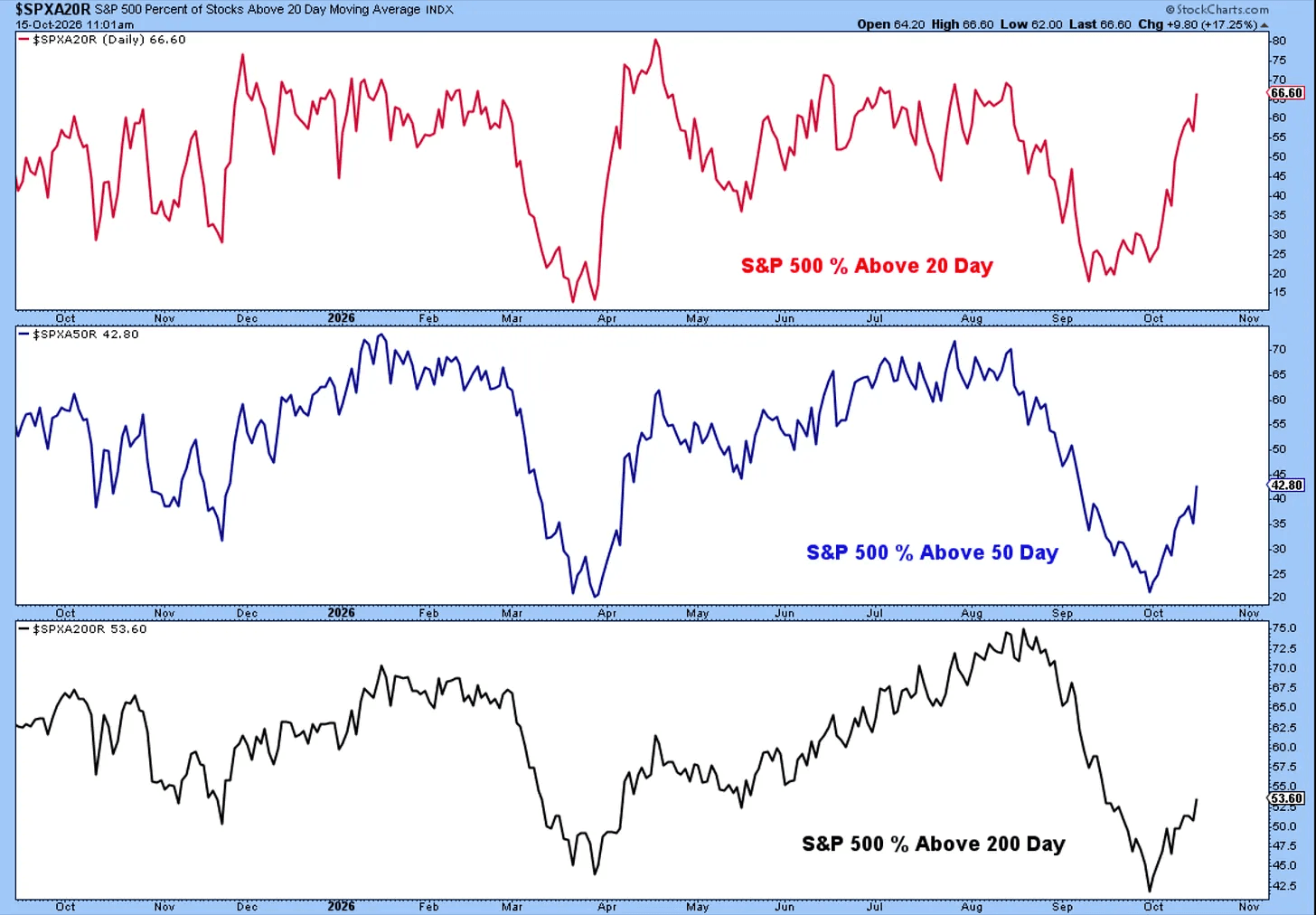
The percentage of S&P 500 stocks trading above their 20-day, 50-day, and 200-day moving averages has finally started to turn around.
At the end of September, fewer than 20% of S&P 500 stocks were trading above their 20-day moving average. This week, that number climbed above 66%.
We still need to see whether this improvement can continue. But for now, this is an encouraging sign that the market is becoming healthier beneath the surface.
Inflation is slowly becoming a significant problem.
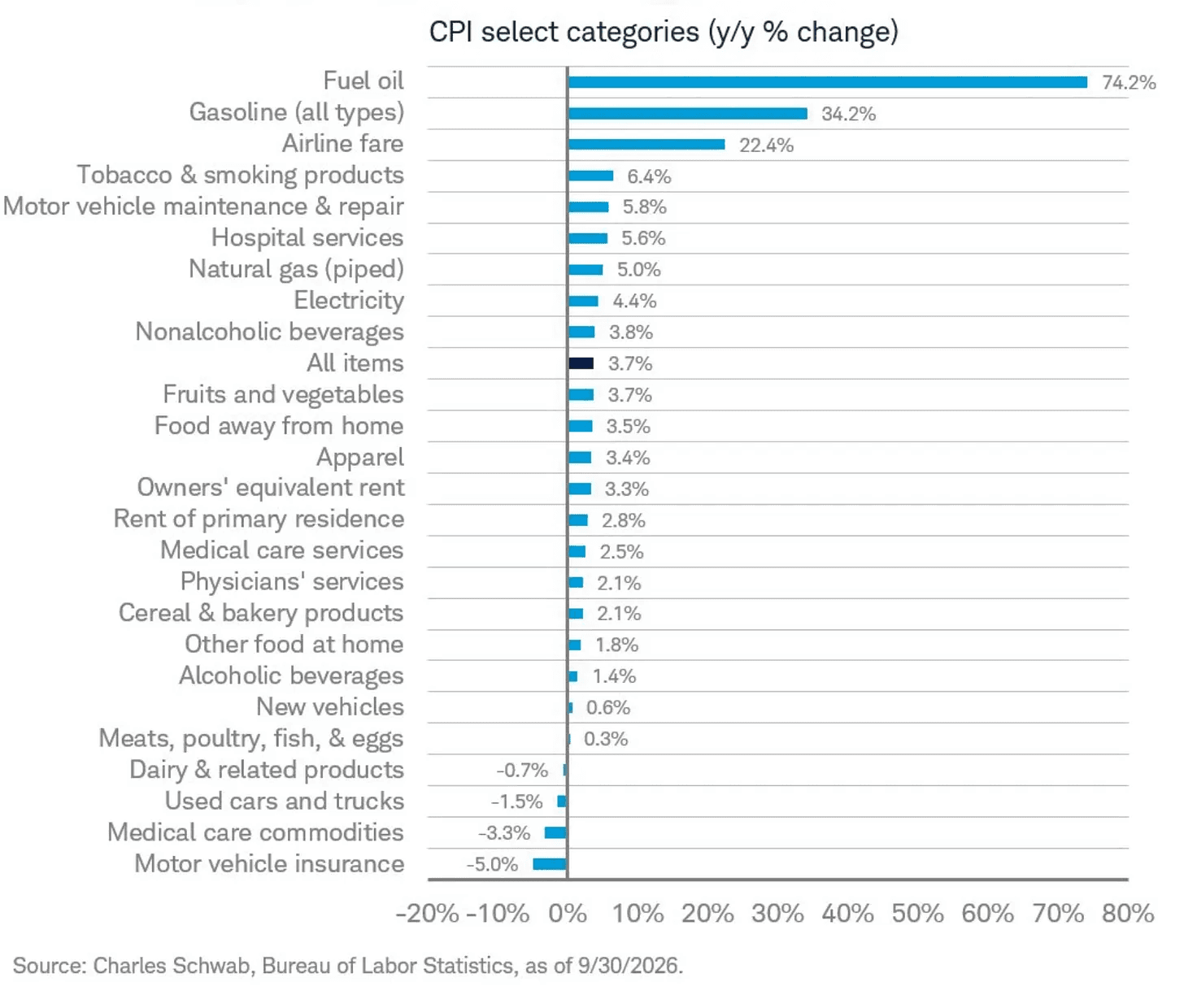
Energy is by far the biggest inflation factor. Fuel oil prices have jumped 74% over the past year, gasoline is up 34%, and airfares have increased 22%. In fact, rising gasoline prices alone accounted for more than half of September's monthly increase in consumer prices.
But the bigger surprise this week came from producer prices.
The Producer Price Index (PPI), which tracks the prices businesses receive for the goods and services they sell, jumped to 6.3% in September, up from 5.6% in August and well above the 5.3% economists had expected. That's the highest annual reading since December 2022.
Businesses are facing rising costs at a time when consumers are already struggling with higher prices. Companies can try to pass those costs on to customers, but there's a limit to how much people are willing to pay.
If businesses absorb those higher costs instead, their profit margins could come under pressure. And if they pass them on, consumer inflation could remain elevated for longer. The market is starting to price in the possibility that interest rates will have to rise further. After the latest inflation reports, expectations for another Fed rate hike increased materially.
Either way, this creates another challenge for corporate earnings, especially for small caps.

That’s why so many companies are struggling right now.
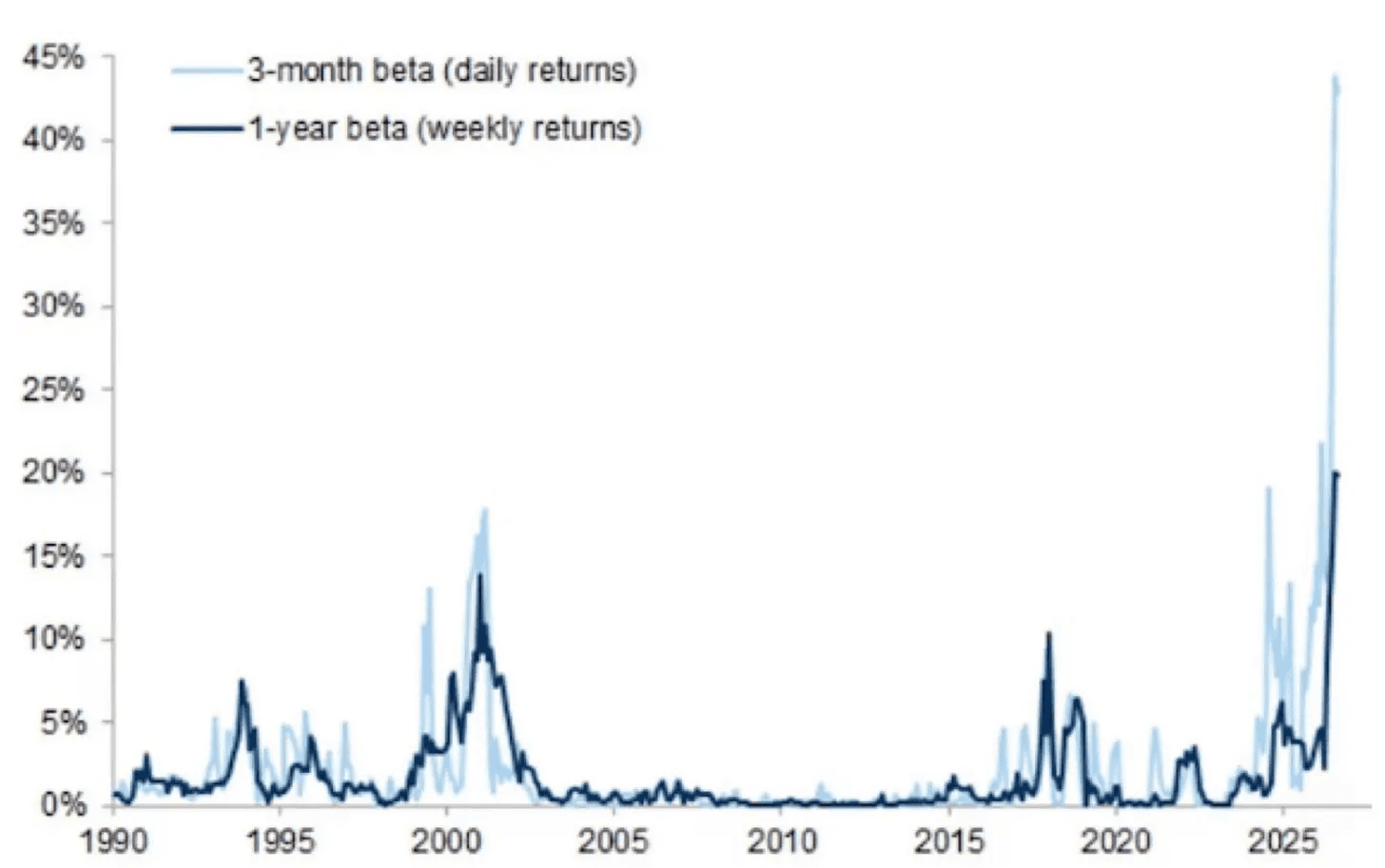
The S&P 500 recently reached a record number of stocks with a negative beta. So, these are stocks that have tended to move in the opposite direction of the overall index.
Around 140 S&P 500 stocks now fall into this category. While the S&P 500 has been climbing toward record highs, more than 1 in 4 stocks actually moved against the index.
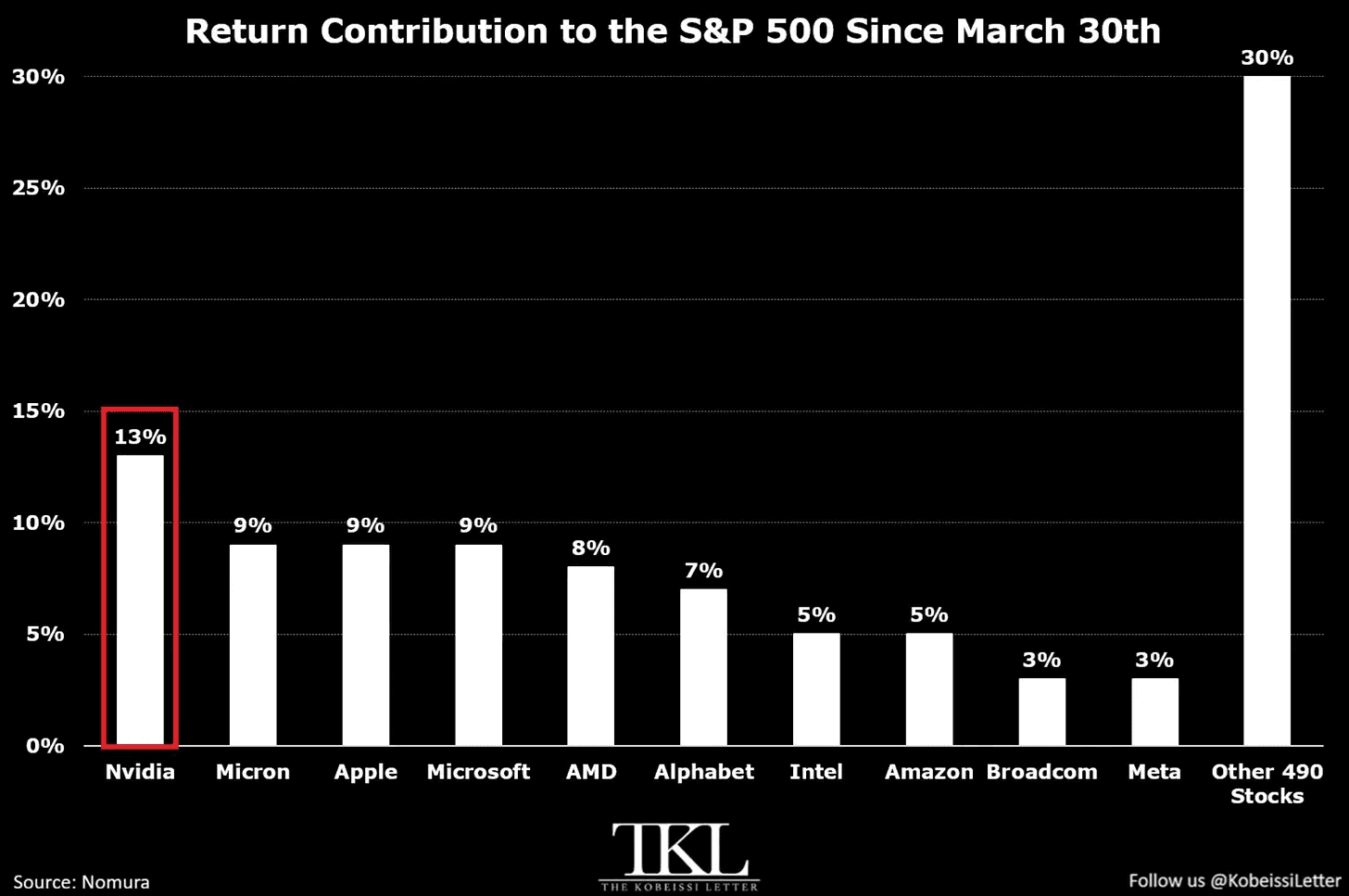
So, it’s not surprising that just 10 stocks have been responsible for around 70% of the S&P 500’s gains since March 30. The index has climbed roughly 23% over that period, but those 10 companies alone contributed 16 percentage points to the rally. The other 490 stocks combined accounted for just 7 percentage points.
But now even the most important sector in the market is going through a correction. The VanEck Semiconductor ETF (SMH) fell for 9 consecutive trading days, down around 19% from its June high. So, the index has basically gone nowhere since April. It’s now at a critical support level that needs to hold or the chances of a serious market correction increases significantly.

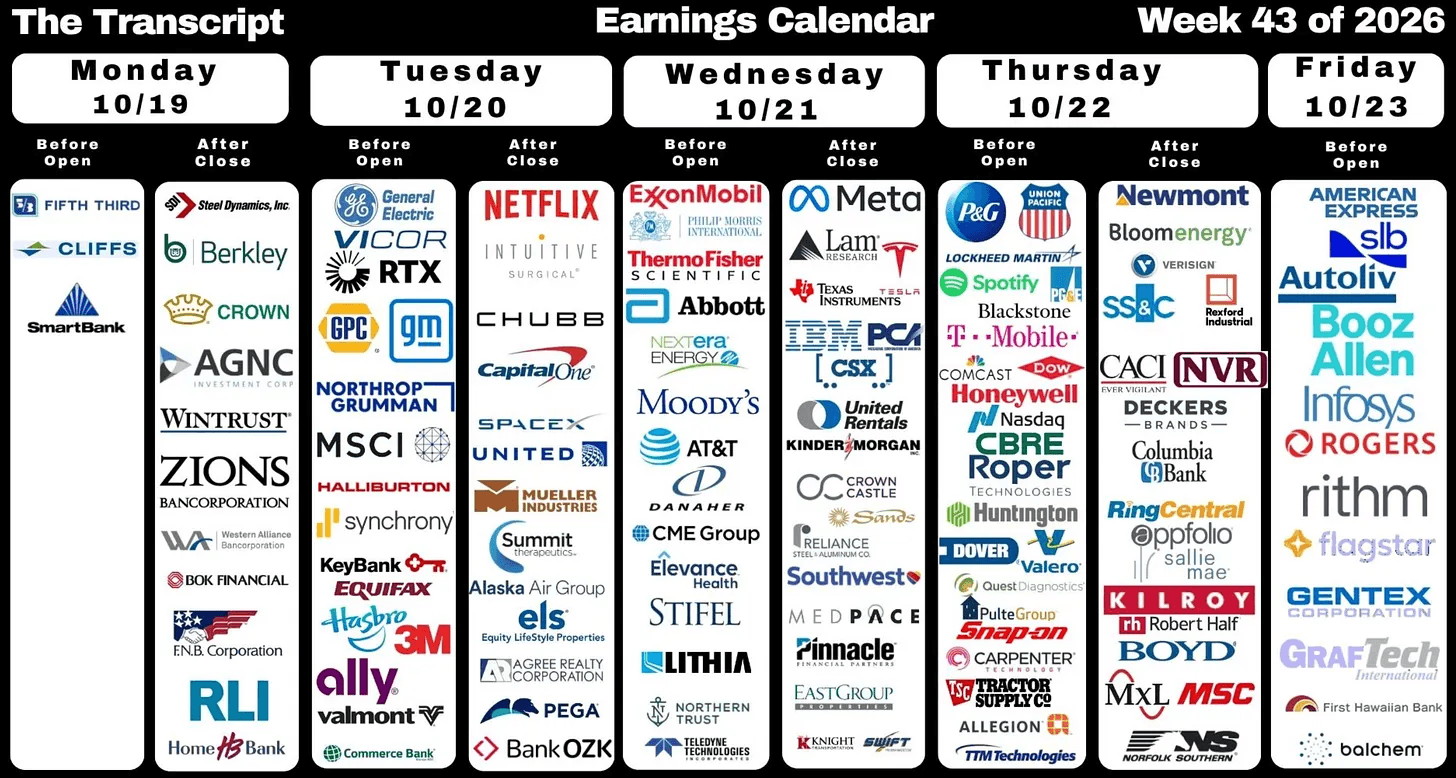
I consider this week the real start of tech earnings season, and it could be one of the most important market periods for the market in quite some time.
We have some massive companies reporting, including Netflix (NFLX), SpaceX (SPCX), Tesla (TSLA), and Meta (META). On top of that, we have important semiconductor companies, Lam Research (LRCX), Western Digital (WDX) and Texas Instruments (TXN), reporting as well.
But given the current market environment, I'm keeping my expectations for positive stock reactions relatively low.
One thing I've learned over the years is that even great earnings don't always lead to higher stock prices. When market sentiment is weak and investors are looking for reasons to sell, companies can beat expectations, raise guidance, and still see their shares fall.
That's why I'll be paying just as much attention to how stocks react to earnings as I do to the actual numbers.
Maybe a few companies can deliver results strong enough to break through the negative sentiment and push their stocks higher. That would be encouraging, especially after the recent selloff in technology stocks.
But until we start seeing the market reward good earnings again, I'm staying cautious. Make sure to keep an eye on the earnings calendar and when your holdings report.
The market is becoming increasingly difficult to navigate. The weakness we've been seeing beneath the surface for weeks is now showing up in the major indexes. Hence, the market environment has clearly changed, and our approach needs to change with it.
There are times when the market rewards aggressive positioning, and there are times when protecting capital and staying patient makes much more sense. Right now, I believe we're firmly in the second category.
The priority is to protect capital today so we can take advantage of better opportunities tomorrow.
And those opportunities will come.
One of the good things about market corrections is that they bring previously expensive and extended stocks back to more attractive levels. They also help shake out excessive speculation and often create the conditions for new market leaders to emerge.
Some of the strongest trends begin after periods of weakness.
The mistake many investors make is trying to force those opportunities before they're ready. They keep buying as stocks fall, hoping they've found the bottom, often without a clear plan for managing risk.
I've never been a fan of trying to predict exactly where the market will bottom or how much further stocks might fall. Nobody knows that with any certainty, and I don't think it's a particularly useful exercise.
I'd rather preserve my capital, keep building my watchlist, and wait until the market starts showing signs of strength again. That means looking for stocks that hold up well during selloffs, recover quickly, and start breaking out when the broader market turns around.
I want the market to show me that buyers are returning before I start getting aggressive again.
The upcoming earnings season should give us a much better idea of where the market stands. I'm particularly interested in seeing whether investors start rewarding companies that report strong earnings and raise their outlooks.
Until then, I see little reason to force trades.
One of the biggest lessons I've learned over the years is that you don't have to participate aggressively in every market environment.
There's nothing wrong with taking a small position when the setup is attractive and the risk is clearly defined. But trading large positions in an environment where breakouts keep failing and stocks struggle to hold gains can quickly do more harm than good.
Sometimes the best trade is simply doing nothing and allowing the market to sort itself out.
It's also important to avoid getting caught up in the extreme opinions that tend to dominate during corrections.
Every time the market pulls back, some people become convinced that a major crash is coming. Others insist that every dip is an opportunity to buy aggressively.
We've had an incredible run in many parts of the market over the past few years. There's absolutely nothing wrong with protecting some of those gains and waiting for conditions to improve.
The biggest mistake right now would be allowing frustration, impatience, or FOMO to dictate our decisions.
There will always be another opportunity to make money. But first, you have to survive to thrive.
Read More
Lin
Weekly Market Update: Earnings Season is Back
The sentiment around AI is pretty sour right now. CoreWeave, Oracle, Anthropic’s IPO valuation getting cut. There’s plenty to choose from. And until some of these clouds clear, it’s probably going to stay choppy.
And it’s been a divergent market. On the surface the indices look fine, and the S&P 500 is sitting just below all-time highs. But underneath, it’s been ugly. A lot of the AI boom’s biggest winners are deep in drawdowns.
Hence, This week, the S&P 500 fell 2.0% and the Nasdaq dropped 4.5%, ending a four-week winning streak. Tech got hit hardest, and Friday was the worst day of the bunch.
If you look beyond the major indexes, many individual stocks are getting hit pretty hard. Many have already suffered significant losses, and the selling pressure is starting to spread across the market.
One encouraging sign from last week was that we didn't see a major spike in selling volume. So, investors weren't rushing to sell at any price, at least not yet. Still, the selling pressure was significant, and a 2% decline in the S&P 500 in a single week is something I take seriously.
The index is still trading within a large consolidation range. The broader uptrend hasn't broken down yet. But what’s happening underneath the surface is becoming harder to ignore and now is definitely not the time to be aggressive.
It’s been a while since the Nasdaq dropped 2% or more on a Friday, but looking at how the market reacted to similar selloffs in the past, a rebound next week wouldn’t be surprising.
The last 7 times this happened, the Nasdaq closed higher the following Monday 4 out of 7 times. More interestingly, it finished the following week in the green 6 out of 7 times. Of course, it’s important to keep in mind that 7 occurrences are a very small sample.
I know that lower valuations don’t automatically lead to better returns. But with stocks now trading at around 20x earnings, valuations have come down significantly. That’s a much more reasonable price to pay, especially for companies that are still growing earnings. I find it hard to call this a bubble when valuations have already come down this much.
But even if this isn’t the end of the AI trade, it’s completely normal to expect some rough patches along the way. Market corrections are a healthy part of any long-term bull market. They help cool down excessive optimism, bring valuations back to more reasonable levels, and create better opportunities for investors to build positions. No bull market just moves up in a straight line.
The current bull market turned 4 years old last week.
Since bottoming on October 12, 2022, the S&P 500 has gained around 118%, making this the 3rd strongest bull market at the 4-year mark since 1949. Only the bull markets that started in 1982 and 2009 performed better over their first 4 years.
That puts the current rally among some of the strongest bull markets in modern history. And while 4 years might sound like a long time, we’ve seen that strong bull markets can continue for years after reaching this milestone.
Bull markets don't simply end because they get old.
So what can we expect in year 5?
Since 1950, the 6 previous bull markets that completed their fifth year all delivered positive returns. The average gain was 18.9%. So, bull markets can definitely continue to deliver strong returns even after several years of gains. Some of the biggest gains have come well after the first few years. And a bull market that’s a few years in doesn't automatically mean it's running out of steam.
Over the past weeks, I’ve been pointing out how weak market breadth had become. Fewer and fewer stocks were participating in the rally, even as the major indexes held up relatively well. A healthy bull market needs broad participation to keep moving higher.
But we’re finally starting to see some improvement.
The percentage of S&P 500 stocks trading above their 20-day, 50-day, and 200-day moving averages has finally started to turn around.
At the end of September, fewer than 20% of S&P 500 stocks were trading above their 20-day moving average. This week, that number climbed above 66%.
We still need to see whether this improvement can continue. But for now, this is an encouraging sign that the market is becoming healthier beneath the surface.
Inflation is slowly becoming a significant problem.
Energy is by far the biggest inflation factor. Fuel oil prices have jumped 74% over the past year, gasoline is up 34%, and airfares have increased 22%. In fact, rising gasoline prices alone accounted for more than half of September's monthly increase in consumer prices.
But the bigger surprise this week came from producer prices.
The Producer Price Index (PPI), which tracks the prices businesses receive for the goods and services they sell, jumped to 6.3% in September, up from 5.6% in August and well above the 5.3% economists had expected. That's the highest annual reading since December 2022.
Businesses are facing rising costs at a time when consumers are already struggling with higher prices. Companies can try to pass those costs on to customers, but there's a limit to how much people are willing to pay.
If businesses absorb those higher costs instead, their profit margins could come under pressure. And if they pass them on, consumer inflation could remain elevated for longer. The market is starting to price in the possibility that interest rates will have to rise further. After the latest inflation reports, expectations for another Fed rate hike increased materially.
Either way, this creates another challenge for corporate earnings, especially for small caps.
That’s why so many companies are struggling right now.
The S&P 500 recently reached a record number of stocks with a negative beta. So, these are stocks that have tended to move in the opposite direction of the overall index.
Around 140 S&P 500 stocks now fall into this category. While the S&P 500 has been climbing toward record highs, more than 1 in 4 stocks actually moved against the index.
So, it’s not surprising that just 10 stocks have been responsible for around 70% of the S&P 500’s gains since March 30. The index has climbed roughly 23% over that period, but those 10 companies alone contributed 16 percentage points to the rally. The other 490 stocks combined accounted for just 7 percentage points.
But now even the most important sector in the market is going through a correction. The VanEck Semiconductor ETF (SMH) fell for 9 consecutive trading days, down around 19% from its June high. So, the index has basically gone nowhere since April. It’s now at a critical support level that needs to hold or the chances of a serious market correction increases significantly.
I consider this week the real start of tech earnings season, and it could be one of the most important market periods for the market in quite some time.
We have some massive companies reporting, including Netflix (NFLX), SpaceX (SPCX), Tesla (TSLA), and Meta (META). On top of that, we have important semiconductor companies, Lam Research (LRCX), Western Digital (WDX) and Texas Instruments (TXN), reporting as well.
But given the current market environment, I'm keeping my expectations for positive stock reactions relatively low.
One thing I've learned over the years is that even great earnings don't always lead to higher stock prices. When market sentiment is weak and investors are looking for reasons to sell, companies can beat expectations, raise guidance, and still see their shares fall.
That's why I'll be paying just as much attention to how stocks react to earnings as I do to the actual numbers.
Maybe a few companies can deliver results strong enough to break through the negative sentiment and push their stocks higher. That would be encouraging, especially after the recent selloff in technology stocks.
But until we start seeing the market reward good earnings again, I'm staying cautious. Make sure to keep an eye on the earnings calendar and when your holdings report.
The market is becoming increasingly difficult to navigate. The weakness we've been seeing beneath the surface for weeks is now showing up in the major indexes. Hence, the market environment has clearly changed, and our approach needs to change with it.
There are times when the market rewards aggressive positioning, and there are times when protecting capital and staying patient makes much more sense. Right now, I believe we're firmly in the second category.
The priority is to protect capital today so we can take advantage of better opportunities tomorrow.
And those opportunities will come.
One of the good things about market corrections is that they bring previously expensive and extended stocks back to more attractive levels. They also help shake out excessive speculation and often create the conditions for new market leaders to emerge.
Some of the strongest trends begin after periods of weakness.
The mistake many investors make is trying to force those opportunities before they're ready. They keep buying as stocks fall, hoping they've found the bottom, often without a clear plan for managing risk.
I've never been a fan of trying to predict exactly where the market will bottom or how much further stocks might fall. Nobody knows that with any certainty, and I don't think it's a particularly useful exercise.
I'd rather preserve my capital, keep building my watchlist, and wait until the market starts showing signs of strength again. That means looking for stocks that hold up well during selloffs, recover quickly, and start breaking out when the broader market turns around.
I want the market to show me that buyers are returning before I start getting aggressive again.
The upcoming earnings season should give us a much better idea of where the market stands. I'm particularly interested in seeing whether investors start rewarding companies that report strong earnings and raise their outlooks.
Until then, I see little reason to force trades.
One of the biggest lessons I've learned over the years is that you don't have to participate aggressively in every market environment.
There's nothing wrong with taking a small position when the setup is attractive and the risk is clearly defined. But trading large positions in an environment where breakouts keep failing and stocks struggle to hold gains can quickly do more harm than good.
Sometimes the best trade is simply doing nothing and allowing the market to sort itself out.
It's also important to avoid getting caught up in the extreme opinions that tend to dominate during corrections.
Every time the market pulls back, some people become convinced that a major crash is coming. Others insist that every dip is an opportunity to buy aggressively.
We've had an incredible run in many parts of the market over the past few years. There's absolutely nothing wrong with protecting some of those gains and waiting for conditions to improve.
The biggest mistake right now would be allowing frustration, impatience, or FOMO to dictate our decisions.
There will always be another opportunity to make money. But first, you have to survive to thrive.
Read More
Lin
Weekly Market Update: Big Tech Divergence
Sentiment around AI continues to get worse.
The Financial Times reported that OpenAI's annualized revenue was approaching $50B, well below the $70B figure previously circulating. The market took this as a major disappointment, triggering a sell-off across AI stocks.
But the difference largely comes down to accounting. Anthropic includes revenue generated through cloud partners, while OpenAI reports those sales differently. Investors had adjusted OpenAI's numbers to make the 2 companies more comparable.
What’s more interesting is how the market reacted. When sentiment around AI was strong, almost every headline was treated as good news. Now, even the smallest bit of uncertainty is enough to trigger a sell-off. This tells you a lot about the current state of the market for tech and AI.
The broader market isn't making things easier either. Despite major indexes hitting record highs, relatively few stocks are doing well. In an environment like this, simply protecting your capital, holding your ground, and wait until the window of opportunity opens up is critical.

The weakness in the broader market has been there since August.
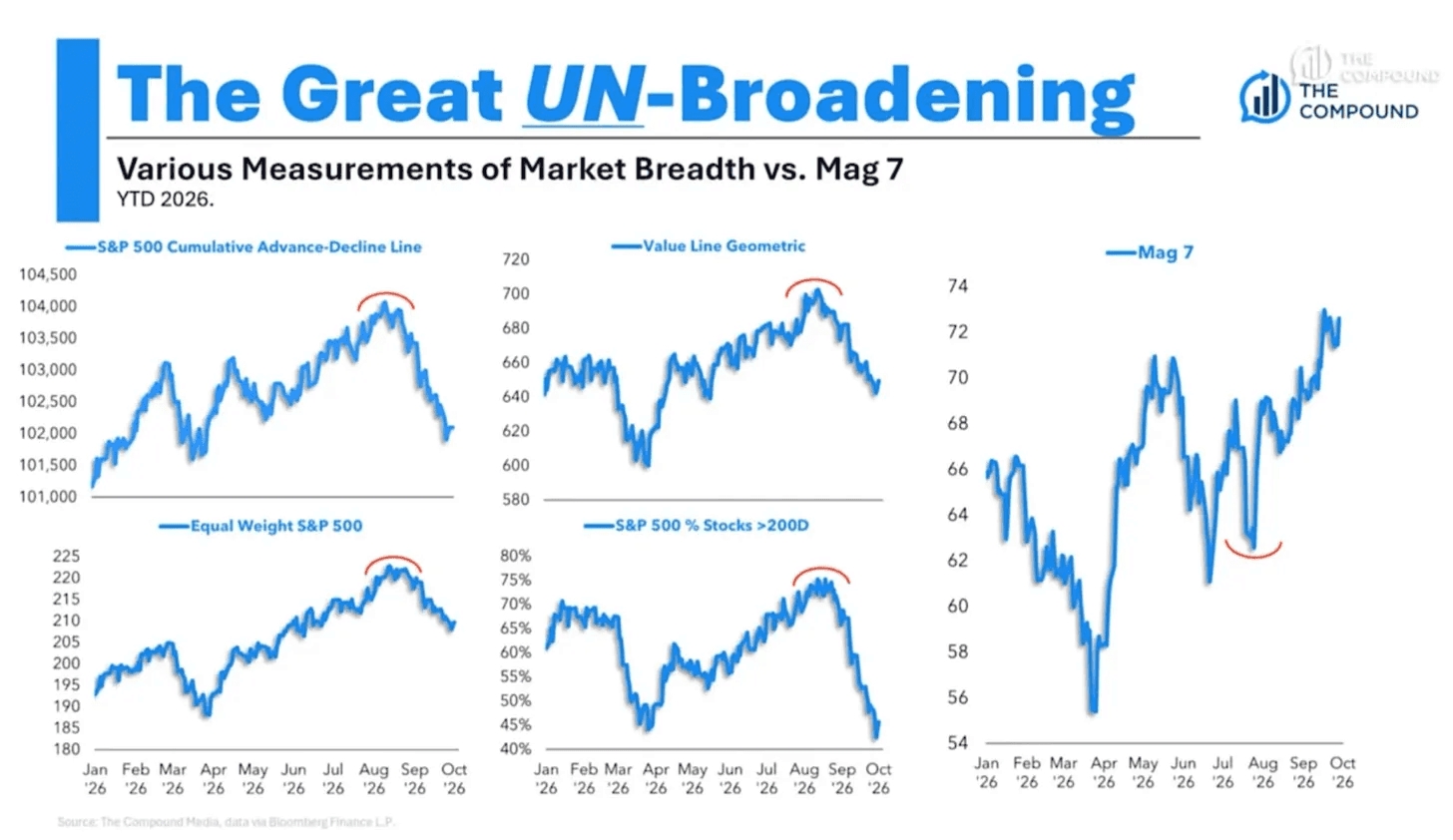
Pretty much every measure of market breadth has been getting worse. Whether you look at the advance-decline line, the equal-weight S&P 500, or the percentage of stocks above their 200-day moving average, they all peaked in August and have been declining since.
The percentage of S&P 500 stocks above their 200-day moving average has dropped from around 75% to the mid-40s.
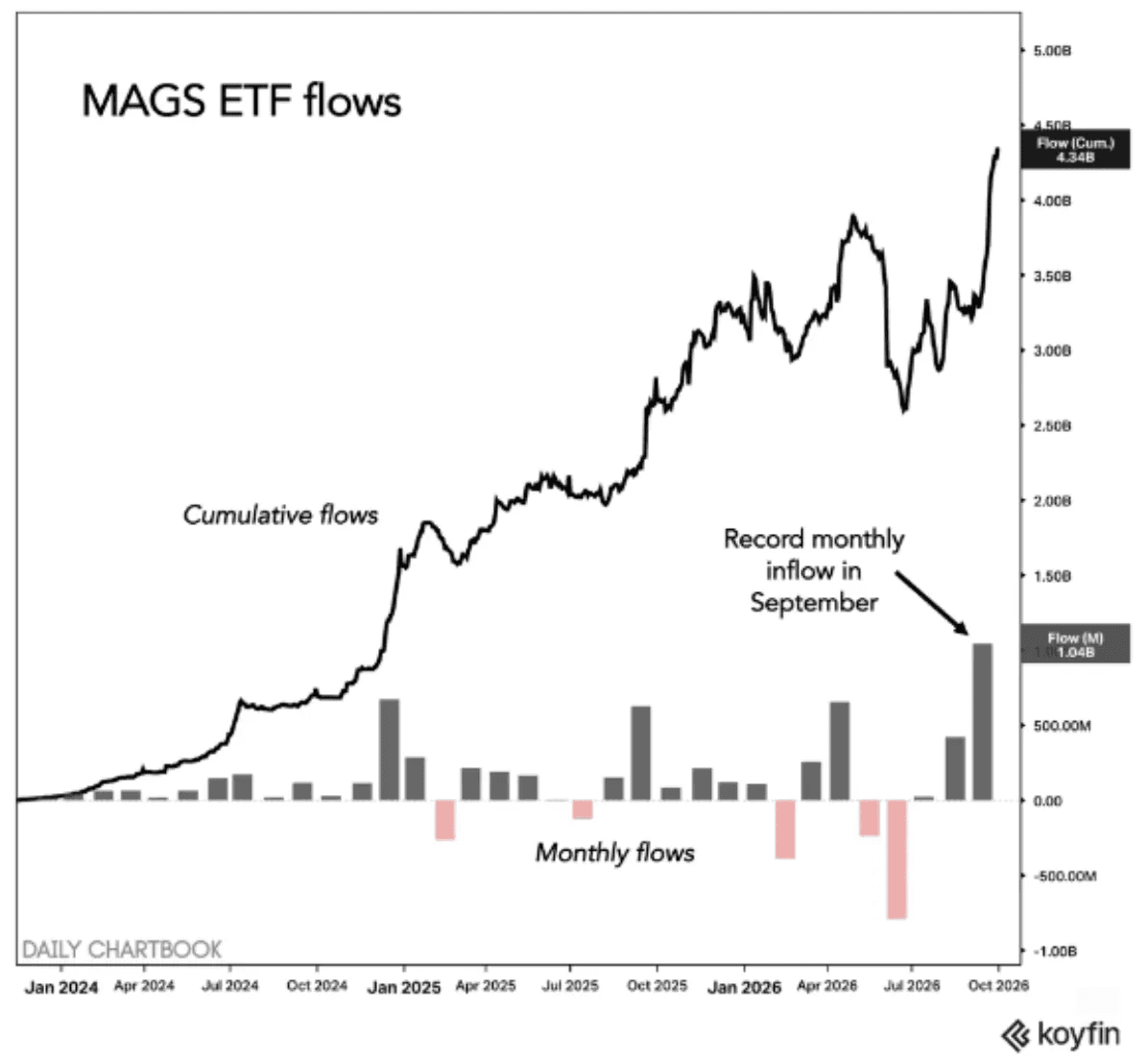
Fewer and fewer stocks are actually doing well. The main exception is the Mag 7, which are pretty much the only thing holding up the market right now.
Hence, it’s not surprising that the MAGS ETF, which invests exclusively in the Magnificent 7, had its biggest month of inflows ever. More and more money continues to flow into a small group of stocks, while most of the market is struggling.
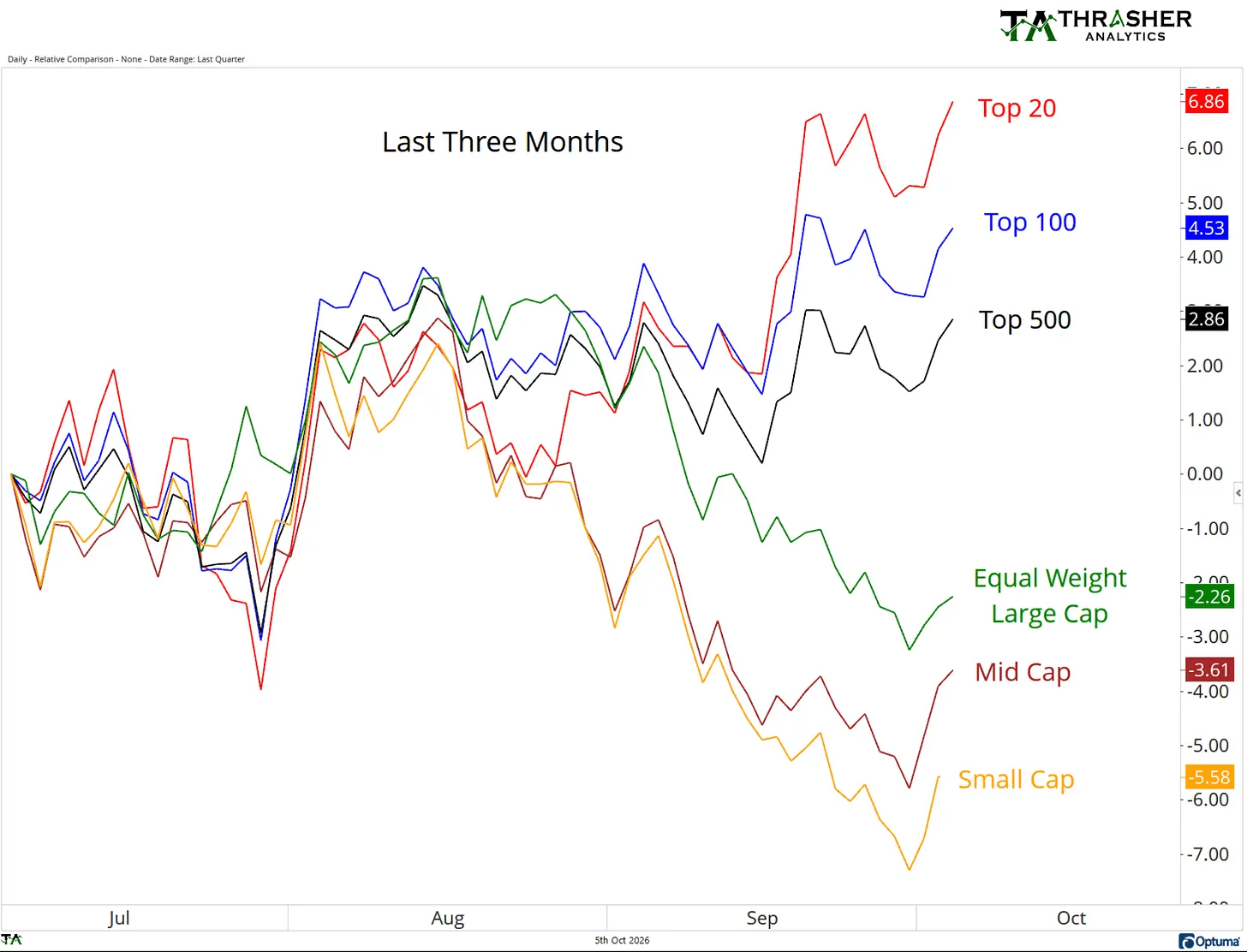
The bigger the stock, the better it performed.
The 20 largest stocks are up almost 7%, the top 100 are up 4.5%, and the full S&P 500 is up less than 3% over the last 3 months.
On the other hand, the equal-weight S&P 500 is down 2%, mid caps are down 3.6%, and small caps are down 5.6%.
The smaller the stocks, the worse they've performed.
You can see the same weakness when comparing tech stocks with the rest of the market.
For most of this bull market, tech and the rest of the S&P 500 moved in the same direction. That's no longer the case.
The 2-month correlation between them has dropped to -0.70, the lowest level since the bull market started in October 2022.
In simple terms, tech stocks and the rest of the market used to move together. Now, they tend to move in opposite directions.
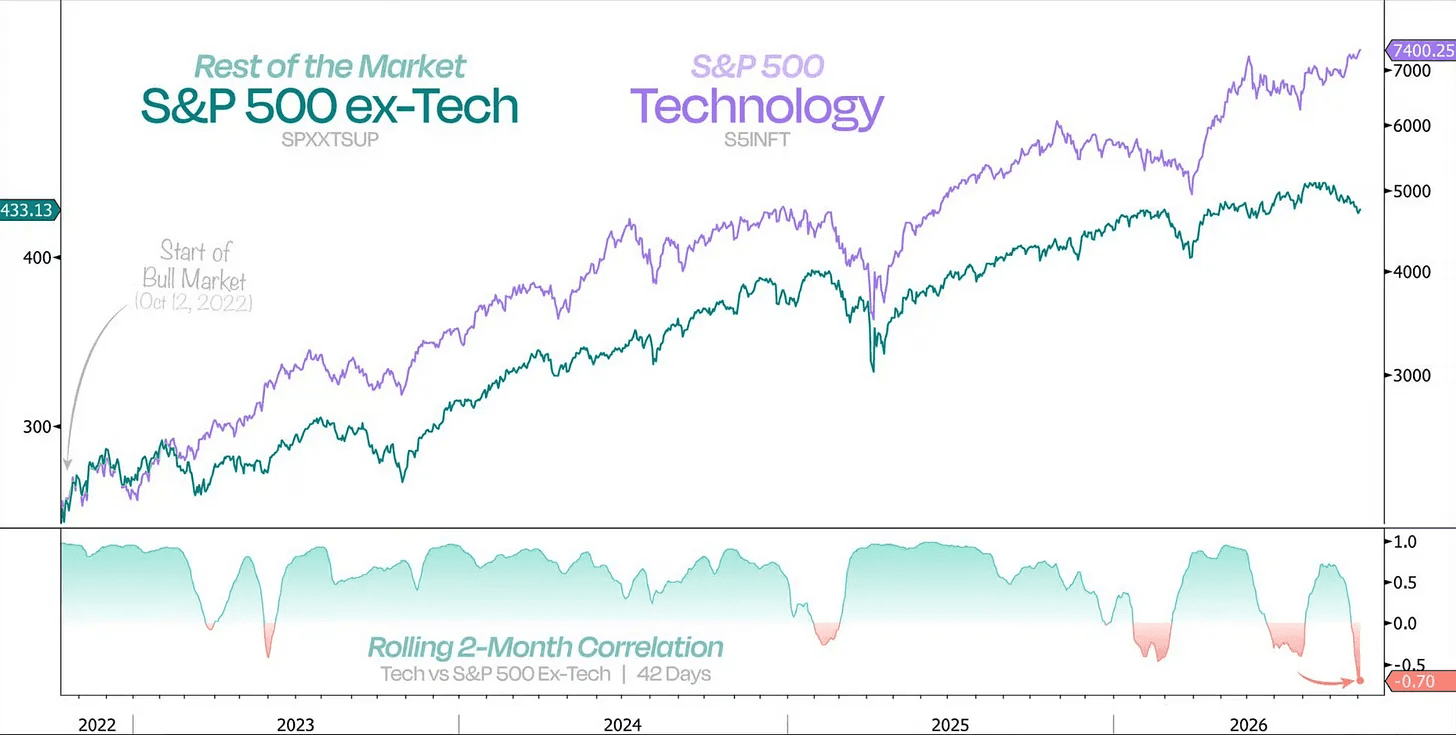
It's not just tech moving differently from the rest of the market. Other sectors are also starting to move independently of the S&P 500.
Over the last 3 months, the correlation between the S&P 500 and sectors like Consumer Staples, Energy, Utilities, and Health Care has dropped to around zero or even turned negative. Consumer Staples and Energy have reached their lowest correlation levels in 20 years.
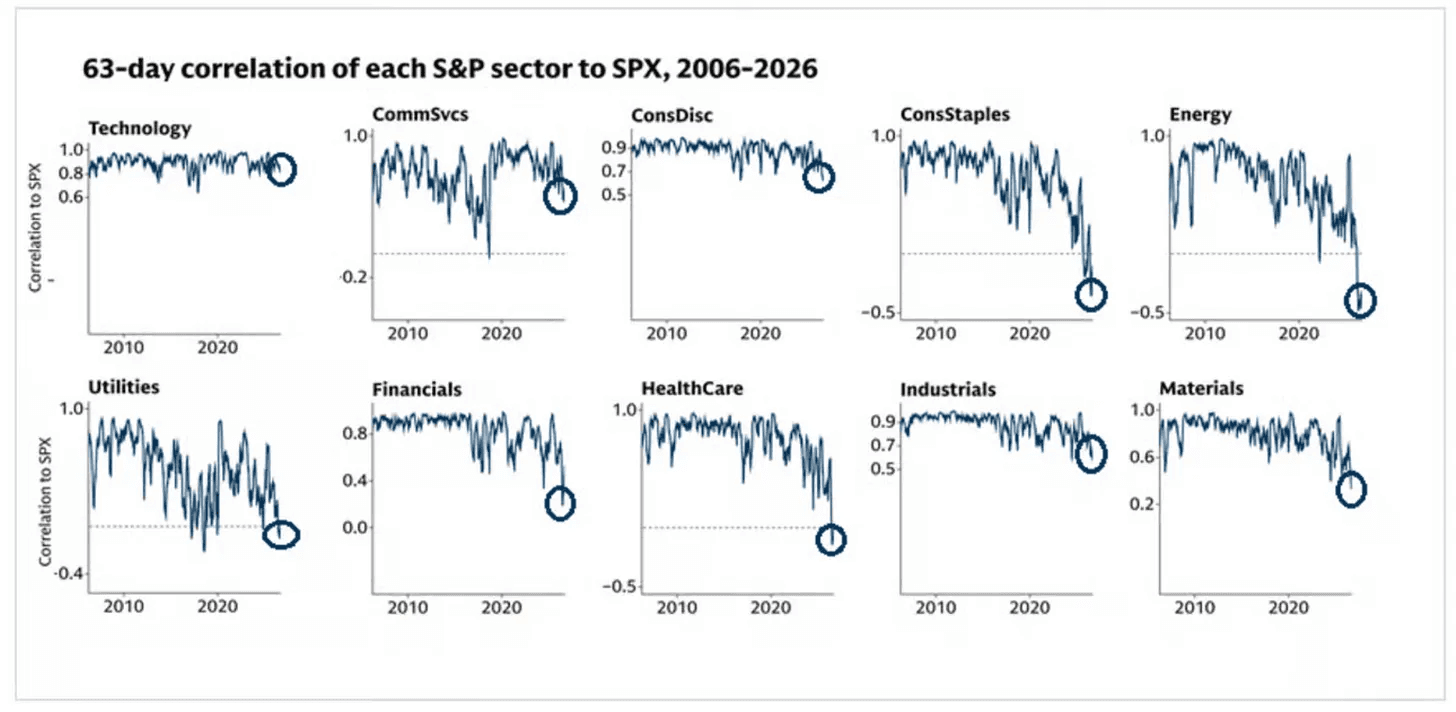
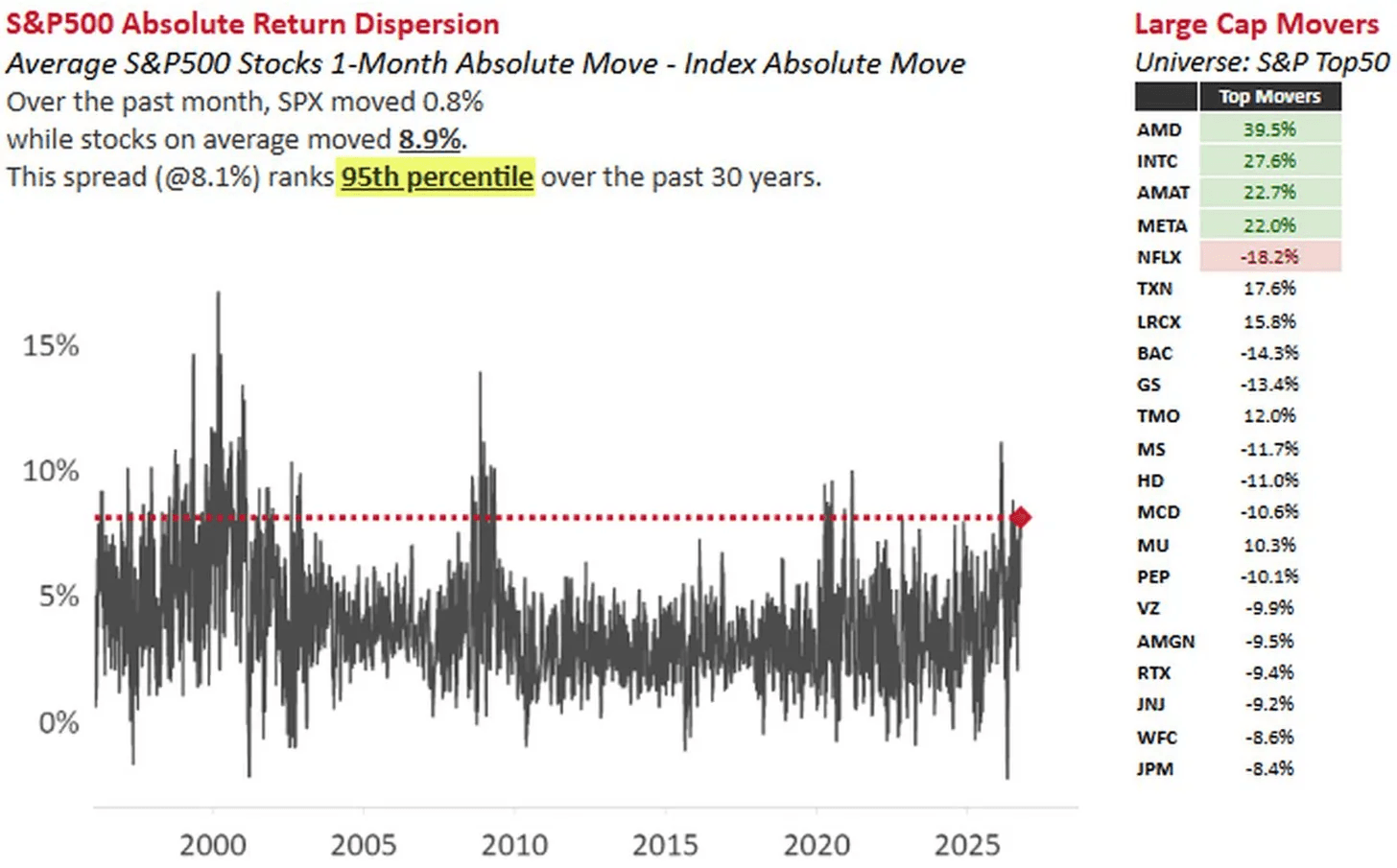
On top of that there is a ton of volatility hidden behind the index.
Over the past month, the S&P 500 has barely moved. It’s up just 0.8%. But the average stock inside the index has moved 8.9% in either direction.
Just look at some of the individual stocks. AMD is up almost 40%, Meta has gained 22%, while Netflix is down 18%. Bank of America, Goldman Sachs, and McDonald's have all fallen by more than 10%.
So we're seeing some pretty big moves in both directions, but they're largely canceling each other out.
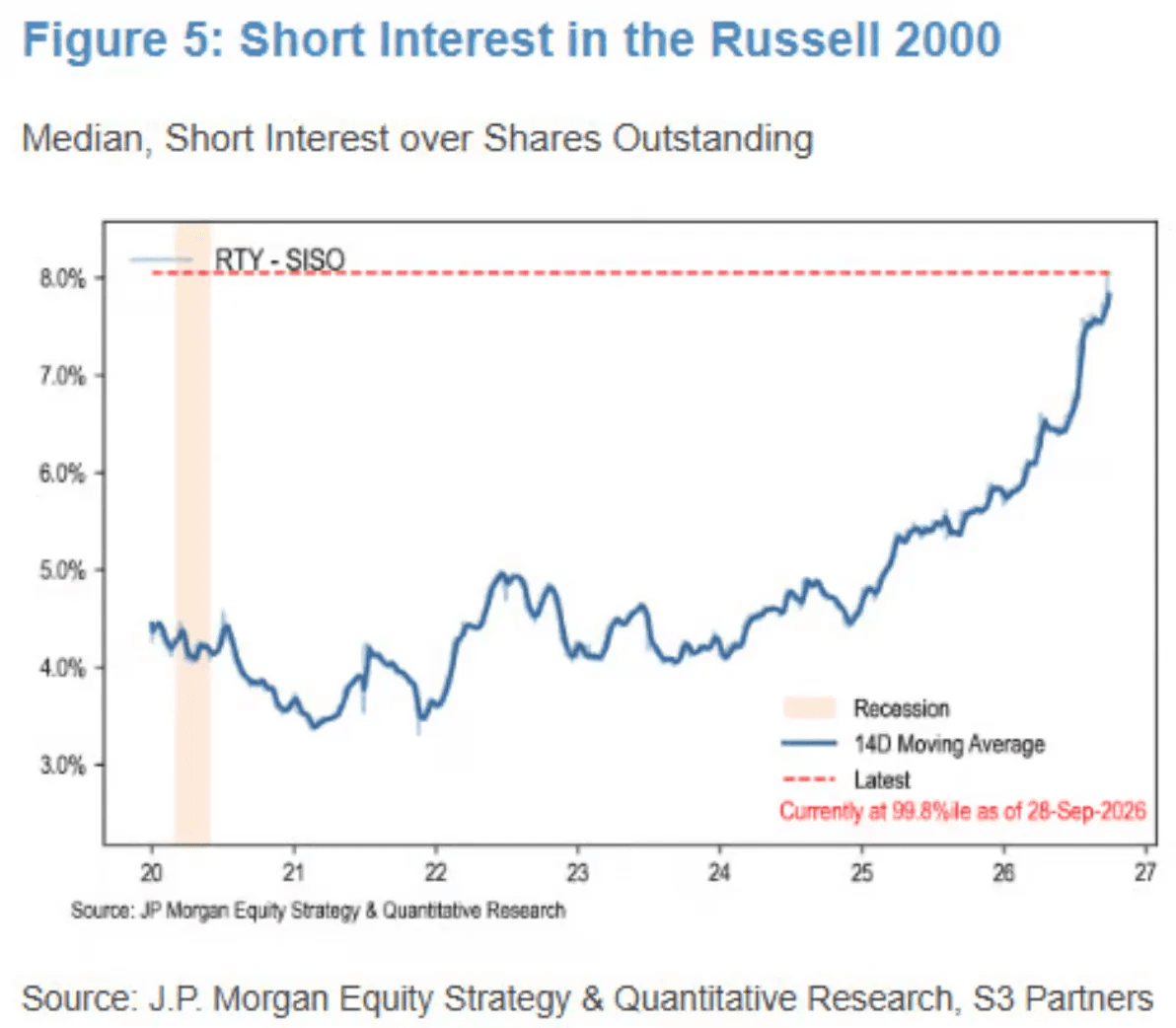
So we have a pretty unusual situation. Hedge funds, wealthy investors, and retail traders are all piling into the same handful of big tech stocks, while short interest in the Russell 2000 is near their highest levels on record. That kind of divergence typically doesn’t last forever. Either small caps have to catch up or big tech might have to go through a period of consolidation first.
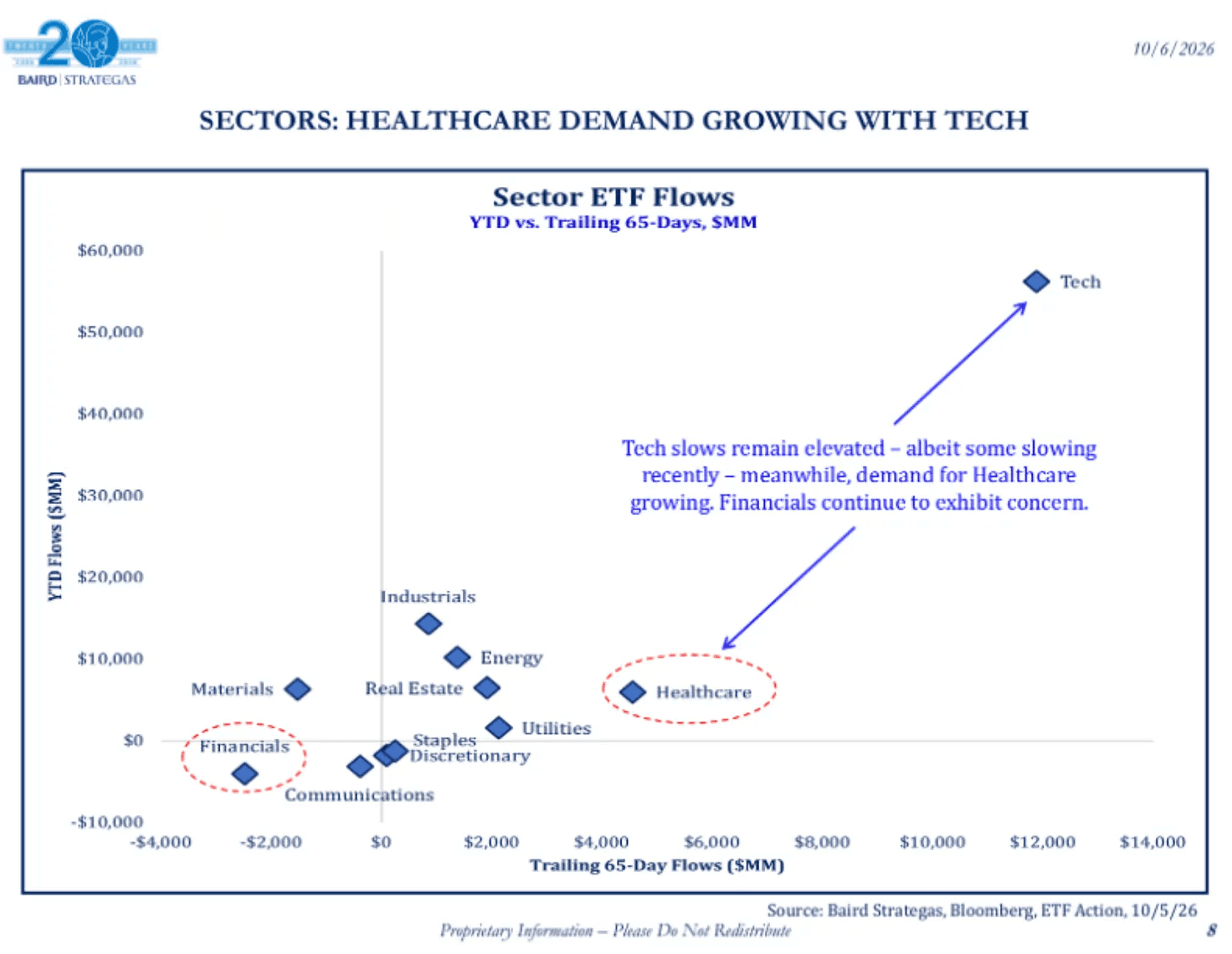
One sector that has attracted investor attention outside of big tech is healthcare.
Company executives and other insiders have been buying healthcare stocks at levels we haven't seen since 2019 and 2020.
And we all know that insiders sell shares for all kinds of reasons, but when they buy with their own money, it's usually because they believe the stock is undervalued or has room to grow. And historically, they've had a pretty good track record. When insider buying in healthcare has been this strong, the healthcare ETF XLV has gained over 15% over the following 12 months, with positive returns 97% of the time.

Hence, it’s not surprising that healthcare is the second most bought sector except tech. Over the last 65 trading days, healthcare ETFs attracted around $4.5B. So, if the market starts to recover and more stocks join the rally, healthcare could be one of the sectors leading the way.
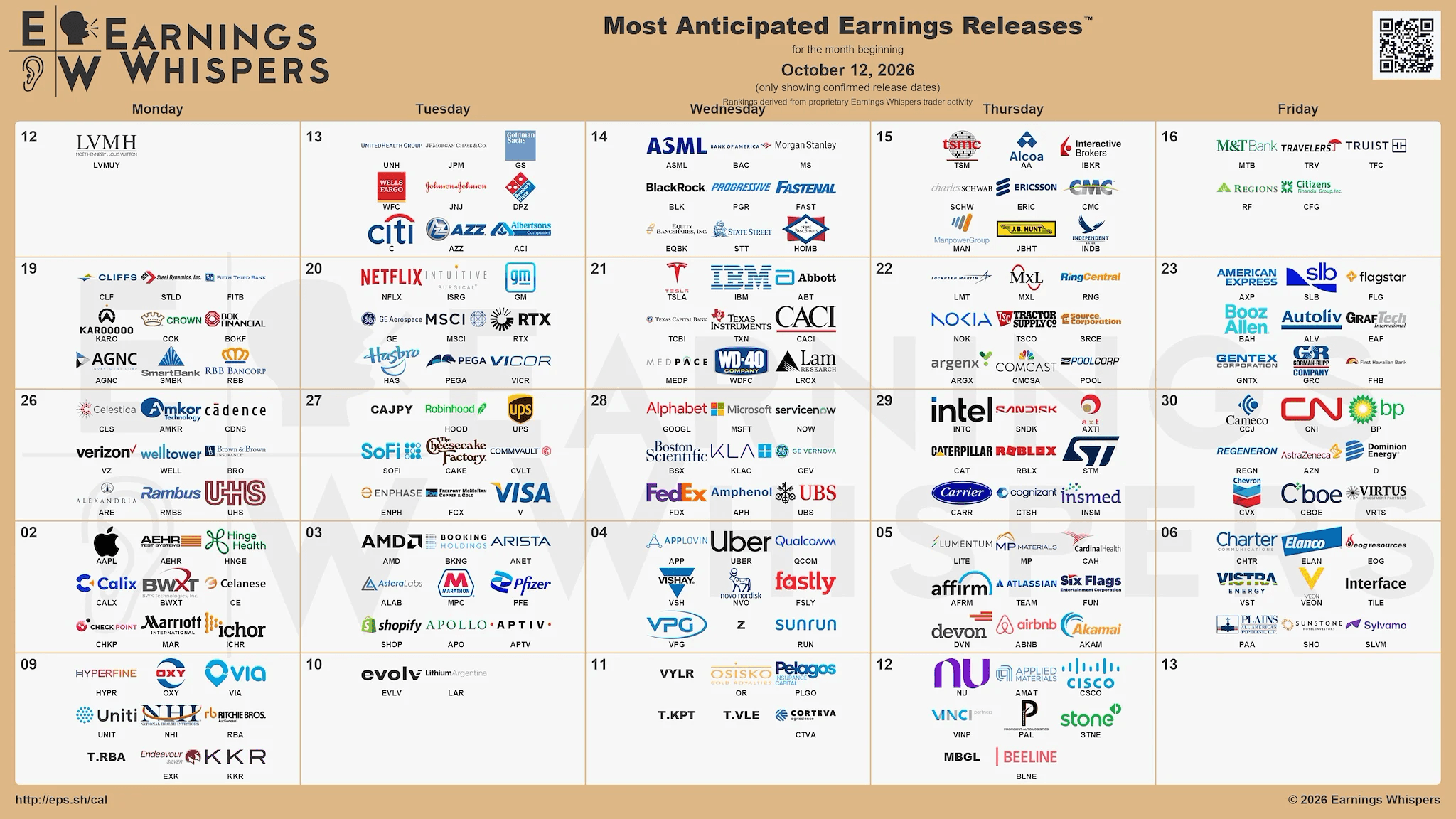
Q3 earnings season is officially getting started, with some of the biggest banks and AI companies reporting this week.
The banks will give us a good look at how the US economy and consumers are holding up. I'll be watching consumer spending, loan defaults, and whether banks are starting to see more people falling behind on payments.
If consumers are still doing well, that would be a positive sign for the broader market. We'll also get important updates on the AI trade from ASML and TSMC, giving us a better idea of how strong demand for AI infrastructure really is.
But this week is just the beginning. Around 7% of the S&P 500 by market cap is expected to report, with the biggest wave coming the week of October 26, when roughly 44% is scheduled to release earnings.
Overall, this wasn't a bad week for the market. The S&P 500 and Nasdaq both closed at new all-time highs, so it's hard to be too negative.
But there are definitely some warning signs worth paying attention to.
The weakness we saw on Thursday, especially in AI and semiconductor stocks, is something worth watching closely. These stocks have been driving most of the market's gains, so any weakness in this group will affect the general market. I still think the market overreacted to the OpenAI headlines, but ultimately, price matters more than opinions. But if the Nasdaq and semiconductor stocks continue to weaken and market leaders start breaking down, it might be time to become more cautious at least temporarily.
The market has been difficult to trade lately, and there's no reason to force trades when opportunities aren't particularly attractive. With earnings season getting started, the next few weeks will be especially important.
So, I think it's best to stay positive but remain flexible as market conditions change. Be ready to get more aggressive when opportunities improve and more defensive when the market starts showing signs of weakness.
Read More
Lin
Weekly Market Update: Big Tech Divergence
Sentiment around AI continues to get worse.
The Financial Times reported that OpenAI's annualized revenue was approaching $50B, well below the $70B figure previously circulating. The market took this as a major disappointment, triggering a sell-off across AI stocks.
But the difference largely comes down to accounting. Anthropic includes revenue generated through cloud partners, while OpenAI reports those sales differently. Investors had adjusted OpenAI's numbers to make the 2 companies more comparable.
What’s more interesting is how the market reacted. When sentiment around AI was strong, almost every headline was treated as good news. Now, even the smallest bit of uncertainty is enough to trigger a sell-off. This tells you a lot about the current state of the market for tech and AI.
The broader market isn't making things easier either. Despite major indexes hitting record highs, relatively few stocks are doing well. In an environment like this, simply protecting your capital, holding your ground, and wait until the window of opportunity opens up is critical.
The weakness in the broader market has been there since August.
Pretty much every measure of market breadth has been getting worse. Whether you look at the advance-decline line, the equal-weight S&P 500, or the percentage of stocks above their 200-day moving average, they all peaked in August and have been declining since.
The percentage of S&P 500 stocks above their 200-day moving average has dropped from around 75% to the mid-40s.
Fewer and fewer stocks are actually doing well. The main exception is the Mag 7, which are pretty much the only thing holding up the market right now.
Hence, it’s not surprising that the MAGS ETF, which invests exclusively in the Magnificent 7, had its biggest month of inflows ever. More and more money continues to flow into a small group of stocks, while most of the market is struggling.
The bigger the stock, the better it performed.
The 20 largest stocks are up almost 7%, the top 100 are up 4.5%, and the full S&P 500 is up less than 3% over the last 3 months.
On the other hand, the equal-weight S&P 500 is down 2%, mid caps are down 3.6%, and small caps are down 5.6%.
The smaller the stocks, the worse they've performed.
You can see the same weakness when comparing tech stocks with the rest of the market.
For most of this bull market, tech and the rest of the S&P 500 moved in the same direction. That's no longer the case.
The 2-month correlation between them has dropped to -0.70, the lowest level since the bull market started in October 2022.
In simple terms, tech stocks and the rest of the market used to move together. Now, they tend to move in opposite directions.
It's not just tech moving differently from the rest of the market. Other sectors are also starting to move independently of the S&P 500.
Over the last 3 months, the correlation between the S&P 500 and sectors like Consumer Staples, Energy, Utilities, and Health Care has dropped to around zero or even turned negative. Consumer Staples and Energy have reached their lowest correlation levels in 20 years.
On top of that there is a ton of volatility hidden behind the index.
Over the past month, the S&P 500 has barely moved. It’s up just 0.8%. But the average stock inside the index has moved 8.9% in either direction.
Just look at some of the individual stocks. AMD is up almost 40%, Meta has gained 22%, while Netflix is down 18%. Bank of America, Goldman Sachs, and McDonald's have all fallen by more than 10%.
So we're seeing some pretty big moves in both directions, but they're largely canceling each other out.
So we have a pretty unusual situation. Hedge funds, wealthy investors, and retail traders are all piling into the same handful of big tech stocks, while short interest in the Russell 2000 is near their highest levels on record. That kind of divergence typically doesn’t last forever. Either small caps have to catch up or big tech might have to go through a period of consolidation first.
One sector that has attracted investor attention outside of big tech is healthcare.
Company executives and other insiders have been buying healthcare stocks at levels we haven't seen since 2019 and 2020.
And we all know that insiders sell shares for all kinds of reasons, but when they buy with their own money, it's usually because they believe the stock is undervalued or has room to grow. And historically, they've had a pretty good track record. When insider buying in healthcare has been this strong, the healthcare ETF XLV has gained over 15% over the following 12 months, with positive returns 97% of the time.
Hence, it’s not surprising that healthcare is the second most bought sector except tech. Over the last 65 trading days, healthcare ETFs attracted around $4.5B. So, if the market starts to recover and more stocks join the rally, healthcare could be one of the sectors leading the way.
Q3 earnings season is officially getting started, with some of the biggest banks and AI companies reporting this week.
The banks will give us a good look at how the US economy and consumers are holding up. I'll be watching consumer spending, loan defaults, and whether banks are starting to see more people falling behind on payments.
If consumers are still doing well, that would be a positive sign for the broader market. We'll also get important updates on the AI trade from ASML and TSMC, giving us a better idea of how strong demand for AI infrastructure really is.
But this week is just the beginning. Around 7% of the S&P 500 by market cap is expected to report, with the biggest wave coming the week of October 26, when roughly 44% is scheduled to release earnings.
Overall, this wasn't a bad week for the market. The S&P 500 and Nasdaq both closed at new all-time highs, so it's hard to be too negative.
But there are definitely some warning signs worth paying attention to.
The weakness we saw on Thursday, especially in AI and semiconductor stocks, is something worth watching closely. These stocks have been driving most of the market's gains, so any weakness in this group will affect the general market. I still think the market overreacted to the OpenAI headlines, but ultimately, price matters more than opinions. But if the Nasdaq and semiconductor stocks continue to weaken and market leaders start breaking down, it might be time to become more cautious at least temporarily.
The market has been difficult to trade lately, and there's no reason to force trades when opportunities aren't particularly attractive. With earnings season getting started, the next few weeks will be especially important.
So, I think it's best to stay positive but remain flexible as market conditions change. Be ready to get more aggressive when opportunities improve and more defensive when the market starts showing signs of weakness.
Read More
Exposure Level
Guidance:
Neutral
0%
100%
Trend Indicator
Long-Term:
Up
Intermediate-Term:
Sideways
Short-Term:
Down
Risk Indicators
Volatility:
High
Sentiment:
Neutral
Momentum:
Neutral
Leading Sectors
View All
Biotech
AI Health
Software
Cybersecurity
Energy
The Fullstack Investor Handbook
BASICS
5 Steps to Improve Your Investing Strategy
The Fullstack Investor Handbook
BASICS
5 Steps to Improve Your Investing Strategy