Go Back

Lin
Market Update: The Next Generation of AI Infrastructure
One of the best businesses of the internet era was the hyperscalers.
Companies stopped buying and operating their own servers. Instead, they rented compute, storage, databases, and networking from AWS, Microsoft Azure, and Google Cloud.
That created a powerful flywheel. More customers meant more scale. More scale lowered costs. Lower costs funded better infrastructure and more software services. Better services attracted even more customers.
But what is a hyperscaler, really?
At its core, it is a giant pool of compute, networking, and storage with a software layer that makes all of that infrastructure easy to consume.
Until today, that model solved 2 problems.
The first was financial. Instead of every company buying servers, building data centers, and carrying that infrastructure on its own balance sheet, hyperscalers could spread those costs across thousands of customers and sell computing capacity as an operating expense. Basically, compute as a service.
The second was operational. AWS, Azure, Google Cloud, you name it, built software that hid most of the underlying complexity. Customers did not need to think about servers, storage systems, networking hardware, or utilization rates. They could simply request resources and let the cloud handle the rest.
This turned out to be a very attractive business. Hyperscalers could buy hardware at enormous scale, finance infrastructure cheaply, and use software to keep those assets busy across many customers. The result was operating margins of about 40%.
Now, AI has changed the shape of that business or at least part of it.
The cloud was built around flexible, multi-tenant infrastructure. AI training increasingly depends on large clusters of accelerators working together as one coordinated system. Inference has its own set of constraints, where power efficiency, networking, memory, and latency matter more than simply maximizing how many virtual machines fit onto a server.
The operating goal started moving from maximizing utilization across many customers toward maximizing the performance of a specific workload. Even though that sounds like a small distinction, it completely changes how data centers are built.
During large training runs, thousands of GPUs may need to operate in sync. A slow server, network bottleneck, or storage issue will reduce the performance of the entire cluster.
Power is another major bottleneck. When electricity and available grid capacity become scarce, the economics increasingly depend on how much useful compute can be produced from every megawatt. Suddenly, maximizing tokens per watt has become the main goal.
And so far, the hyperscalers were Nvidia's largest customers. But they also had strong incentives to reduce their dependence on Nvidia over time. Nvidia earns very high margins on accelerators. A cloud provider would naturally prefer to replace some of those chips with its own silicon, capture more of the economics internally, and reduce the cost of providing AI compute. AWS built Trainium and Inferentia. Google had TPUs. Microsoft developed Maia.
At the same time, the large cloud companies had enormous existing businesses to protect. Their infrastructure roadmaps, procurement processes, software stacks, and internal return requirements had been built over many years.
AI companies were often asking for something different. They want clusters quickly. They want specific configurations. They want bare-metal access. They want Nvidia reference architectures with as little overhead as possible. In some cases, they were willing to use unusual sites or retrofit existing power infrastructure if it meant getting GPUs online sooner.
That opened the door for a new group of infrastructure companies. CoreWeave became the best-known example, but it was part of a broader category that eventually became known as neoclouds.

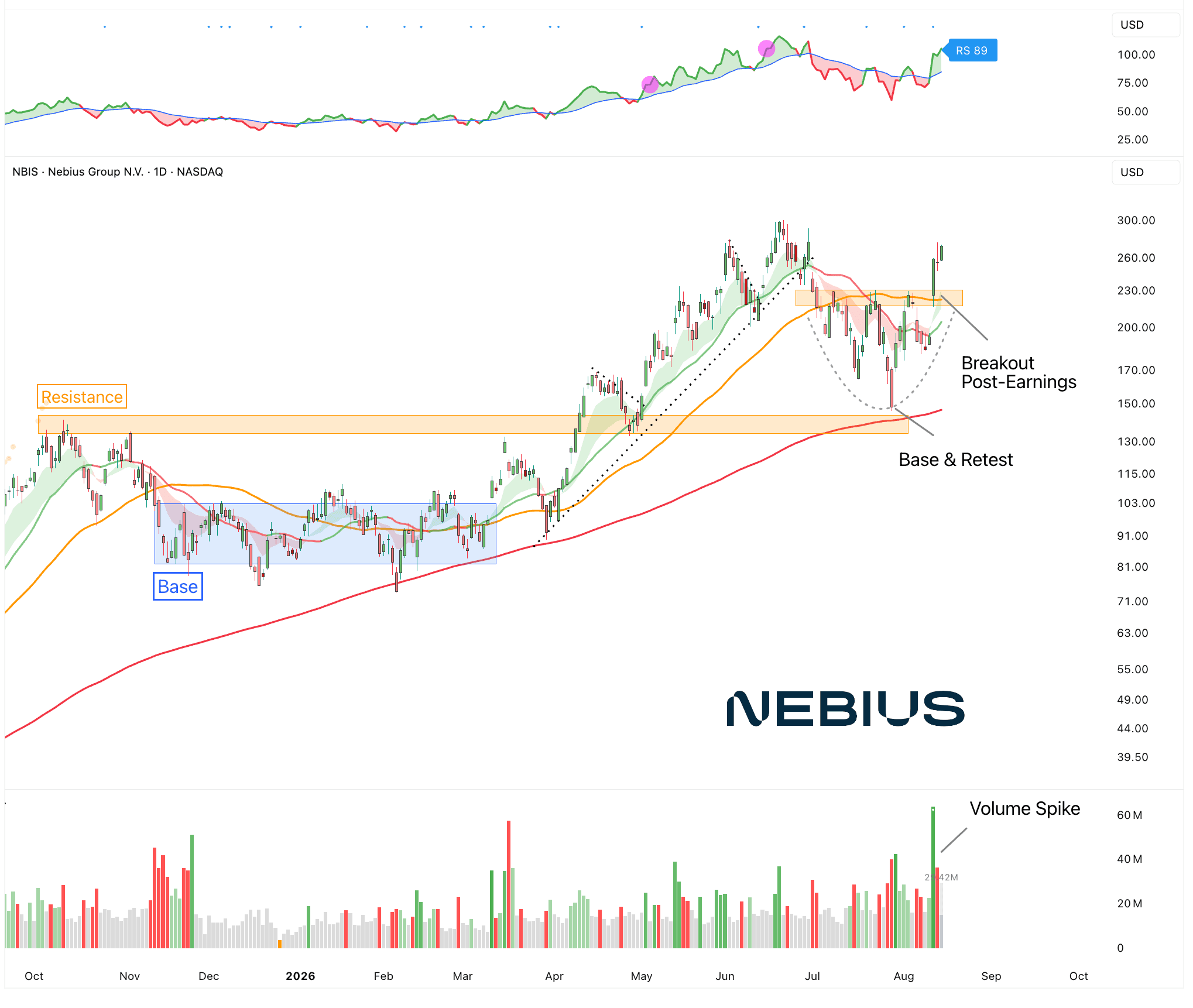
And CoreWeave is definitely not alone in this category anymore. More and more neocloud companies popping up left and right. But Nebius is the poster child right now, and rightfully so. Nebius has signed large infrastructure agreements with pretty much all the biggest names in the space. Q2 2026 revenue is up 454% yoy and reached $582.3M. Nvidia has invested over $2B and they are working together on the next generation of AI infrastructure.
The starting point of neoclouds is different from the traditional cloud. Rather than building a broad platform for databases, business applications, storage, analytics, and general-purpose computing, they focused heavily on accelerated computing. Their customers were AI labs, model developers, and companies running GPU-intensive workloads.
The software followed the hardware. These operators built systems for GPU scheduling, cluster monitoring, failure prediction, rapid hardware replacement, high-performance storage, and networking designed around large distributed AI workloads.
They also had a simpler commercial incentive.
A traditional hyperscaler wants customers to use an entire ecosystem of services. A neocloud mainly wants the customer's GPU workload. That can lead to very different decisions around architecture and pricing. It also gave Nvidia another distribution channel.
Instead of relying almost entirely on AWS, Microsoft, Google, and a handful of large enterprises to deploy its newest systems, Nvidia could work with a growing group of specialized operators that were often willing to move faster and accept lower margins.
The weakness of that model was financing.
A hyperscaler can spend billions of dollars building capacity before a customer has committed to using it. Investment-grade balance sheets and enormous cash flows make that possible.
Most neoclouds cannot do the same thing. Their lenders generally want contracted customers behind the infrastructure they finance. A GPU cluster backed by a multi-year agreement is much easier to finance than a speculative cluster that might find a customer later.
The operator that can build ahead of demand has more capacity available when shortages appear. Scarce capacity can then be rented at higher prices.
For years, the large hyperscalers had a major advantage here. That advantage is now becoming less absolute. The amount of capital required for AI infrastructure has grown so large that even the biggest technology companies are increasingly turning to leases, joint ventures, outside investors, private credit, infrastructure funds, and other forms of third-party financing.
At the same time, Nvidia has gradually expanded beyond simply supplying GPUs.
On the operating side, Nvidia now provides reference architectures for AI factories, software for managing GPU fleets, digital twins for designing facilities, and infrastructure software such as Dynamo for inference.
The company is increasingly standardizing how a modern GPU data center can be designed, built, and operated. That lowers the amount of proprietary infrastructure knowledge required from the operator.
A technically capable company with access to land, power, financing, and customers can start from an Nvidia-defined architecture instead of recreating an entire cloud infrastructure stack from scratch.
If Nvidia systems can be built around standardized reference designs, moved between operators, and used by a broad group of customers, then the hardware begins to look more financeable.
Infrastructure investors care about exactly that.
They want to know what happens if the original customer disappears. They want to know whether another customer can use the equipment, whether another operator can run it, how quickly the asset depreciates, and how predictable future cash flows may be.
The more standardized the infrastructure becomes, the easier those questions are to answer. That helps explain Nvidia's growing relationships with large pools of infrastructure capital.
CoreWeave and Nvidia were already closely linked early in the AI infrastructure cycle. BlackRock and other infrastructure investors began organizing large pools of capital around AI infrastructure. Brookfield, KKR, and others followed with increasingly large financing programs.
Now, AI infrastructure is gradually developing its own financial system.
The original hyperscaler bundled 2 capabilities under one roof: the software needed to operate infrastructure and the balance sheet needed to finance it. The AI market is beginning to unbundle those functions.
Nvidia is supplying more of the technical standardization. Specialized operators are building and running the sites. Infrastructure investors, private credit firms, and asset managers are supplying more of the capital. That structure will eventually allow AI compute capacity to expand without every operator needing the balance sheet of Microsoft or Amazon.
The more investors and operators standardize around Nvidia reference architectures, the easier Nvidia-powered capacity becomes to finance, deploy, transfer, and resell.
That creates a powerful feedback loop.
Customers want access to Nvidia systems because the software ecosystem is mature. Operators build Nvidia infrastructure because customers want it. Investors are more willing to finance it because demand is broad and the asset can potentially be redeployed. That financing makes more Nvidia infrastructure available.
Seen through that lens, Nvidia's role in AI infrastructure is becoming even more dominant.
Nvidia is still the center of the AI ecosystem. Hence, betting on Nvidia and its ecosystem is still the best bet even in the next phase of the AI infrastructure buildout.
Previous Updates
View All
- Weekly Market Update: The Best Quarter
- Weekly Market Update: Rate Hikes
- Weekly Market Update: AI is Not Slowing Down
- Market Update: Has AGI Arrived?
- Weekly Market Update: Consolidation
- Weekly Market Update: September is Here
- Market Update: Nvidia Crushes Earnings
- Weekly Market Update: Yields
- Market Update: The Future of Biotech
- Weekly Market Update: Earnings Acceleration
- Market Update: The Next Generation of AI Infrastructure
- Weekly Market Update: New Highs
- Market Update: Nvidia’s Way Around Memory