Go Back

Lin
Weekly Market Update: September is Here
The competition in AI is getting more aggressive.
OpenAI has told Cursor that access to its models will be removed from the platform over security concerns, and I expect moves like this to become more common as the major labs fight for control over distribution, developers, data, and ultimately the AI ecosystem itself. The next phase of AI competition will be about much more than who has the best model. It will increasingly be about who controls the platforms, infrastructure, and customer relationships around those models.
At the same time, the market just worked through 2 major catalysts: Nvidia earnings and Kevin Warsh’s first Jackson Hole appearance as Fed Chair. So far, both have been relative nothing burgers for the broader market. We have had Nvidia earnings, Jackson Hole, major AI developments, and yet none of it has been enough to push the indexes decisively out of their current range.
The Nasdaq has effectively gone sideways since early May, giving us nearly 4 months without a sustained directional move. There have absolutely been opportunities underneath the surface, but this has not been an easy market where you can simply buy beta and let the trend do the work. In a choppy environment, trying to trade every small move is one of the fastest ways to burn (mental) capital and overtrade.
For now, this remains a stock-picker’s market rather than a broad trending market.
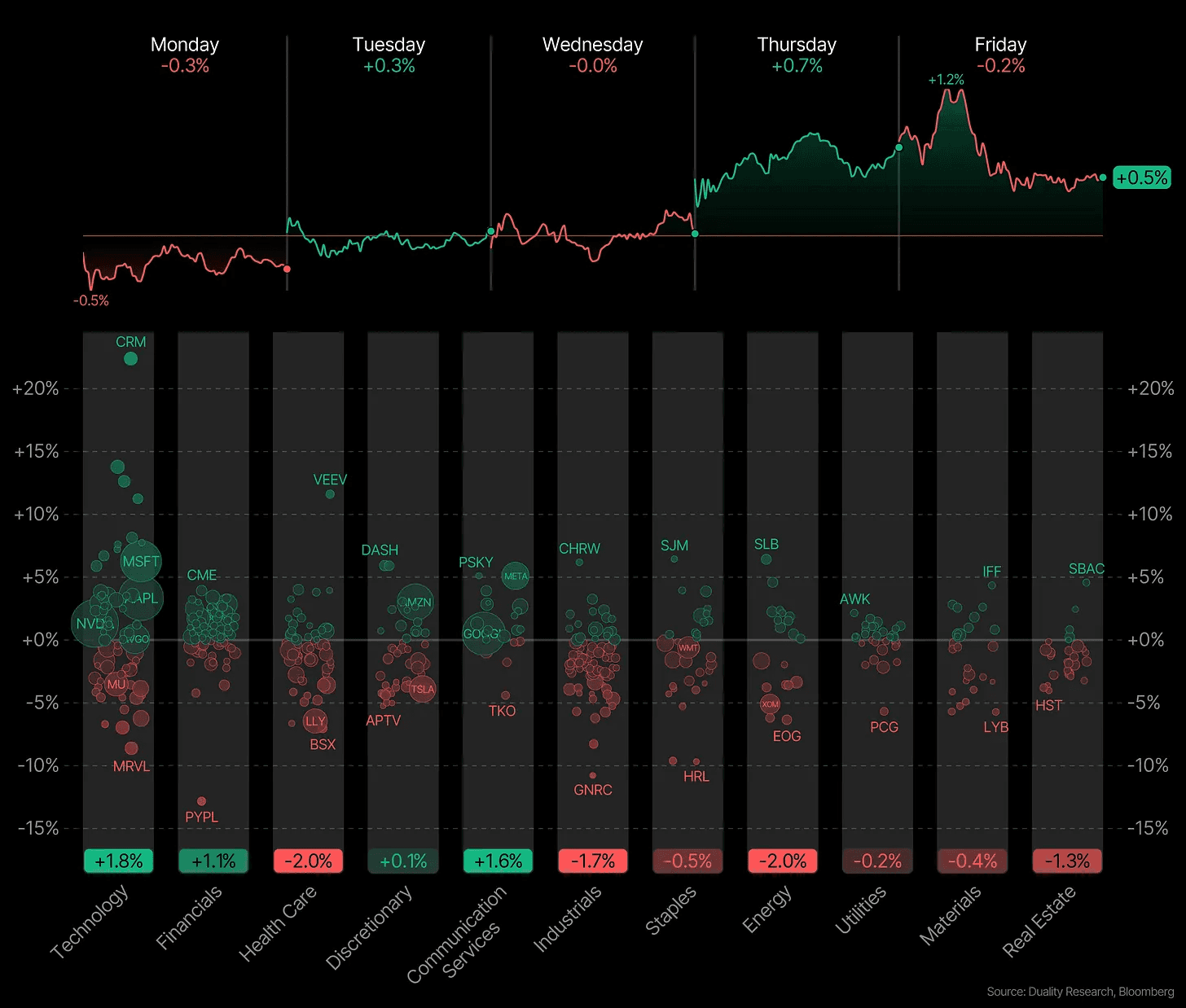
The last month of price action has been anemic. There is almost no sustained momentum in either direction, and from an index perspective, there simply has not been much to talk about.
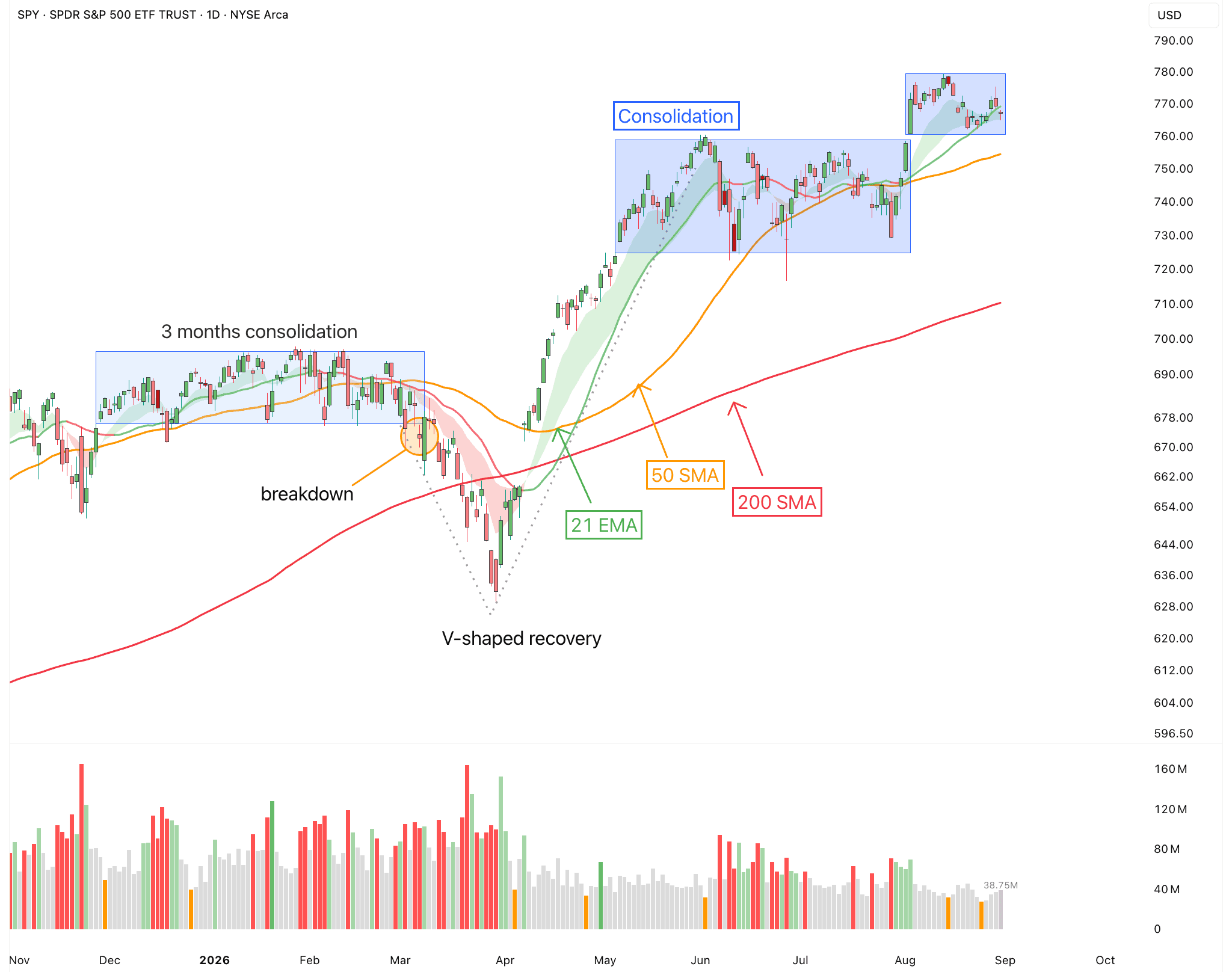
The S&P 5ßß broke out of the multi-month consolidation that ran from early May through late July, but the breakout has produced very little follow-through. Normally, after spending several months building a base, you want to see price expand quickly after the breakout. Instead, the index has mostly drifted sideways near the highs. This is still positive but not enough conviction to turn it into a meaningful momentum move, at least not yet.
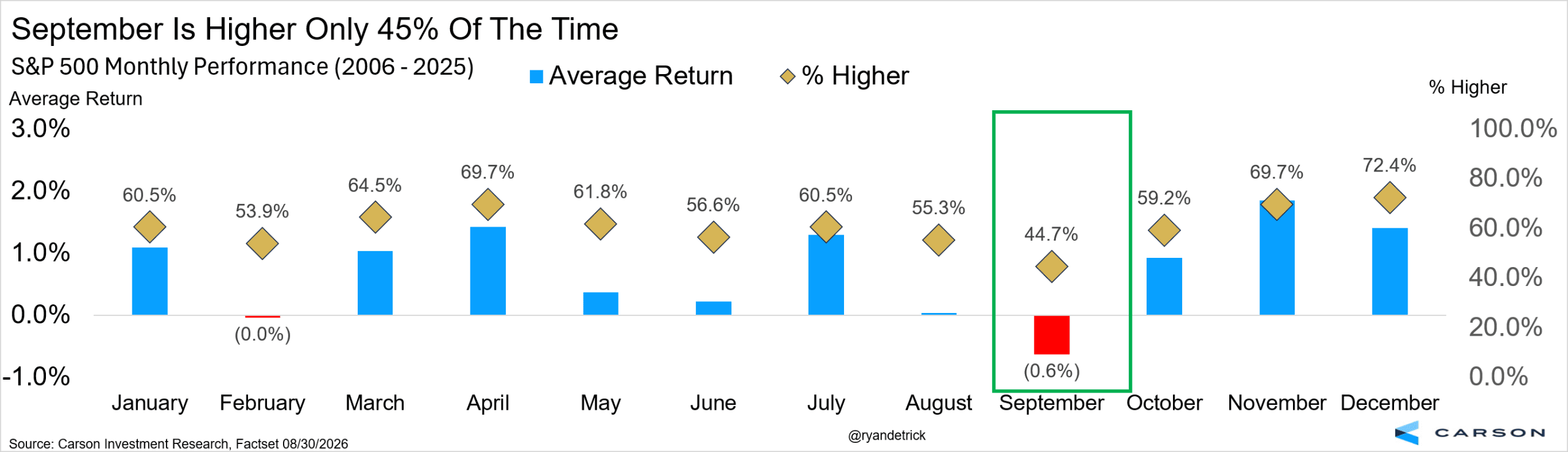
September is here.
Historically, September has been the weakest month of the year for the S&P 500, with an average decline of 0.8% since 2006. Of course, is not a prediction but serves a general guide and it’s important to treat it with enough context.
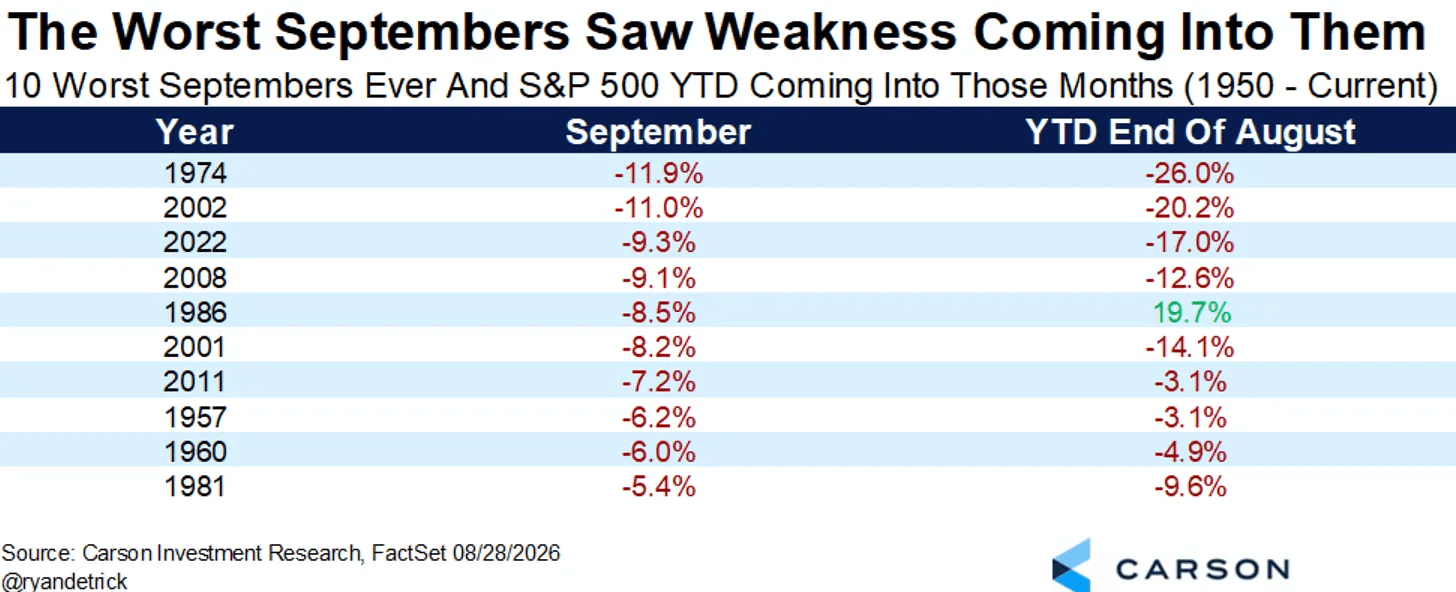
The worst Septembers historically have usually started from a much weaker market. 9 of the 10 worst Septembers on record came when the S&P 500 was already negative for the year heading into the month. That is very different from what we have today.
The S&P enters September up roughly 12% YTD, sitting close to record highs and comfortably above its 200-day moving average. Historically, September outcomes have been considerably better when the market enters the month with a positive performance rather than already being under pressure. Strong markets tend to stay strong until the data gives you a reason to think otherwise.
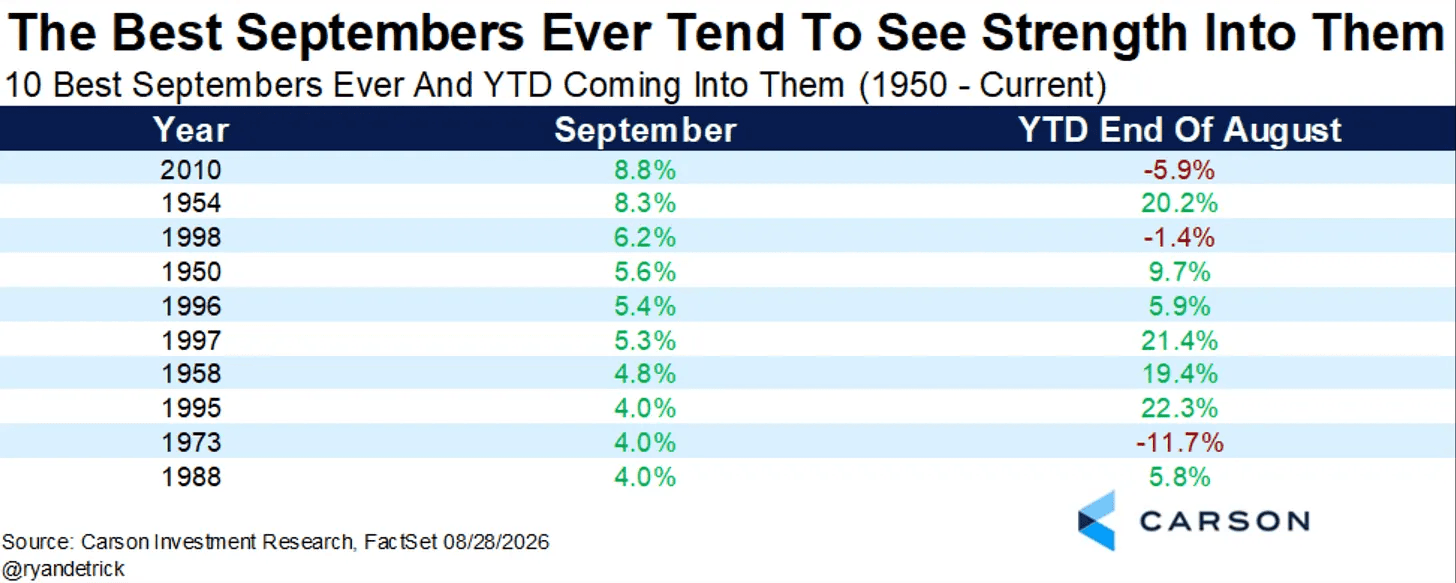
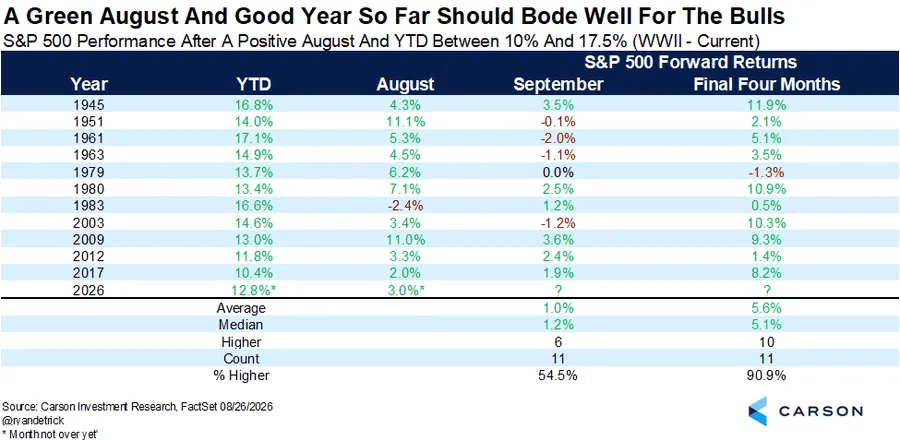
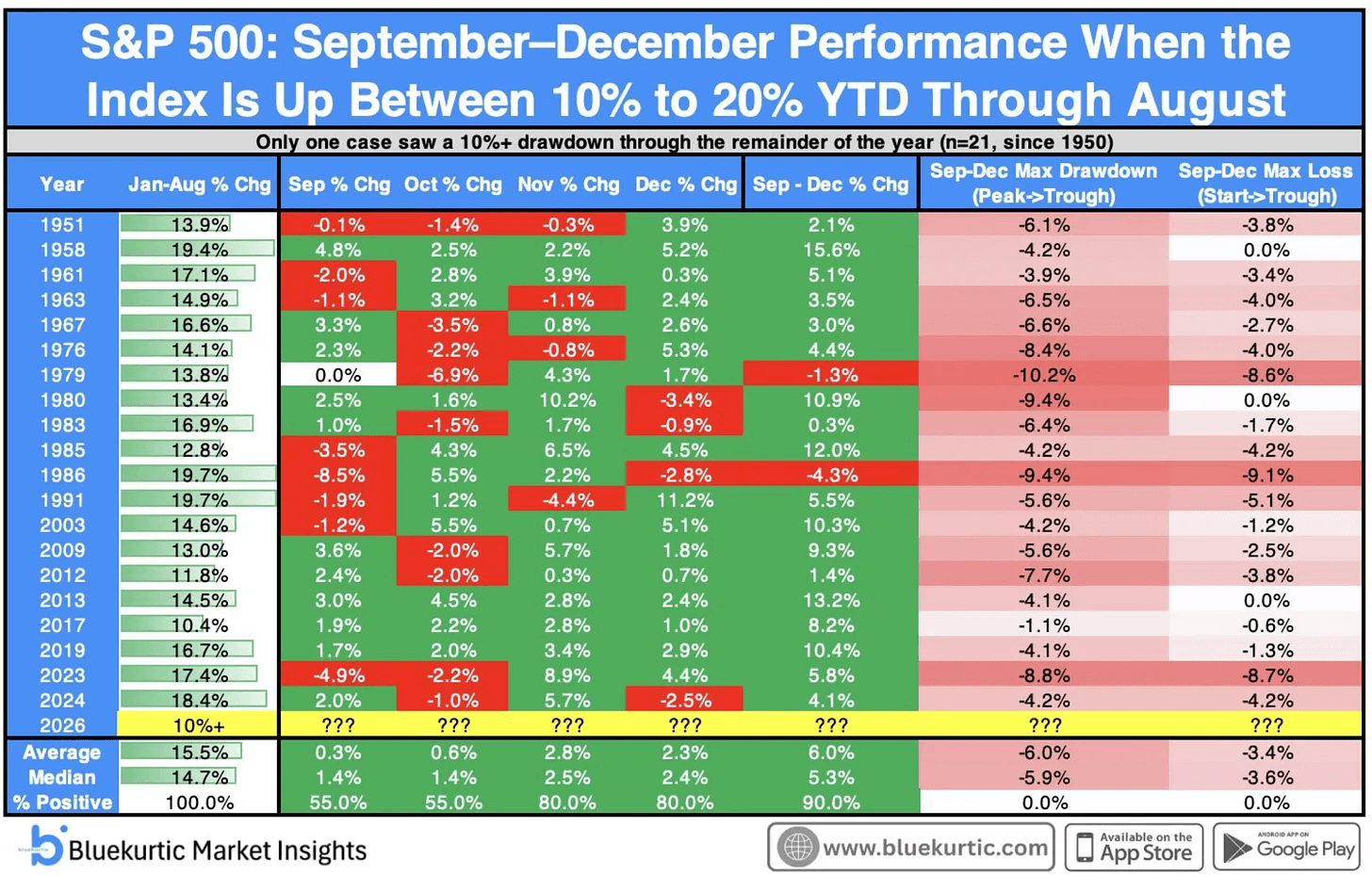
We’re set to close out August with the S&P already up double digits YTD, and historically that has been a very positive sign for the market going-forward.
Since 1950, there have only been 20 years where the S&P entered September with a double-digit YTD gain. In just 1 of those 20 years did the market suffer a double-digit drawdown during the rest of the year.
So yeah, September can still be volatile. We could easily get a 3%, 5%, or even larger pullback along the way. But for now September does not look as bad as many might think.
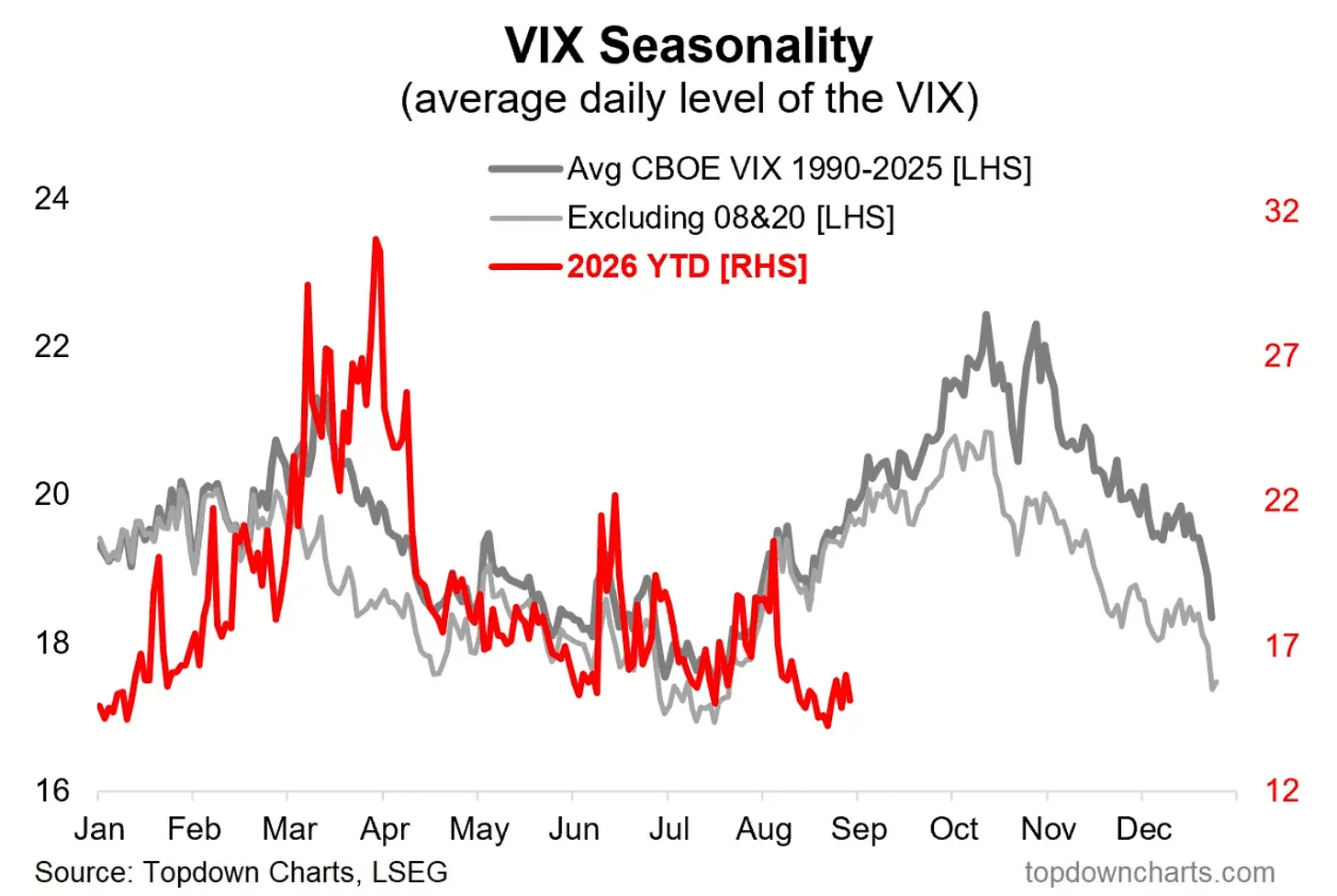
The S&P 500 has now gone 22 straight trading days without falling 1% or more. At the same time, the VIX has stayed at or below 16 for 18 straight days. On Friday, it closed around 14.4, its second-lowest level since December 2025 and about 20% below its 1-year average.
The market is surprisingly calm. That can become a risk by itself. The 12 to 14 range has historically been near the bottom for the VIX. When volatility stays this low for too long, fewer people hedge, dips feel harmless, and everyone starts expecting the market to keep moving higher. The problem comes when something suddenly changes. Investors rush to hedge at the same time causing volatility to rise suddenly and turning seemingly small moves into much bigger ones.
And we are now entering a time of year when volatility has historically started to rise.
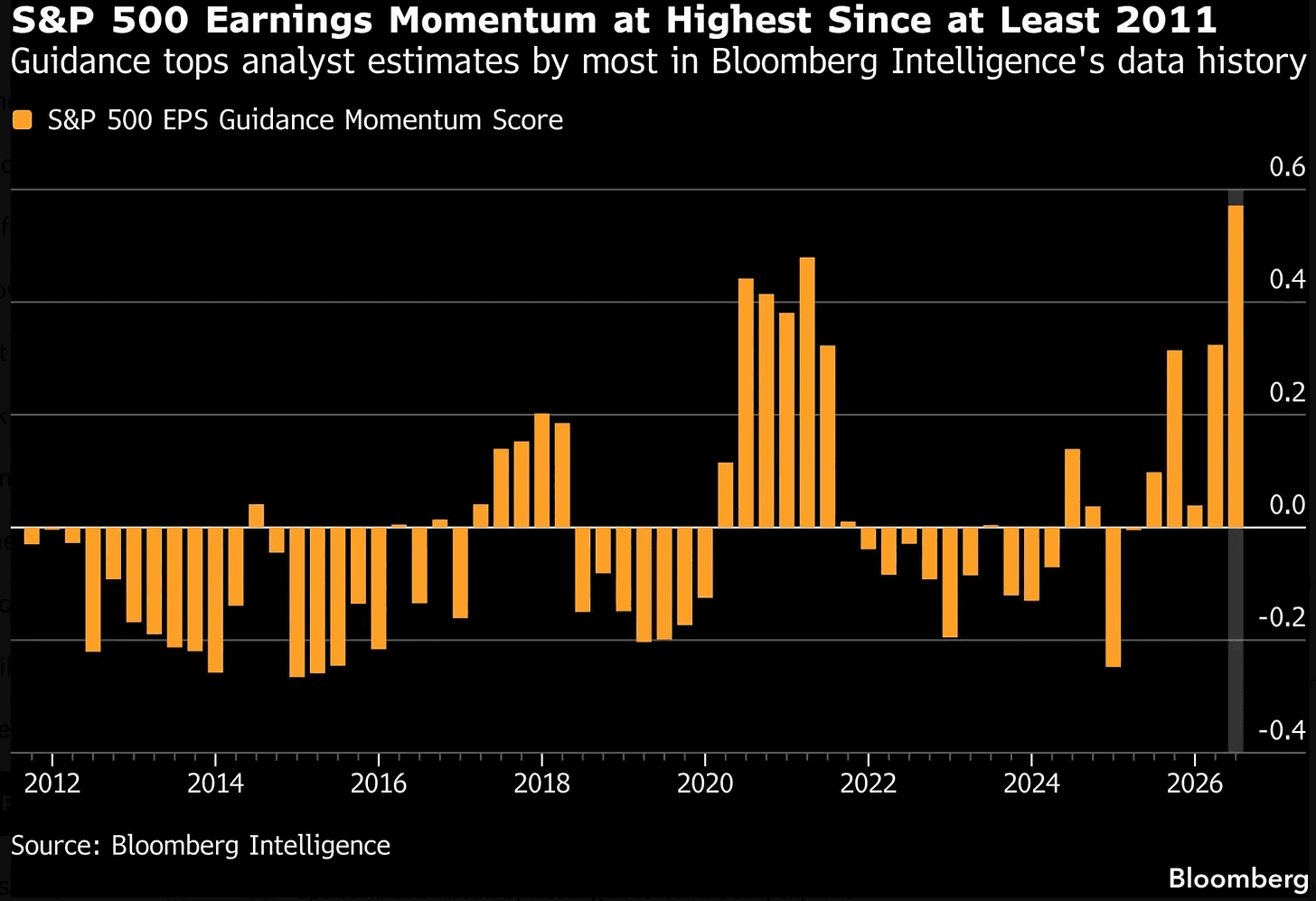
earnings right now are not just strong. They are historically strong.
S&P 500 EPS guidance momentum has climbed to its highest level since Bloomberg Intelligence began tracking the data in 2011. It is the highest reading on record.
Companies are raising expectations faster than they are cutting them. We’re in an environment where earnings estimates are moving higher and fundamentals are giving investors very little reason to question the broader bull case. That is exactly what you want to see in a healthy bull market.
At some point, expectations can become so strong that simply beating estimates is no longer enough. Companies then need to beat by a wide margin, raise guidance, and show that growth is still accelerating. The higher expectations move, the smaller the margin for error becomes.
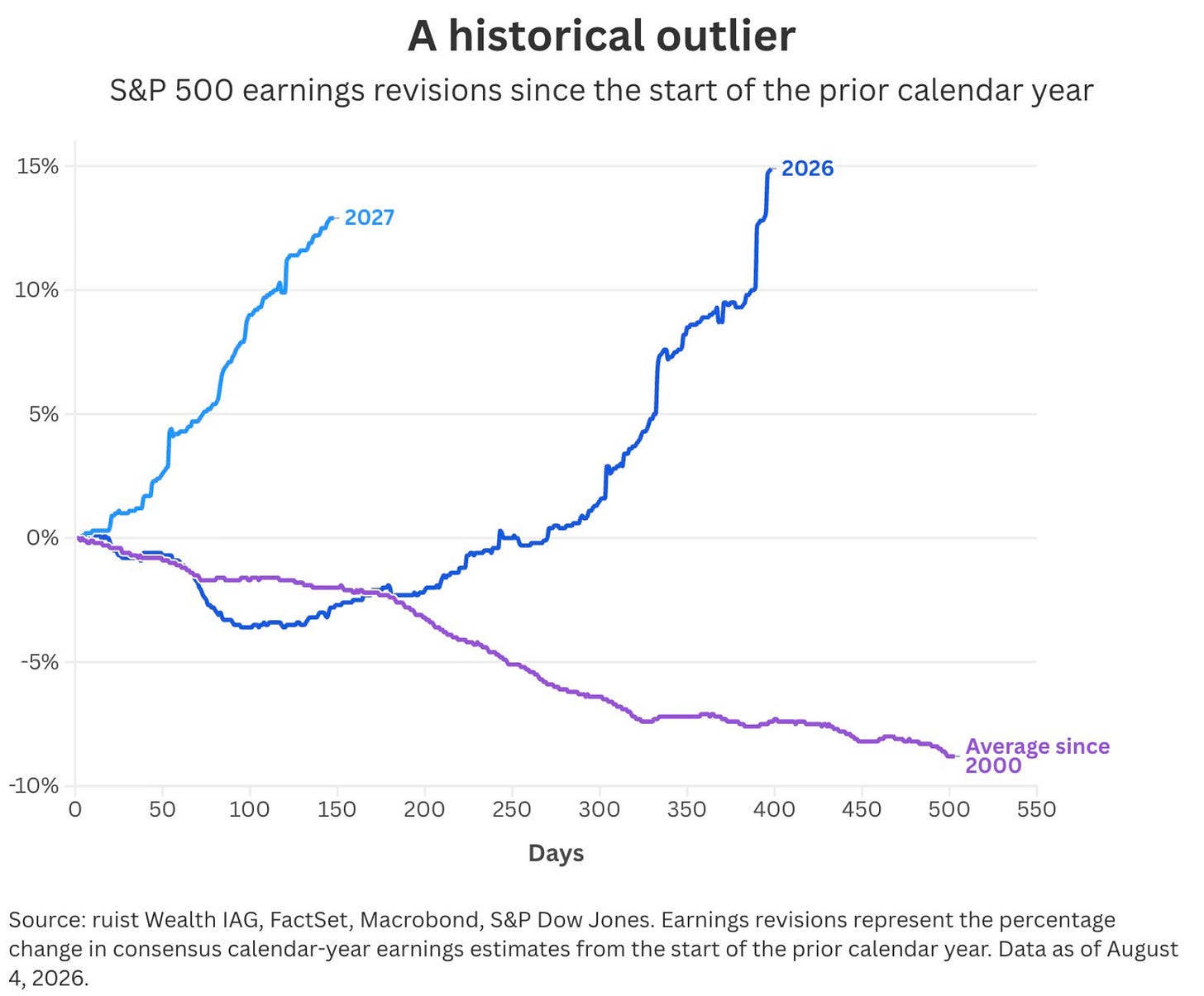
We are not there yet. Right now, earnings revisions are still moving in the right direction, and that remains one of the strongest arguments for staying constructive on the market.
e’rebeOf the 465 S&P 500 companies that have reported Q2 results, 69% beat revenue expectations. Among companies issuing Q3 guidance, 64% came in above consensus, the highest share since the post-COVID recovery period. W now looking for roughly 27% adjusted earnings growth in 2026, which would among the strongest fundamental backdrops in more than 50 years. And I do not see anything in the near term that looks strong enough to derail it.
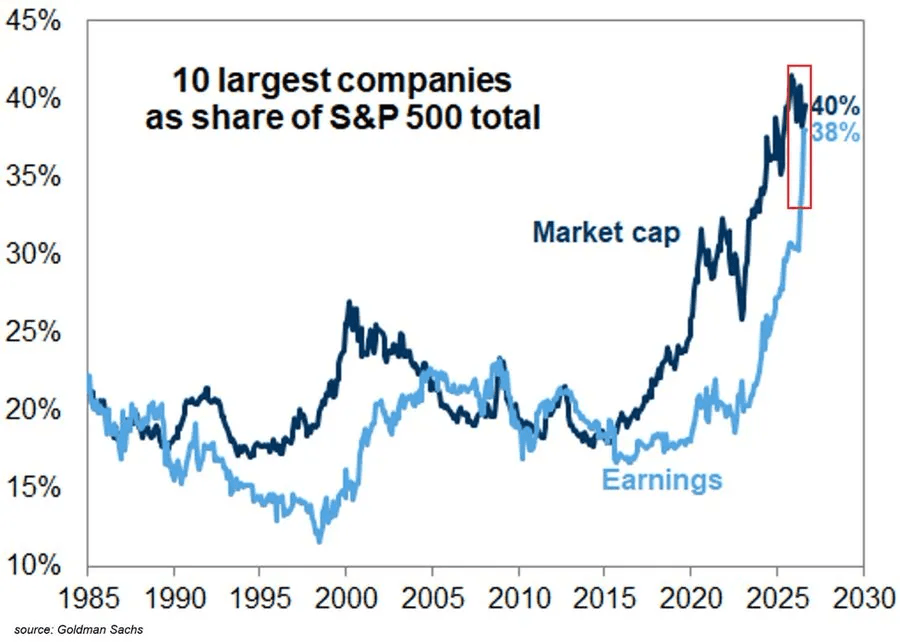
Earnings are justifying this massive move higher in concentration. The top companies in the world are earning more than they ever have before.
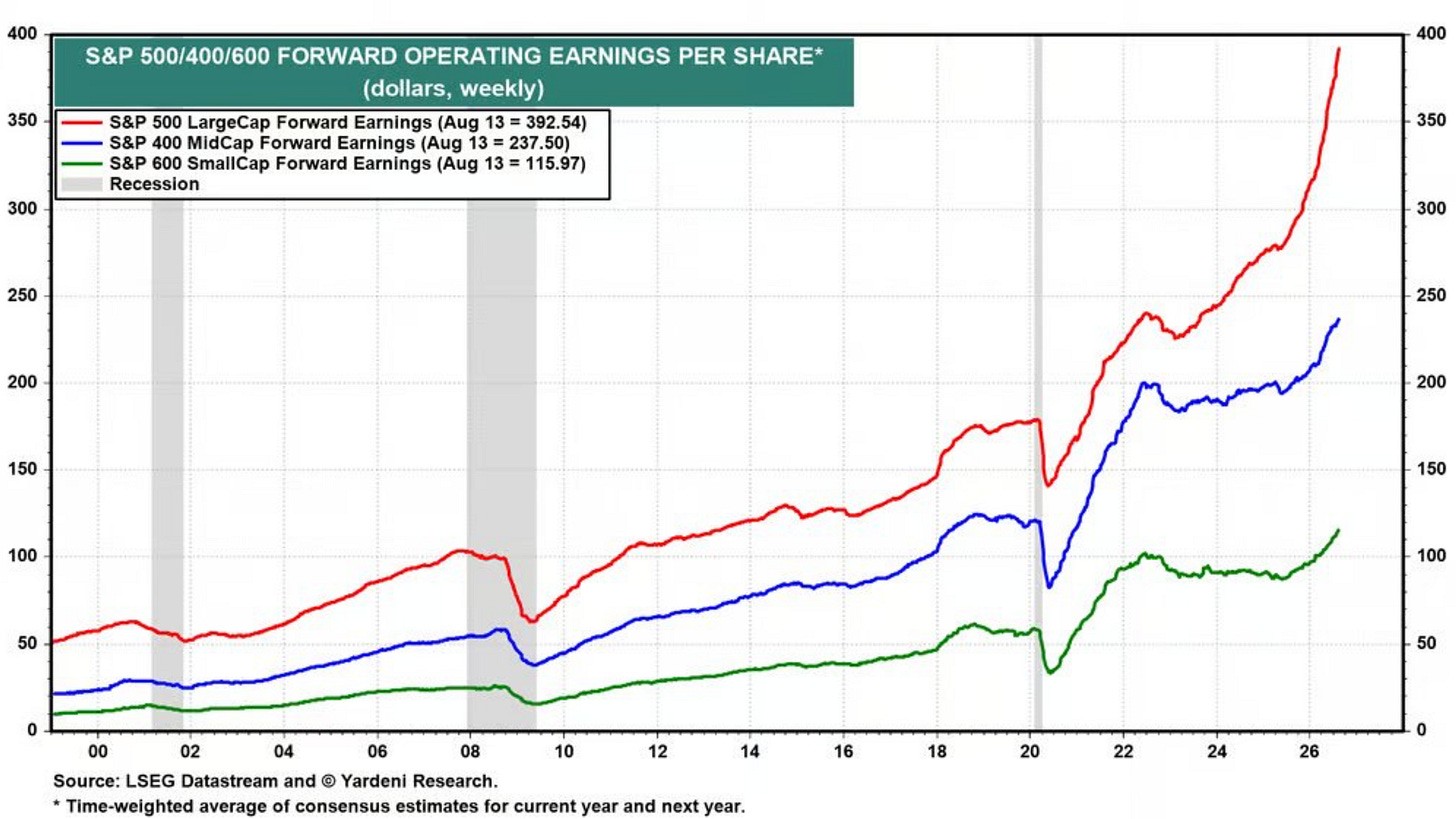
But it’s not just the largest companies in the world. Earnings are rising across large caps, mid caps, and small caps at the same time.
Small and mid caps are still dealing with tighter financial conditions and higher sensitivity to rates, so seeing their earnings move higher alongside large caps is especially important. So, it is likely that fundamentals is spreading beyond the biggest AI and technology names.
The bigger picture still looks healthy, but this remains a difficult trading environment.
The major indexes have not broken down. S&P 500 is still near its highs, and the Nasdaq continues to hold its key moving averages. That’s is still positive. The problem is underneath the surface momentum has faded, there is little volume, and large parts of the market is still moving sideways.
Right now we are seeing rotation rather than broad deterioration.
Semiconductors and many of the former AI infrastructure leaders have weakened, but that capital has not disappeared. It has rotated into software, cybersecurity, fintech, biotech, crypto-related names, and a few other pockets of strength. That rotation has kept the major indexes supported and prevented weakness in the crowded AI trade from developing into a much broader correction.
Semiconductors remain the biggest technical concern. The SOXX semiconductor index continues to make lower highs and its structure is clearly weaker than the broader market. There is no reason to be concentrated there while relative strength is deteriorating. Leadership changes, and there is no reason to keep forcing exposure into the groups that led the previous move simply because they worked before.
In fact, some of the most interesting opportunities are starting to appear elsewhere. New groups begin to strengthen, new relative-strength leaders emerge, and individual stocks start separating themselves even while the broader market remains stuck. That is roughly where we are now.
For now, patience matters more than activity.
There are periods when you should press the gas and periods when preserving capital matters more. For weeks, I have been arguing that this is not the environment to aggressively increase exposure, and my trading activity reflects that. I would rather avoid burning mental and financial capital trading a sideways market and have both available when momentum returns.
The main macro catalysts I am watching are a resolution or meaningful de-escalation in the Iran conflict, lower oil prices, and lower Treasury yields. Any combination of those could remove pressure from financial conditions and help restart risk appetite.
But the most important signal remains earnings.
This is the one thing investors can track quarter after quarter without needing to predict every geopolitical headline or short-term market move. Watch actual earnings growth. Watch forward estimates. Watch revisions. As long as corporate earnings continue rising and analysts are not meaningfully cutting future estimates, the fundamental foundation of the bull market remains intact.
The walls of worry will always be there. There will be another geopolitical scare, another political headline, another inflation concern, another reason to sell. That is normal. Bull markets rarely move higher in a straight line with everyone feeling comfortable.
So I am still bullish, just less aggressive.
Previous Updates
View All
- Weekly Market Update: Big Tech Divergence
- Weekly Market Update: Accumulation
- Weekly Market Update: The Best Quarter
- Weekly Market Update: Rate Hikes
- Weekly Market Update: AI is Not Slowing Down
- Market Update: Has AGI Arrived?
- Weekly Market Update: Consolidation
- Weekly Market Update: September is Here
- Market Update: Nvidia Crushes Earnings
- Weekly Market Update: Yields
- Market Update: The Future of Biotech
- Weekly Market Update: Earnings Acceleration
- Market Update: The Next Generation of AI Infrastructure