Go Back

Lin
Market Update: Nvidia’s Way Around Memory
The memory crunch is so severe that Nvidia is planning several versions of its next-generation Rubin Ultra GPU with much less memory than originally planned. Simply because there is not enough supply of advanced HBM.
When Nvidia first introduced Rubin Ultra, Nvidia said each GPU would come with as much as 1TB of HBM4E spread across 16 memory stacks. Some of the versions now being tested reportedly have only 192GB or 256GB, and some even use the older HBM4 standard instead of HBM4E. For comparison, Nvidia’s current Vera Rubin GPU comes with up to 288GB of HBM4.
HBM sits directly next to the GPU and gives it extremely fast access to the data needed to train and run AI models. The more memory a GPU has, the larger the models and workloads it can handle locally without constantly moving data between chips.
So if Rubin Ultra ships with less memory, customers running very large models could need more GPUs to handle the same workload.
Nvidia may be able to offset some of that through the rest of the system. Faster networking, better memory management, and spreading a model across more GPUs can reduce the impact of having less memory on each individual chip. Nvidia sells mostly entire AI systems rather than standalone GPUs, so system-level performance matter more than the specification of a single GPU.
There is also a potential cost advantage.
HBM is one of the most expensive parts of an AI accelerator and can represent more than half of its component cost. A Rubin Ultra with 192GB or 256GB of memory could therefore be significantly cheaper than the original 1TB design while still being powerful enough for training and inference.
Reducing the amount of HBM per Rubin Ultra would allow Nvidia to stretch the available memory supply across more GPUs. Instead of using 1TB of HBM on a single accelerator, the same amount of memory could theoretically support several lower-memory GPUs.
The demand created by Nvidia GPUs has become so large that Nvidia itself may now be struggling to secure enough memory. It has been working aggressively to secure more capacity by deepening its relationship with SK Hynix, which is already one of the largest HBM suppliers in the world, while SK Hynix itself is spending tens of billions of dollars expanding production.
However, HBM production is much harder to scale because manufacturers have to stack multiple memory dies vertically, connect them with extremely dense interconnects, and use more packaging.
SK Hynix recently approved roughly $38B for 2 new fabs in South Korea. Construction of its M17 fab in Cheongju is expected to begin in February 2027, while its Y2 fab in Yongin is scheduled to start construction in July 2027. Their first cleanrooms are currently planned for 2028 and 2029. But even then that is still years away.
If Nvidia manages to redesign its AI systems around lower-memory GPUs without sacrificing too much performance, it could cut costs by a lot and turn a major industry bottleneck into an advantage. And with no meaningful HBM supply relief coming anytime soon, that may become essential if Nvidia wants to keep scaling shipments.
Using less memory per GPU would let Nvidia stretch the same HBM supply across more systems while potentially bringing down the cost of each accelerator.
If you’ve been following me for a while, you know I’ve been bullish on Nvidia for a very long time. It has now been more than 10 years since I first bought the stock. And despite how much the company has grown since then, Nvidia is currently trading at one of its lowest forward P/E multiples of the past decade.
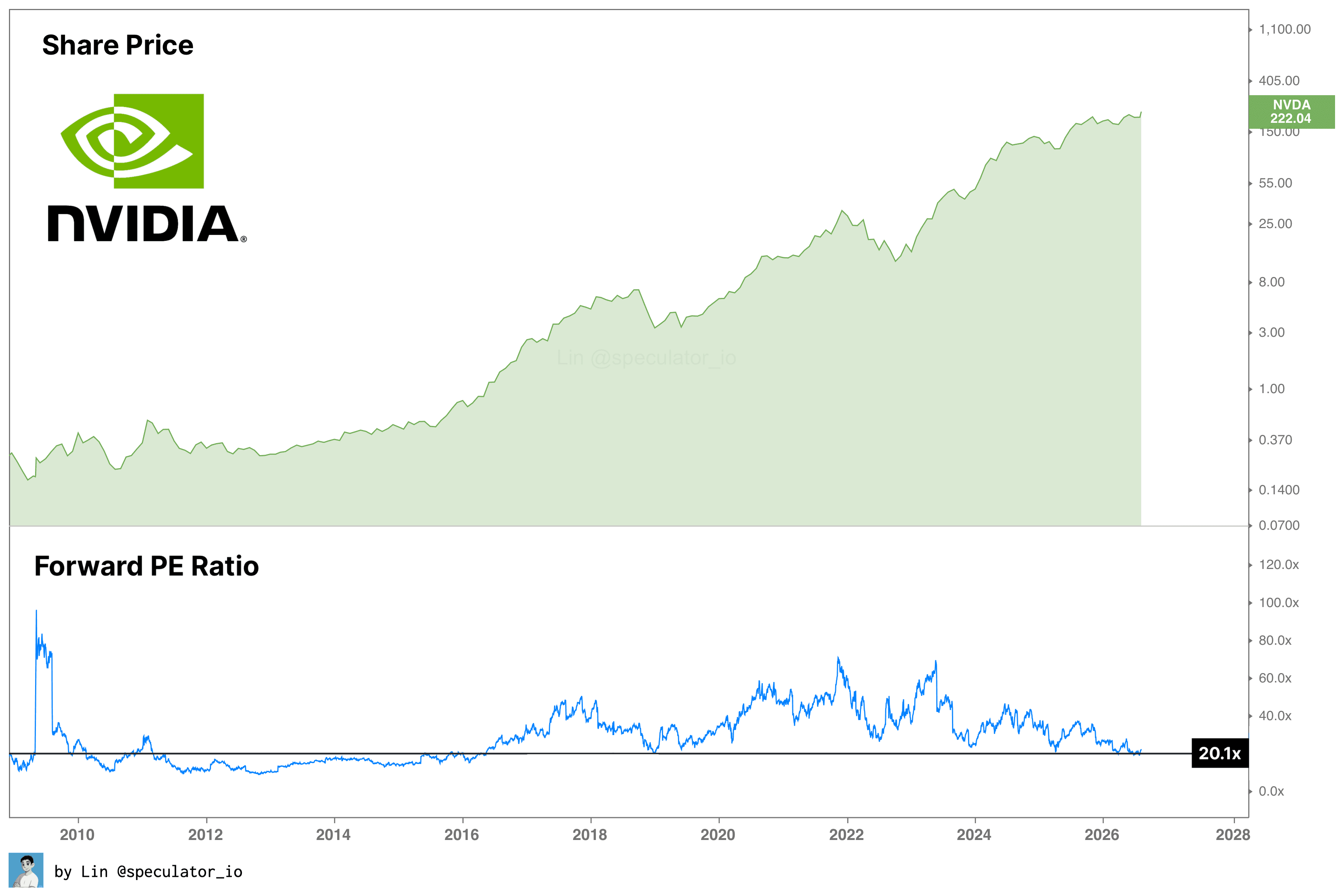
So, while revenues have gone through the roof, the stock price barely moved a year now. Its next earnings report is scheduled for the end of August. That’s still a few weeks out. But there is no reason to think that they will comfortably beat and raise again.
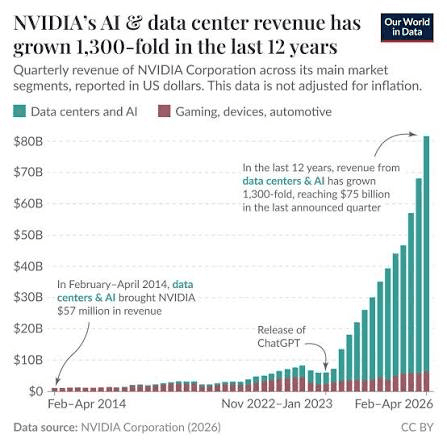
Basically Nvidia has been pretty much neglected by Wall Street for over a year now. At some point, that will change, and earnings could be the next catalyst. But right now the current setup looks very attractive. It’s built a beautiful base and just broke out. There is a good chance Nvidia starts making a run toward all-time highs going into earnings. Again Nvidia is the ultimate stock to hold for the long-term.

Previous Updates
View All
- Weekly Market Update: Rate Hikes
- Weekly Market Update: AI is Not Slowing Down
- Market Update: Has AGI Arrived?
- Weekly Market Update: Consolidation
- Weekly Market Update: September is Here
- Market Update: Nvidia Crushes Earnings
- Weekly Market Update: Yields
- Market Update: The Future of Biotech
- Weekly Market Update: Earnings Acceleration
- Market Update: The Next Generation of AI Infrastructure
- Weekly Market Update: New Highs
- Market Update: Nvidia’s Way Around Memory
- Weekly Market Update: LTCM 2.0