Go Back

Lin
Market Update: The Trajectory of AI Compute
Here’s why demand for AI compute and infrastructure is still being completely underestimated.
Anthropic’s revenue has grown roughly 10x every year since it’s founding.
• 2022: $10 million
• 2023: $100 million
• 2024: $1 billion
• 2025: $9 billion run-rate
So, if it ends this year at roughly $100 billion in annualized revenue, another 10x year would put it near $1 trillion for 2027. This is unprecedented growth. There is nothing that comes even close to that.
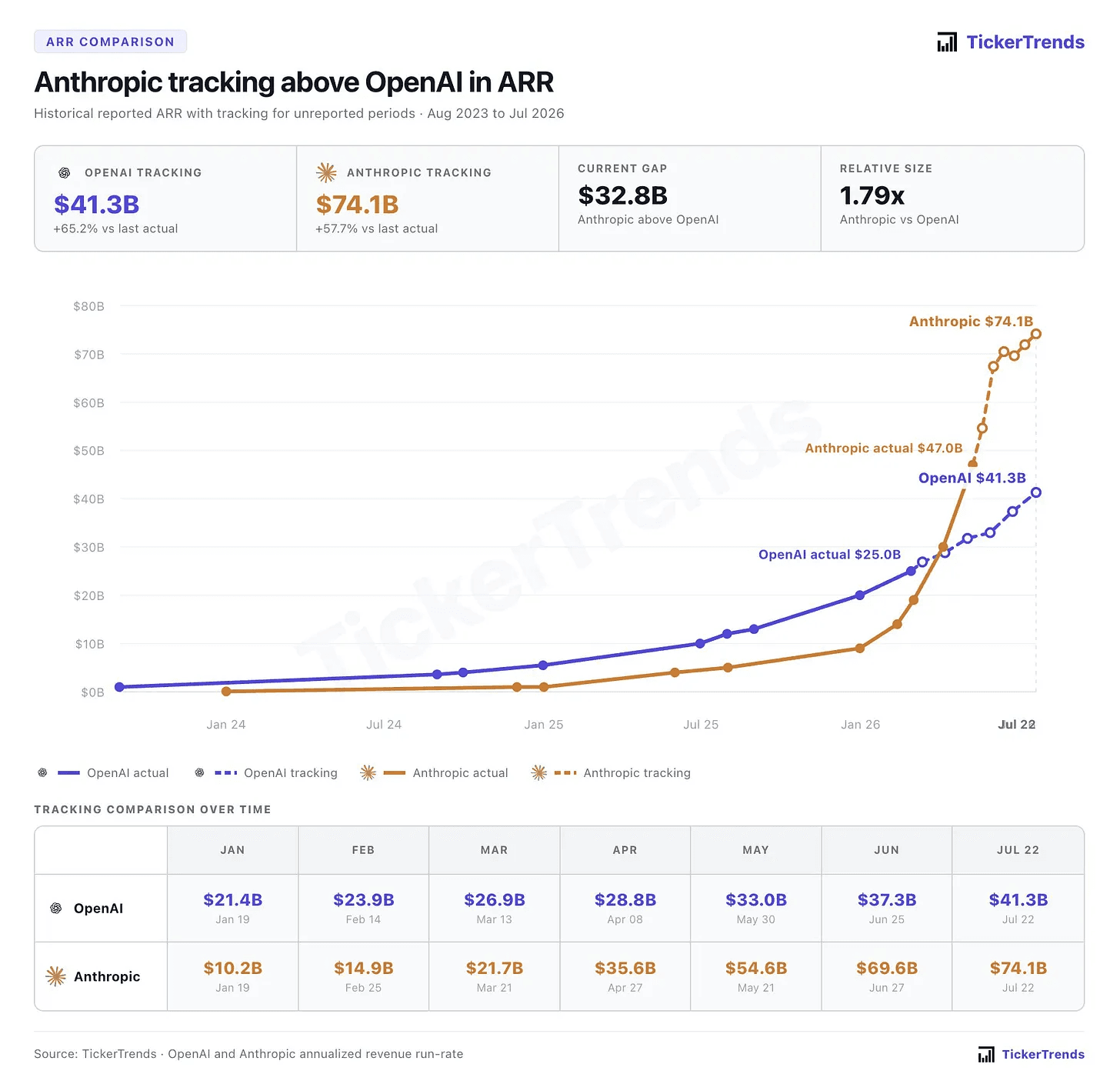
But to power this growth, it requires compute and a lot of it. While it’s growing 10x every year, the amount of compute available to the lab only grows around 3x per year. Obviously, the individual lab will grow somewhat faster, but there is still a ceiling to that.
The trajectory may not continue at this pace. But assuming it does, the key question is: how can revenue grow 10x when the amount of compute available to the lab only grows around 3x?
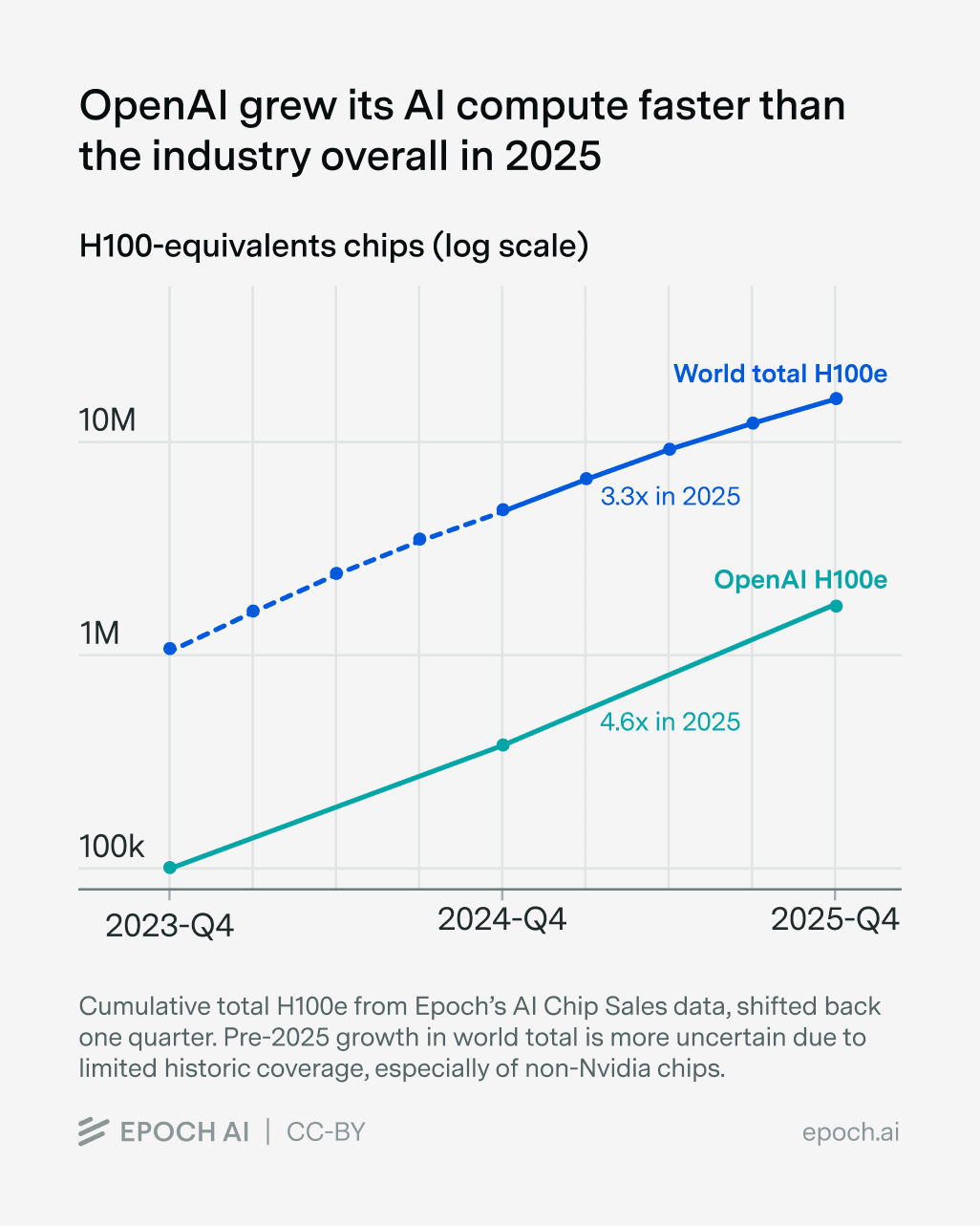
For revenue to grow faster than compute, each unit of compute has to produce more revenue.
There are 3 main ways this can happen. Labs can earn higher margins, compute prices can rise, or labs can move more compute from training into inference. And all 3 are already happening to some degree.
Start with inference. Inference means using a trained model to answer questions and perform tasks. More inference creates more revenue because customers pay to use the model. But labs cannot move all their compute into inference. They still need huge amounts of compute to train the next generation of models. If most compute goes into serving current models, less is available for research and training.
That creates a hard trade-off. Labs need current revenue to fund growth, but they also believe today’s models will look weak within 1 year. Their long-term advantage comes from training better systems, not only from serving existing ones. So inference can take a larger share of compute, but there is a limit before the lab starts acting more like a cloud provider than a frontier research company.
The next option is higher margins. If one lab has a much better model than everyone else, it can charge more and keep more profit on each dollar of revenue. This can help explain part of the gap between 10x revenue growth and 3x compute growth. But margins cannot keep rising forever. Once gross margins reach 90% or 95%, there is almost no room left. The lab still has to pay for GPUs, electricity, networking, data centers, staff, and research.
That means higher margins probably cannot explain the full gap. The remaining explanation is that compute itself becomes much more valuable and more expensive. Public GPU prices already point in this direction, but the real cost for frontier labs is likely higher than public spot prices suggest.
Frontier labs cannot rely on random GPUs rented for a few hours. They need secure, reliable clusters with tens of thousands of GPUs connected through very fast networks. They also need long-term access, high utilization, and strong protection for model weights and customer data. This type of compute is far scarcer than a single GPU listed on a public marketplace.
The last few deals show how large this premium can be. Google is reportedly paying around $900 million per month for access to roughly 110,000 GB200 and GB300-class GPUs. Depending on the exact contract and utilization, the implied cost may be close to 2x normal spot prices. And spot prices themselves are already more than 40% above their February lows.
The reason labs can pay these prices is that smarter models make the same hardware more valuable. Imagine that 1 H100-equivalent GPU can run an AI system that performs software engineering at the level of a strong human developer. A strong developer can create more than $250,000 of value per year. If 1 GPU can produce similar work, then the economic value of that GPU could rise far above today’s rental price.
This does not mean every GPU would immediately earn $250,000 per year. If millions of AI engineers enter the market, the price of software work could fall. But the amount of useful work is not fixed. More engineering capacity can create more products, new companies, and new demand. So the value of AI labor may fall less than people expect, especially if AI also speeds up innovation.
Once compute becomes more valuable, the leading labs gain a major advantage. Better models produce more revenue. More revenue allows the lab to buy more compute. More compute allows it to train better models. This creates a loop that is hard for new competitors to break. A startup with no revenue has to compete for the same GPUs against labs earning tens or hundreds of billions.
High compute prices also make model efficiency much more important. If 2 models can solve the same task but one needs half the tokens or GPU time, the efficient model becomes much cheaper to run. When GPU time is expensive, using a weaker model that wastes compute becomes a bad deal. Customers may then pay a large premium for the best model because it produces more useful work from the same hardware.
Some AI applications would get priced out in this world. Compute would move toward the uses that generate the most revenue per GPU-hour. A model that performs valuable engineering work can afford to pay more than an application that generates low-value videos. Lower-value uses may return later when supply catches up, but during a shortage they would struggle to compete.
Ultimately, AI infrastructure is still severely supply constraint. Current estimates suggest around 3x annual growth. That comes from better chips, more fabrication capacity, and shifting more advanced wafers toward AI. And each part has limits. EUV tools, packaging, memory, power, and new fab construction all take years to expand. Once AI already uses most advanced wafer capacity, there is also less capacity left to reallocate. And it is not realistic for this bottleneck to disappear in the near-future.
So, the logic is as follows. AI revenue is growing 2x or even 3x faster than available AI compute. That means each unit of compute is producing much more revenue over time. As models become more capable, companies are willing to pay more for every GPU. If compute supply cannot grow fast enough, demand and prices rise across the infrastructure needed to deliver it, including chips, memory, networking, data centers, and power.
Hence, compute must become much more valuable. Which means AI infrastructure becomes much more valuable.
A ton of AI-related stocks were sold off during this recent correction. Some deservedly so, but many were simply caught in the broader wave of de-risking across the sector. Investors were reducing exposure to anything connected to AI. And that creates opportunity.
It could very well be that we’re close to a market bottom for AI infrastructure. Hundreds of thousands of retail investors in Korea got margin called due to excessive leverage. There are reports that tons of Koreans who lost everything. For what it’s worth, this is another great lesson why leverage should only used sparingly and with strict risk management. Otherwise, leverage is a killer because it turns normal volatility into permanent losses.
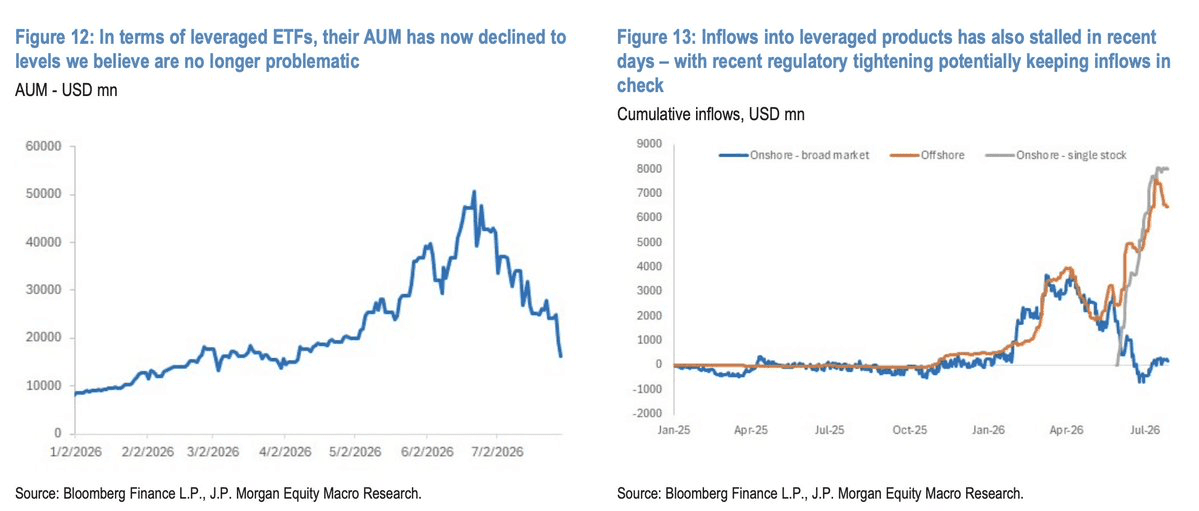
And it seems that even the AI wizkid Leopold Aschenbrenner seems to have been forced to sell everything in the recent downturn. Typically, a ton of forced selling is what happens at the lows. So, AI infra will be one of the key focus areas for now.
Previous Updates
View All
- Market Update: Has AGI Arrived?
- Weekly Market Update: Consolidation
- Weekly Market Update: September is Here
- Market Update: Nvidia Crushes Earnings
- Weekly Market Update: Yields
- Market Update: The Future of Biotech
- Weekly Market Update: Earnings Acceleration
- Market Update: The Next Generation of AI Infrastructure
- Weekly Market Update: New Highs
- Market Update: Nvidia’s Way Around Memory
- Weekly Market Update: LTCM 2.0
- Market Update: The Trajectory of AI Compute
- Weekly Market Update: Peak Earnings Season