Go Back

Lin
Weekly Market Update: AI’s Biggest Test
The biggest news of the week came from the company at the very center of the AI boom.
Jensen Huang has stepped down as CEO of Nvidia.
The man who co-founded Nvidia and spent more than 30 years building it into one of the world's most valuable companies is suddenly gone.
It's a remarkable sad development for a company that has pretty much started the AI revolution.
So, what does Jensen's departure mean for Nvidia and AI?
The reality is that nobody knows exactly how this will play out.
Nvidia remains a leader in AI computing, and its products are still central to the massive infrastructure investments taking place around the world. But Jensen was much more than just another CEO. He helped shape the company's strategy, built relationships with its biggest customers, and became the most recognizable face of the entire AI boom.
Losing that leadership creates a ton of uncertainty.
Years from now, we might look back at Jensen stepping down as a defining moment in the AI trade. Perhaps it marks the end of 1 chapter and the beginning of another.
And I think that next chapter will look quite different from the last.
But more on that later.
For now, I want to focus on something I've been seeing a lot over the past few weeks.
Investors are increasingly defending stocks that have fallen 50%, 60%, or even more, arguing that the fundamentals are still strong and that the market has simply gotten things wrong.
And sometimes they're right.
I spend a lot of time studying company fundamentals. Earnings growth, valuations, competitive advantages, and long-term opportunities are all important parts of my investment process.
But I also have to respect what the price is telling me.
If a stock keeps falling despite strong fundamentals, I don't want to keep buying simply because I believe the company is worth more.
The market can disagree with you for much longer than you expect.
Let's say you loved a stock at $300 and continued buying as it fell. Your average purchase price is now $240, but the stock has dropped to $120.
You're sitting on a 50% loss.
And the problem is now you need that stock to rise 100% just to get back to breakeven.
That's why managing risk is so important.
You're going to be wrong plenty of times in the stock market. That's unavoidable. Even the best investors make mistakes.
But taking massive losses isn't something you have to accept.
Large losses don't just hurt your portfolio. They also affect your confidence and make it harder to think clearly. Investors often become desperate to recover their money, take bigger risks, and end up making even worse decisions.
That's how a manageable mistake turns into a much bigger problem.
And that’s what critical to avoid during a major correction.
Over the past month, I've remained very cautious. Even though I've been optimistic that the market is getting closer to a bottom, there’s no reason to be buying every dip or adding heavily to stocks that continue making new lows.
And looking at how the AI trade has performed lately, I think that caution has been justified.
Stocks like NBIS, INTC, and MRVL have suffered substantial selling pressure. We've seen occasional sharp rebounds, but those moves have often faded after just 1 or 2 sessions.
For traders, that creates opportunities to catch short-term bounces. But for investors looking to build positions in the next major uptrend, the market has offered very little confirmation that the selling is finished.
We're also seeing enormous companies swing 10% in either direction within a matter of days.
That tells you just how unstable the environment has become.
Some people will call this a day trader's paradise, but large price swings also mean large risks. It's incredibly easy to get caught on the wrong side of a move when stocks are behaving like this.
And this week will give us 2 major events that will help us understand where the AI trade goes next.
The first is Nvidia's earnings report on Tuesday.
This will be one of the most closely watched earnings releases of the year, especially following Jensen Huang's unexpected departure.
But I'm even more interested in how the stock reacts.
If Nvidia delivers strong numbers and investors still sell the stock, that would tell us a lot about how bad sentiment has become. If the results are well received and the stock can hold its gains, that would be an encouraging sign that buyers are finally becoming more willing to take risks again.
The second major event is Anthropic's IPO.
Anthropic is expected to price its shares on Wednesday, November 18, and begin trading on Thursday, November 19, under the ticker ANT.
I think the market's reaction to this IPO is more important than many investors realize.
Anthropic is one of the biggest names in artificial intelligence, and its public debut will give investors another opportunity to decide how much they're willing to pay for exposure to the AI boom.
With Nvidia reporting earnings and Anthropic entering the public market in the same week, we're about to get a very important test for the markets.
And given everything that's happened over the past few weeks, I expect plenty of volatility.

Despite everything that's happened since the midterm elections, the S&P 500 is basically flat.
Think about that for a moment. We've had a massive 4% selloff in a single day, another round of hotter-than-expected inflation data, and even the unexpected resignation of Nvidia CEO Jensen Huang.
Yet the S&P 500 has barely moved.
But when you look beyond the major indexes, the picture is much more concerning.
While the S&P 500 is down just 3.6% from its recent high, the equal-weighted index is down only 1.2%. Meanwhile, the median stock has fallen 11.7%, semiconductor stocks have plunged 31%, and nearly 1 in 3 stocks is down at least 20%.
That's what makes this market so unusual.

But the damage is even worse when you look at AI stocks.
Goldman Sachs' AI stock basket has fallen around 30% from its peak, and many individual stocks have suffered even bigger losses. Some of the hardest-hit areas include memory chips, data centers, and semiconductors, which were among the biggest winners earlier in the bull market.
Many of these stocks had seen massive gains as investors rushed to benefit from the AI boom. Now they're experiencing some of the largest corrections.

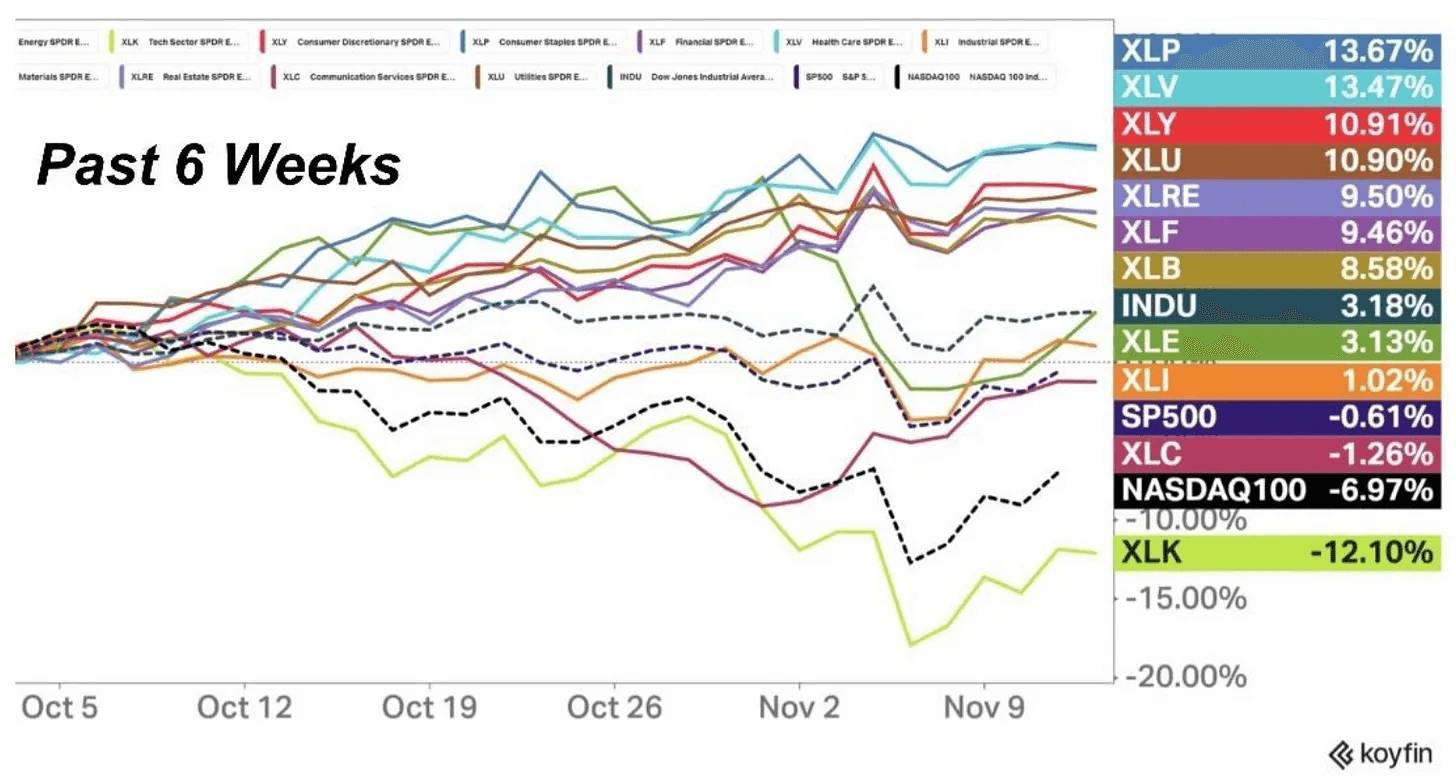
Over the past 6 weeks, consumer staples and healthcare stocks have gained more than 13%, while the technology sector has fallen around 12%.
Investors are moving money away from technology stocks that have led the rally for years and into more defensive sectors. These are companies that tend to have more stable demand for their products and services, even when the economy slows down.
Rotation is healthy for the market.
A strong bull market needs different sectors to take turns leading. When money moves out of overheated parts of the market and into other areas, it helps keep the broader rally going. And I wouldn't be surprised if we see more of this in the coming weeks.
But there are also some warning signs we shouldn't ignore.
Almost all of these former market leaders have started underperforming the S&P 500. Some have given back 1 to 2 years of relative gains in just a few weeks.
This is why they say stocks take the stairs up but the elevator down.
That’s why risk management is so so important. Protecting your downside matters just as much as capturing the upside. Stocks can spend months climbing higher, only to give back those gains in a matter of days.

We keep hearing the same warnings about the AI bubble. It's going to burst, stocks are going to crash, and the entire market is supposedly way too expensive.
But when you look at valuations, the picture is becoming much more interesting.
The S&P 500 is now trading at just 17.7 times expected earnings over the next 12 months, its lowest valuation since November 2023. That's also below both its 5-year and 10-year averages.
In simple terms, investors are now paying much less for every dollar of expected earnings than they were just a few months ago.
And the recent selloff has already taken some of the excess optimism out of the market.
Of course, earnings expectations can still fall, and stocks can always get cheaper.
But it’s difficult to argue that the entire market is still trading at bubble-like prices. Nevertheless, corrections are part of the market cycle.

Technology stocks have become even cheaper after the recent selloff.
The Nasdaq 100 is now trading at around 19 times expected earnings over the next 12 months, its lowest valuation in 4 years and roughly 25% below where it started the year.
This goes to show how bad sentiment has gotten actually.

Looking back to 2000, we've only seen valuation declines of this size during a handful of periods, including the dot-com crash from 2001 to 2003, the financial crisis in 2008, the market selloff in 2018, and the bear market of 2022 to 2023.

Nobody wans to own AI stocks anymore.
Positioning in the AI trade has fallen to its lowest level since the current bull market began in October 2022, even below the levels we saw during the selloff in early 2025.
That shows just how dramatically sentiment has changed. Investors who were aggressively buying AI stocks just a few months ago are now cutting their exposure and moving money elsewhere.

Unvestors have significantly reduced their use of leverage. Many of the heavily leveraged positions built up during the rally have now been unwound as investors cut risk and reduce their exposure. So, a lot of the speculation and excessive risk-taking has already been flushed out of the market.
At least that's a healthy reset.

Producer inflation rose to 6.5% in October, its highest level since November 2022. Even when we exclude food and energy, core PPI is still running at 5.0%.
Meanwhile, consumer inflation is running at around 4%, with core CPI closer to 2.8%.
How much longer can businesses deal with rising prices before passing more of those increases on to consumers?
Some companies have enough pricing power to raise prices without losing customers. Others have to absorb higher costs, putting pressure on their profit margins.
And that's exactly what could be troublesome heading into 2027.

The last time business inflation was running this far ahead of consumer inflation was in 2021. And we all remember what happened next. Inflation kept rising, eventually reaching levels we hadn't seen in 40 years.
And there's another worrying sign in the latest inflation report.
Ernie Tedeschi, chief economist at Stripe, recently highlighted an inflation measure called Stage 4 intermediate demand.
It sounds complicated, but the idea is pretty simple. It tracks the prices businesses pay for goods and services that are close to becoming finished products. In other words, it gives us a look at inflation pressures before they reach consumers.
And the latest numbers are not really encouraging.
Stage 4 inflation jumped to 8% in October compared to a year ago, its highest level since September 2022. It also increased from 7.9% in September.

We have another busy week of earnings ahead, but there's 1 company everyone will be watching: Nvidia.
The AI giant reports its results after the market closes on Tuesday, and given everything that's happened in the AI trade recently, this might be one of the most anticipated earnings reports in market history.

Overall, I think the market is still trying to figure out where it wants to go next.
In my view, the bigger bull market remains intact, but the short-term environment continues to be frustrating and unpredictable.
Neither bulls nor bears seem to have a clear advantage right now. We get sharp rallies followed by aggressive selling, and every time it looks like the market is finally gaining momentum, stocks start falling again.
There's very little consistency, and the market seems determined to punish anyone who gets too aggressive in either direction.
That's exactly why I've been much more cautious over the past weeks.
My strategy works best when strong stocks are breaking out, holding their gains, and continuing higher. Right now, we're seeing the opposite. Breakouts keep failing, rallies are being sold, and many stocks struggle to hold onto their gains for more than a few days.
There's certainly money to be made from these large intraday swings, but day trading has never been where my edge lies.
And I see little reason to force trades when the market isn't consistently rewarding them.
What's particularly interesting is that despite all the damage we've seen in the AI trade over the past few months, the major indexes have held up surprisingly well.
Money is still flowing into the market, but investors are moving away from high-growth technology stocks and into more defensive areas like healthcare and consumer staples.
That's helping support the broader market, even as many former leaders continue to struggle.
But it also raises an important question.
How much longer can the major indexes hold up if the stocks that drove this bull market continue to underperform?
One thing I've been discussing a lot recently is how much pessimism has already been priced into certain parts of the market.
Many growth stocks have fallen 50%, 60%, or even more from their highs. The AI trade has gone from being one of the most popular investments in the world to something investors are increasingly reluctant to touch.
And the shift in sentiment has been remarkable.
Not long ago, investors were willing to buy almost anything connected to AI. Companies didn't necessarily need strong earnings or attractive valuations. As long as they had a convincing AI story, investors were excited.
Now we're seeing the opposite.
Even companies with strong fundamentals are being sold, and investors are questioning whether the massive investments in AI infrastructure will ever generate enough returns to justify their costs.
Bearish sentiment has climbed above 50%, bullish sentiment has fallen sharply, and institutional positioning in AI has reportedly dropped to its lowest levels since the current bull market began.
That's a pretty dramatic change in sentiment.
But there's something important to remember.
Just because a stock has fallen 50% doesn't automatically make it a bargain. A stock that drops 50% can still fall another 50%, leaving investors down 75% from the original price.
That's why I'm waiting for evidence that the selling pressure is easing and buyers are starting to return. I want to see stocks holding important support levels, recovering after selloffs, and showing sustained strength again.
And this week we have 2 major events that will help us understand whether sentiment is finally starting to change.
Nvidia reports earnings on Tuesday, while Anthropic is expected to make its stock market debut on Thursday.
Both events are especially important given everything that has happened to the AI trade recently.
The reaction to these events will tell us much more about the market's strength than the headlines alone.
Looking at the bigger picture, my view hasn't changed.
I still believe we're going through a difficult correction within a longer-term bull market. As I've said many times, I don't believe the AI trade is over. I believe the next phase will look very different from the last.
The companies that led the previous rally won't necessarily lead the next one.
I expect investors to become much more selective, with a greater focus on earnings growth, profitability, free cash flow, and the ability to turn AI investments into real financial results.
Simply being associated with AI won't be enough anymore.
And I actually think that's a healthy development.
For now there's no reason to exhaust yourself trying to make money in an environment where taking risks is rarely being rewarded.
Sometimes the best decision is simply to stay patient, protect what you've already made, and let the market work through its problems.
I still believe there are enormous opportunities ahead, particularly as AI continues to change how companies operate and generate profits.
But I want the market to prove it's ready before I become aggressive again.
The opportunities will come. They always do.
Previous Updates
View All
- Weekly Market Update: AI’s Biggest Test
- Weekly Market Update: AI Takes Another Hit
- Weekly Market Update: Breaking Down
- Weekly Market Update: Key Support
- Weekly Market Update: Earnings Season is Back
- Weekly Market Update: Big Tech Divergence
- Weekly Market Update: Accumulation
- Weekly Market Update: The Best Quarter
- Weekly Market Update: Rate Hikes
- Weekly Market Update: AI is Not Slowing Down
- Market Update: Has AGI Arrived?
- Weekly Market Update: Consolidation
- Weekly Market Update: September is Here