Go Back

Lin
Weekly Market Update: Risk-Off
The world is moving very fast.
Just as this week was coming to an end the US and Israel have launched large strikes on Iran. They killed its leader, Supreme Leader Ayatollah Ali Khamenei and other top officials. Hence, Iran has launched missiles and drones on Israel and U.S. allies through the Mideast, vowing revenge for the death of Supreme Leader. In some ways, it feels similar to what happened in 2022.
Back then, the bear market started when Russia invaded Ukraine. But the market was already stretched. Valuations were high, hype was everywhere, and we were late in the cycle. The invasion caused fear at first, but that alone did not break the market. What really mattered was what came next. Commodities surged, inflation jumped, rates moved higher, and the macro picture worsened. That is what made the selloff last.
Geopolitics usually only move markets for hours or days unless they hurt the macro picture. So the real things to watch now are oil prices, inflation, interest rates, and any disruption to global trade or a wider escalation.
Hence, it was a another rough week across the board for the markets. All four major indexes closed in the red, with the Dow dropping 1.3% and the Nasdaq falling 1%. The S&P 500 is hanging on to a slim 0.5% gain YTD. And the internals continue to tell a more cautious story, as we’ll discuss below.
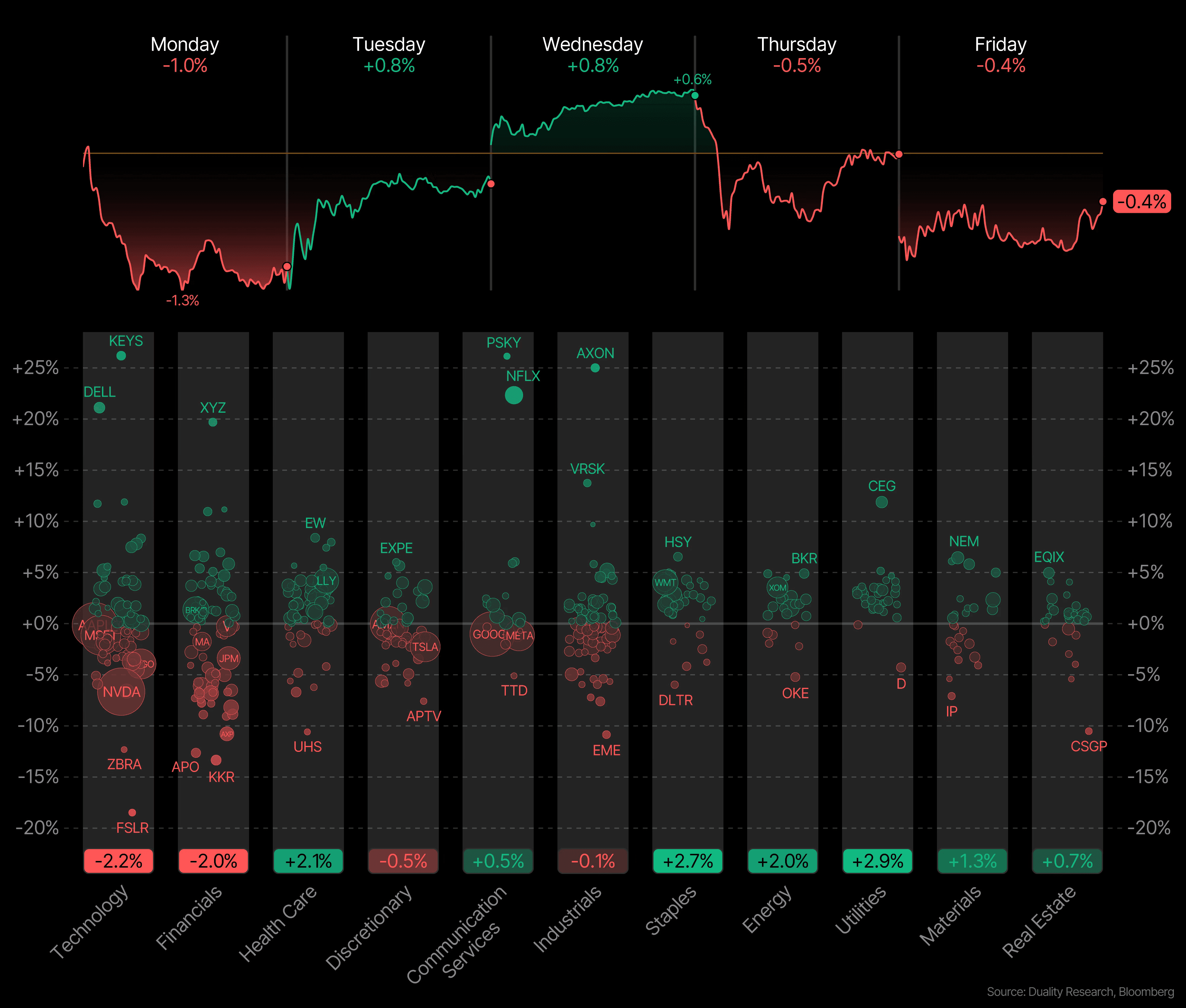
One of the main reasons for my continued caution is the growing number of risk-off signals. Many of them have been mentioned or discussed or the last few weeks. But let’s break down a few of the most important ones.
1. Value > Growth
In 2026, the market leaders are Energy, Materials, and Consumer Staples. These are defensive areas. At the same time, Technology, Financials, and Consumer Discretionary are down for the year. So even though the index looks fine on the surface, underneath it shows a market that is highly sceptic. Investors are looking for safe places to park their money and avoid taking any risks.
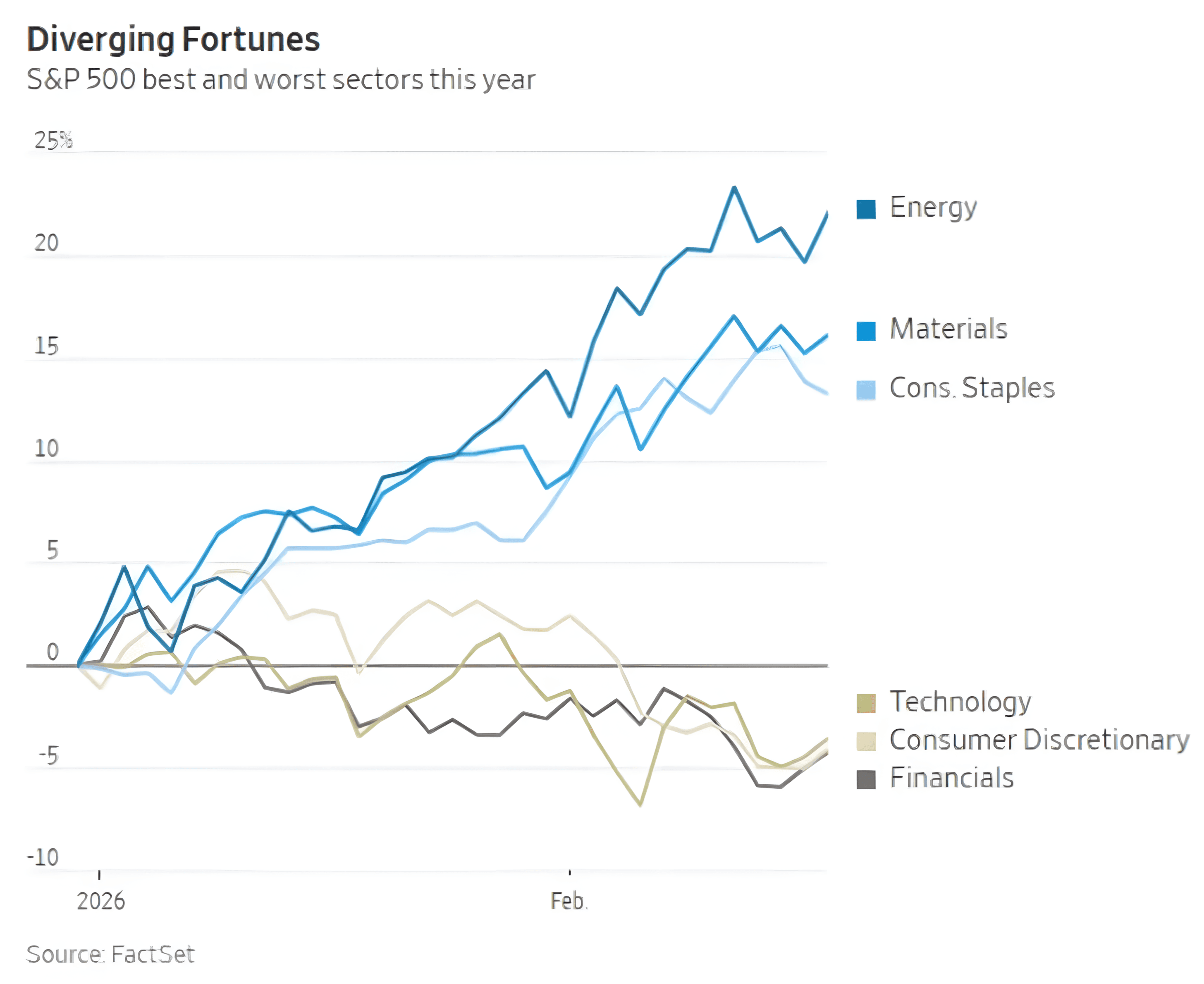
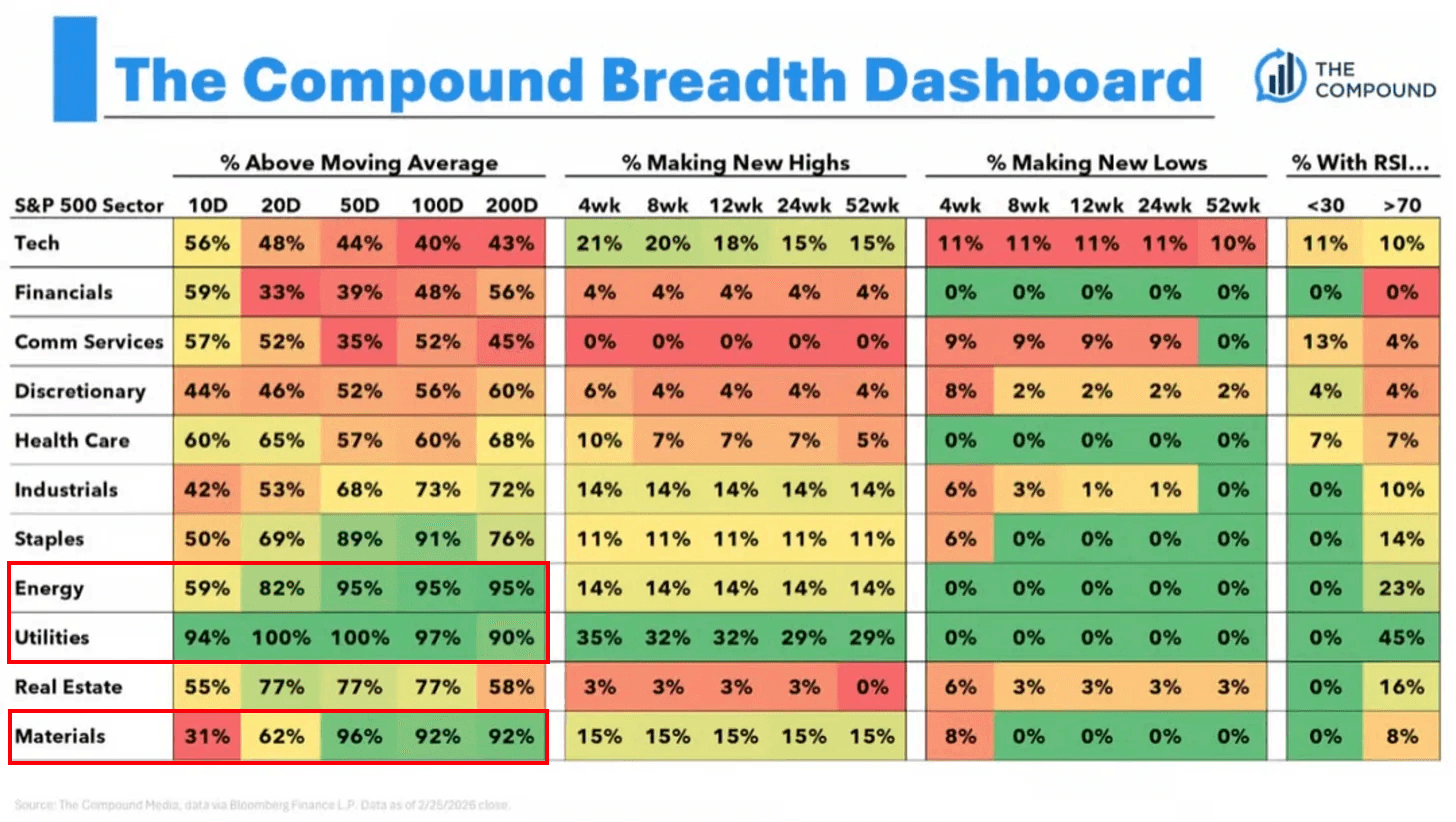
Here’s a more granular view.
In Technology, Financials, and Consumer Discretionary, only 50% of stocks are trading above their 50d SMA and 200d SMA. This is important because it shows how cooperative the market is. In a strong market, most stocks move up together and trade above their 50-day average.
This is now the widest gap we’ve seen in recent history.
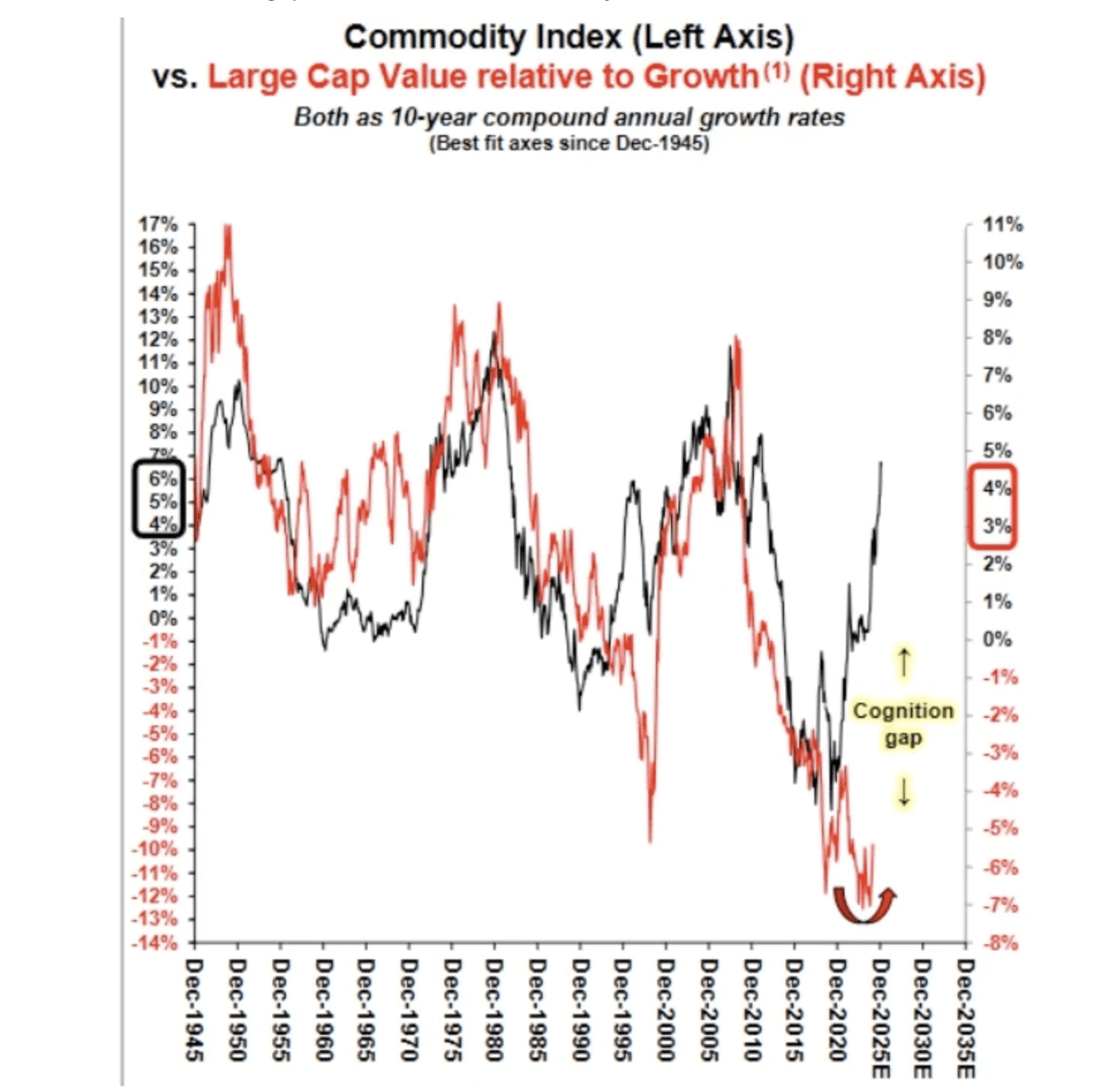
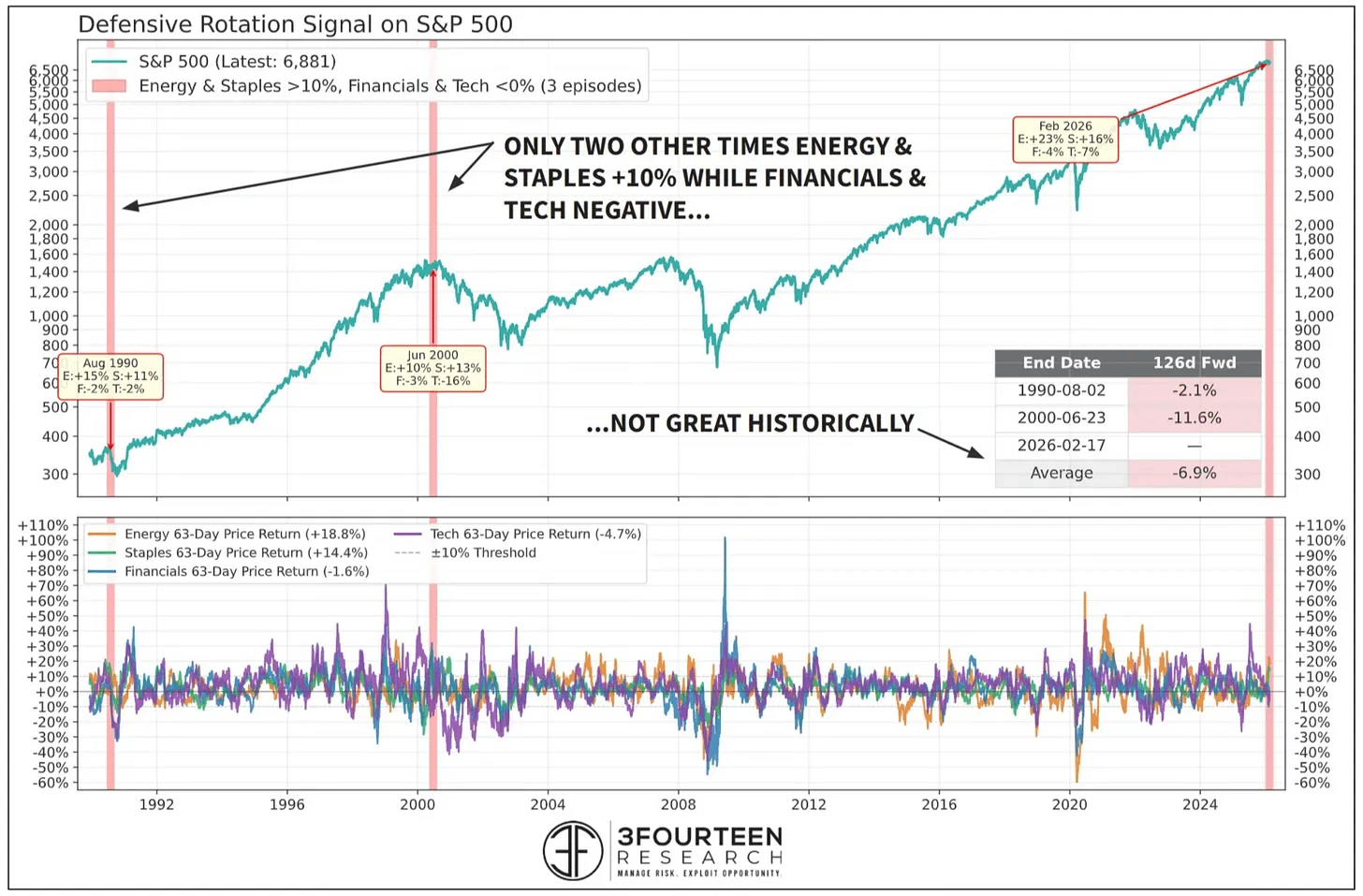
Over the last 63 trading days, Energy and Staples are both up more than 10%. At the same time, Financials and Tech are down.
That combination is unusual.
It has only happened 2 times in the past.
One case was in 1990 around Desert Storm. The other was in 2000 near the peak of the dot-com cycle. Both are not very comforting comparisons.
2. Financials Look Precarious
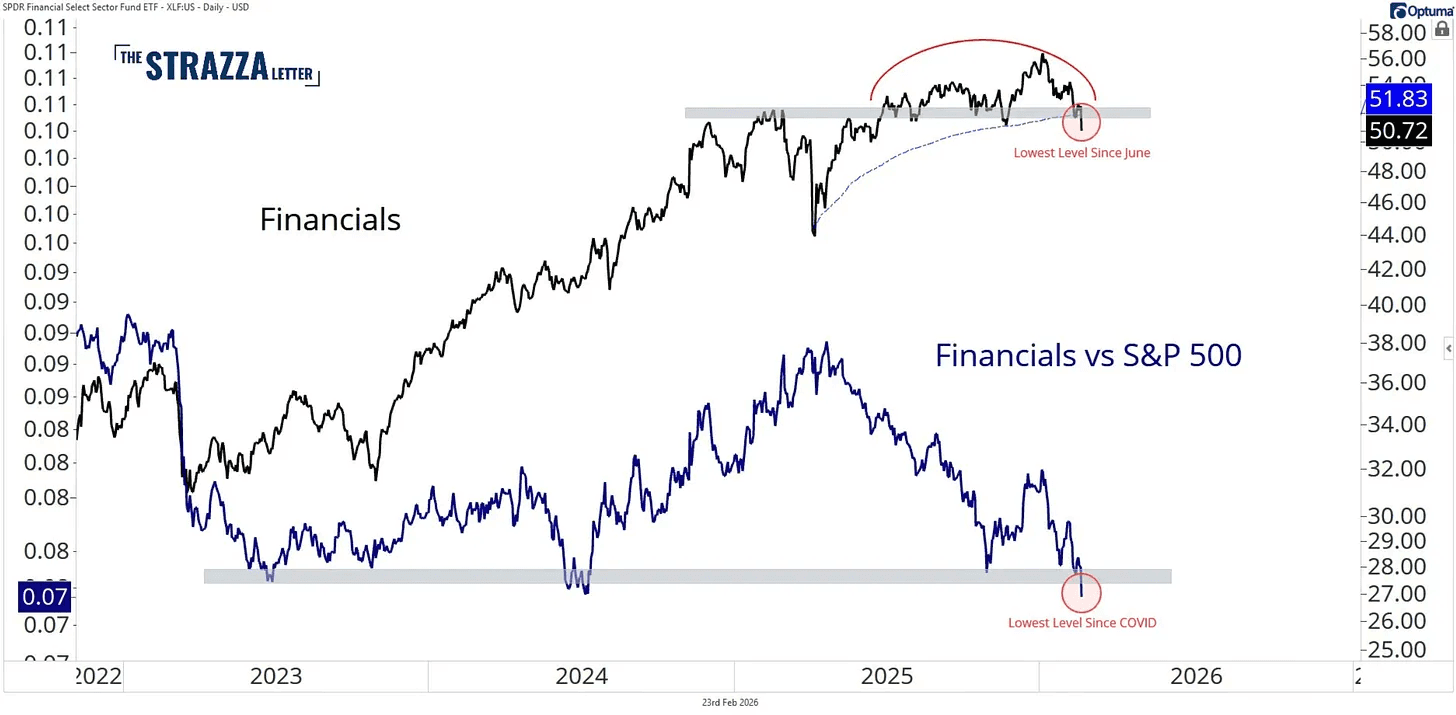
Financial stocks are the engine of the market. You want to see banks and insurers thriving, because it means money is circulating, credit is healthy, and the economy is fine. If this breakdown continues, it will likely spill over into the rest of the market, because many other sectors depend on financials staying stable.
Now, The Financial Sector ETF ($XLF) just closed at its lowest level relative to the S&P 500 since 2020. The sector has wiped out every gain made since last June. The XLF attempted a breakout and failed. And now it’s sitting right on the 200-day moving average. And as discussed recently that marker is important. It has to hold.
3. Valuation Compression
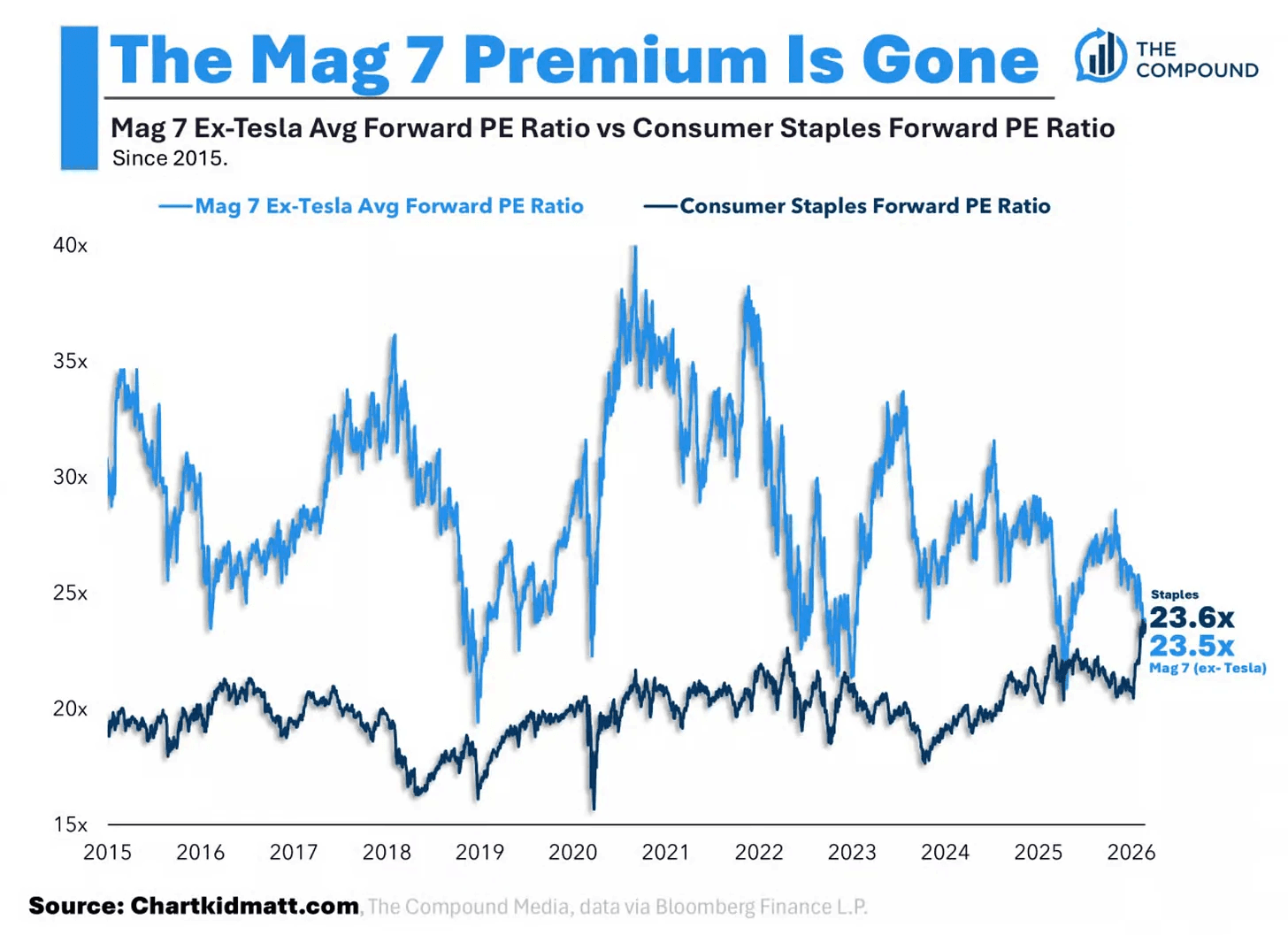
The Mag 7, excluding Tesla, now trades at a lower forward P/E than Consumer Staples.
Think about that for a moment. Consumer Staples are the slow, defensive part of the market. Yet they are now valued more highly than Apple, Microsoft, Google, Meta, Amazon, and Nvidia combined.
Staples trade at about 23.6x forward earnings. The Mag 7 trade at about 23.5x.
In other words, the valuation premium for big Tech has almost fully disappeared.
That does not happen often. It has only occurred 3 times in the last 7 years: during COVID, during the 2022 bear market, and around Liberation Day. It shows how fast market cycles are moving. Investors went from euphoria to panic in a matter of weeks.
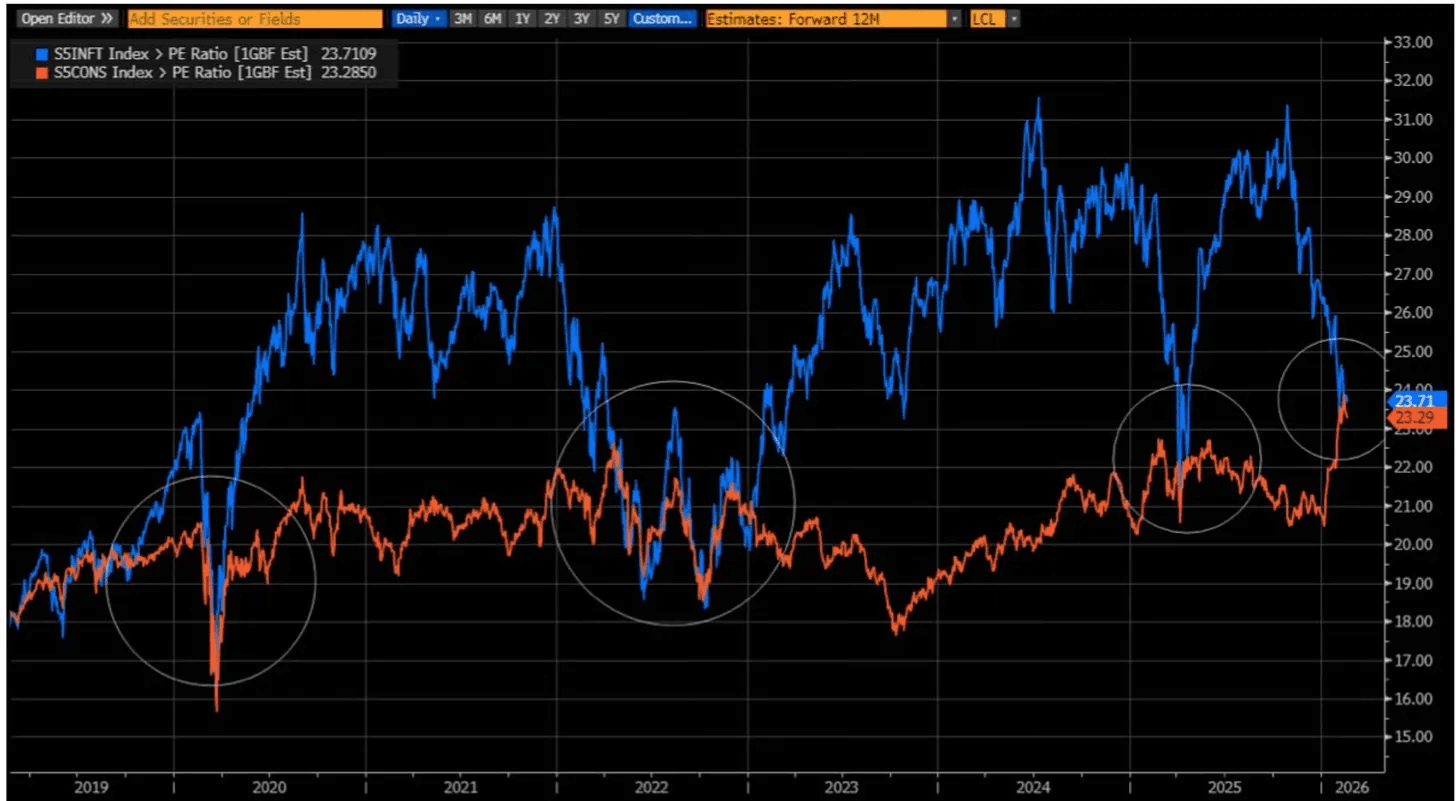
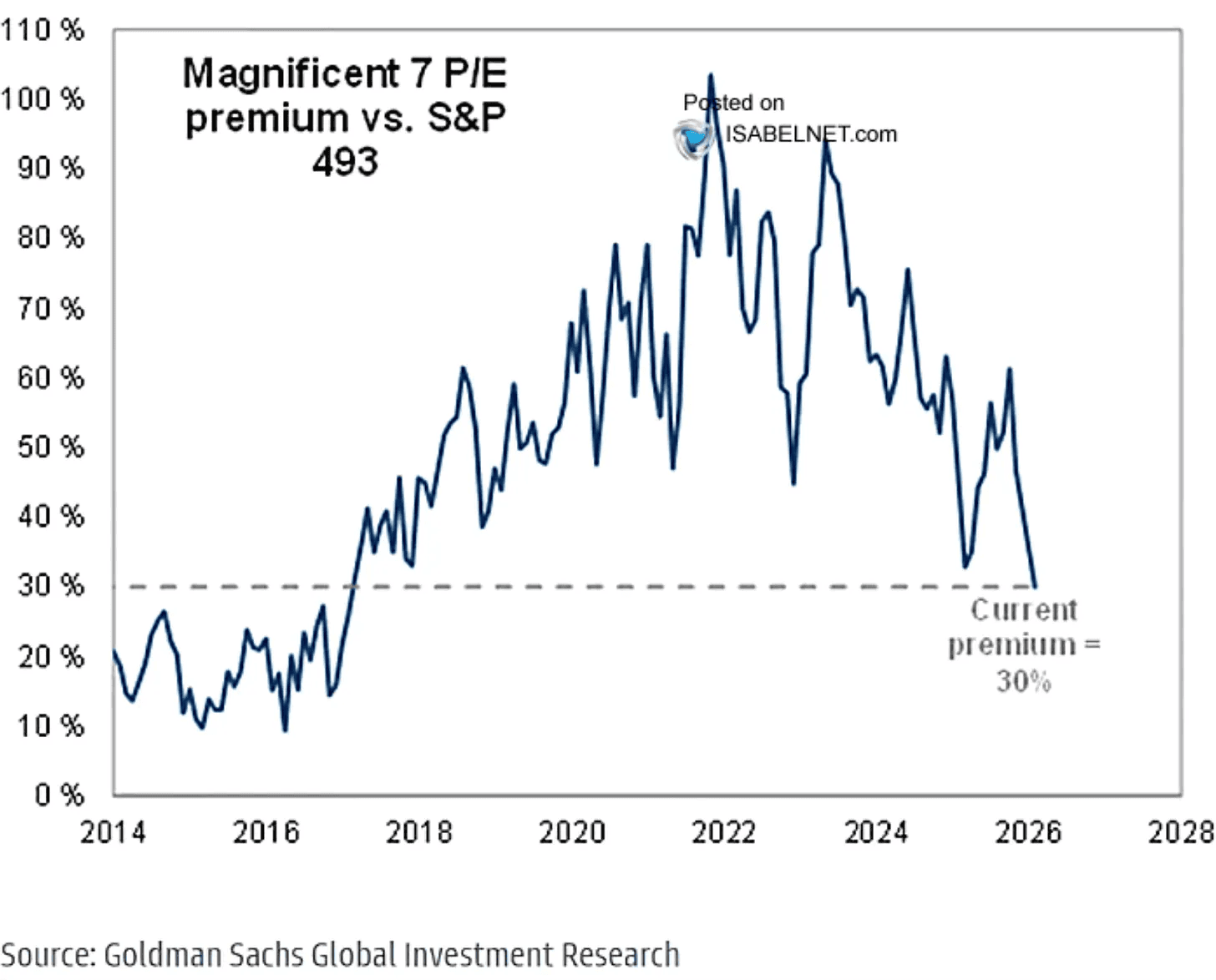
The Mag 7 P/E premium compared to the rest of the S&P 500 is now at its lowest level in 10 years. It is back to levels we saw in the early days of this AI bull market. This is not how bubbles usually end. So, there is no reason to believe that the AI story is over but corrections should be expected and are completely normal within a bull market, which could create a great setup for BigTech.
4. The AI Hit List
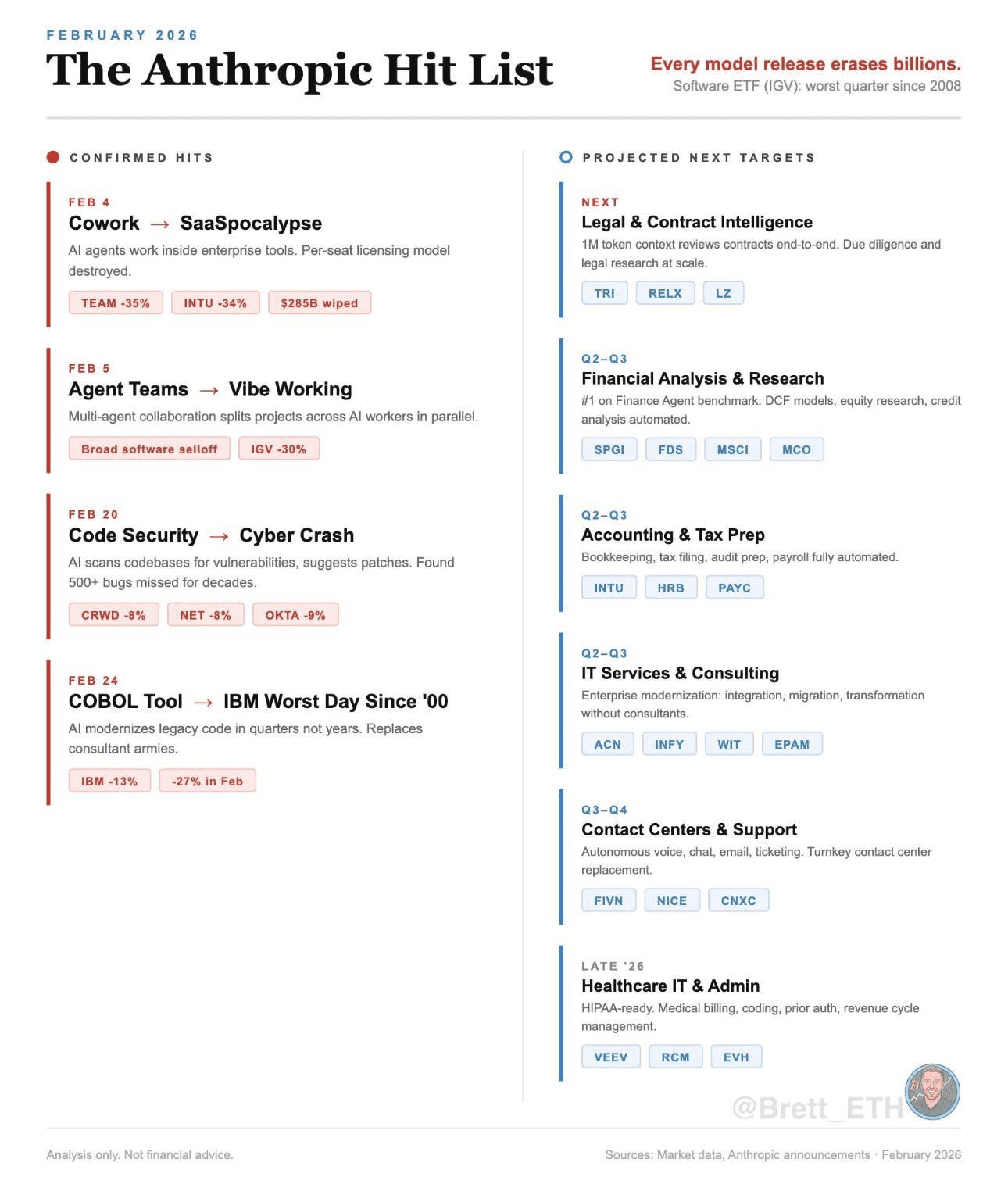
The market is pricing in the AI tornado. It’s very clear something is changing, and investors are left asking one question. Every time Anthropic releases a new feature entire industries are collapsing.
We just saw IBM, a tech giant that has been around for decades, drop 13% in one day after Anthropic’s latest AI news. That was its worst day in over 10 years. Last week, it was CrowdStrike. Cybersecurity stocks fell hard, with shares down almost 20% in just a few days.
This is not just hitting software. The services economy is getting hit too. Companies like Uber and DoorDash are getting pulled into the selloff as investors question whether these apps can be easily built or replaced with AI and simple code.
It feels like AI has become a tornado, sweeping through the market and picking up anything in its path it deems exposed. Fundamentals matter less than perception in the short term, and right now perception assumes disruption is inevitable unless proven otherwise.
Of course, the answer is not that simple. Markets tend to overshoot in both directions. Euphoria convinces investors that nothing can go wrong and panic convinces them nothing can go right. Right now, software among others are in the second camp.
But many of these companies will not only survive but thrive in the age of AI. But at this stage of the market, that does not matter. This is the narrative that is in control. On the other hand, there will be incredible opportunities once this storm has past.
5. The Crypto Debacle
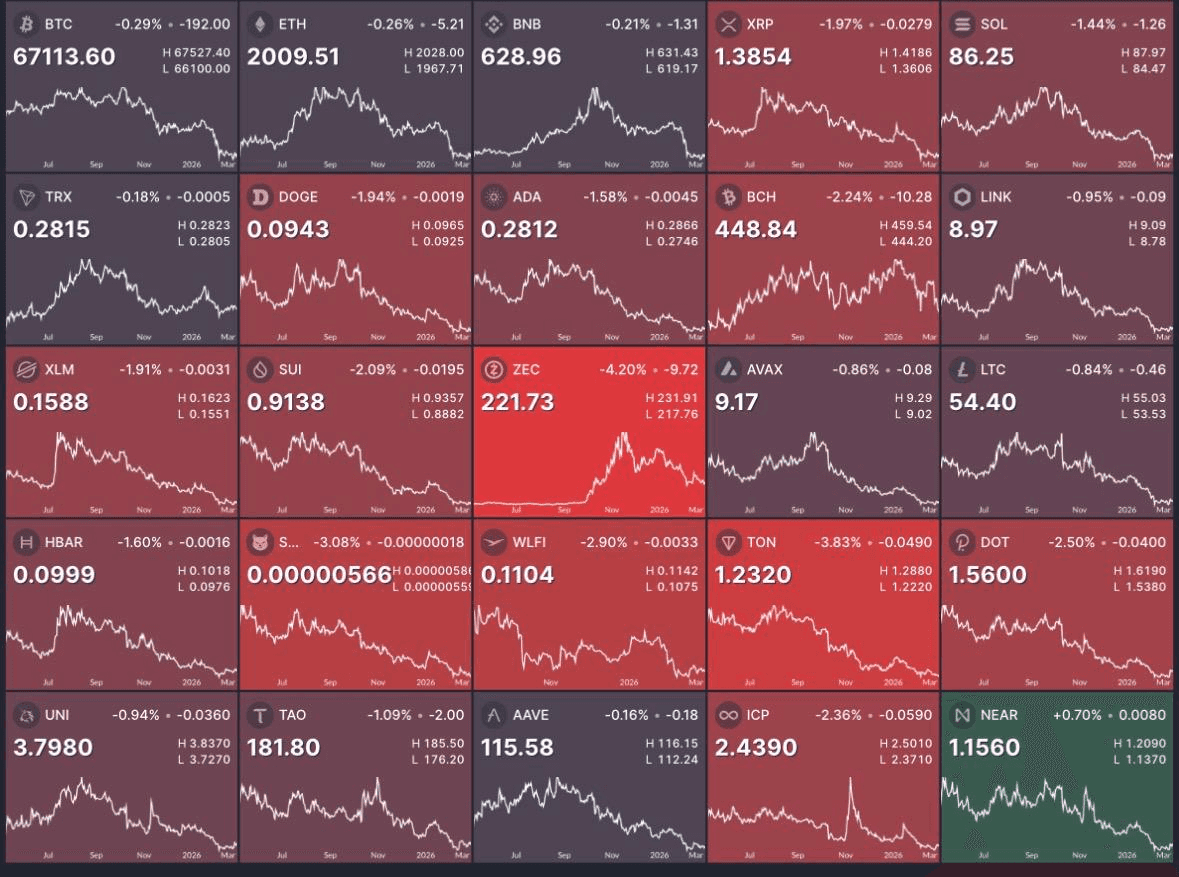
For months now, crypto has been in a free fall. It is the perfect example of everything I try to talk about here (just in reverse):
Focus on uptrends (crypto has been in a clear downtrend).
Focus on the leading sectors (the entire crypto sector has been week).
Focus on breakouts (crypto continues to breakdown).
Focus on your winners (there hasn’t many if any at all).
Focus on cutting your losses (that keeps you out of a lot of trouble.
On their own, each of these signals could be ignored. Markets are noisy and false signals happen all the time. But when many of them show up at once, it usually means something is changing. Right now, they are all pointing to the same thing. Investors are pulling back and taking less risk. The market has clearly shifted into risk off mode. So, it’s wise to pay attention and adjust accordingly.
On the positive side:
Yes, Nvidia sold off after earnings. But there is no reason to think that the AI revolution is over.
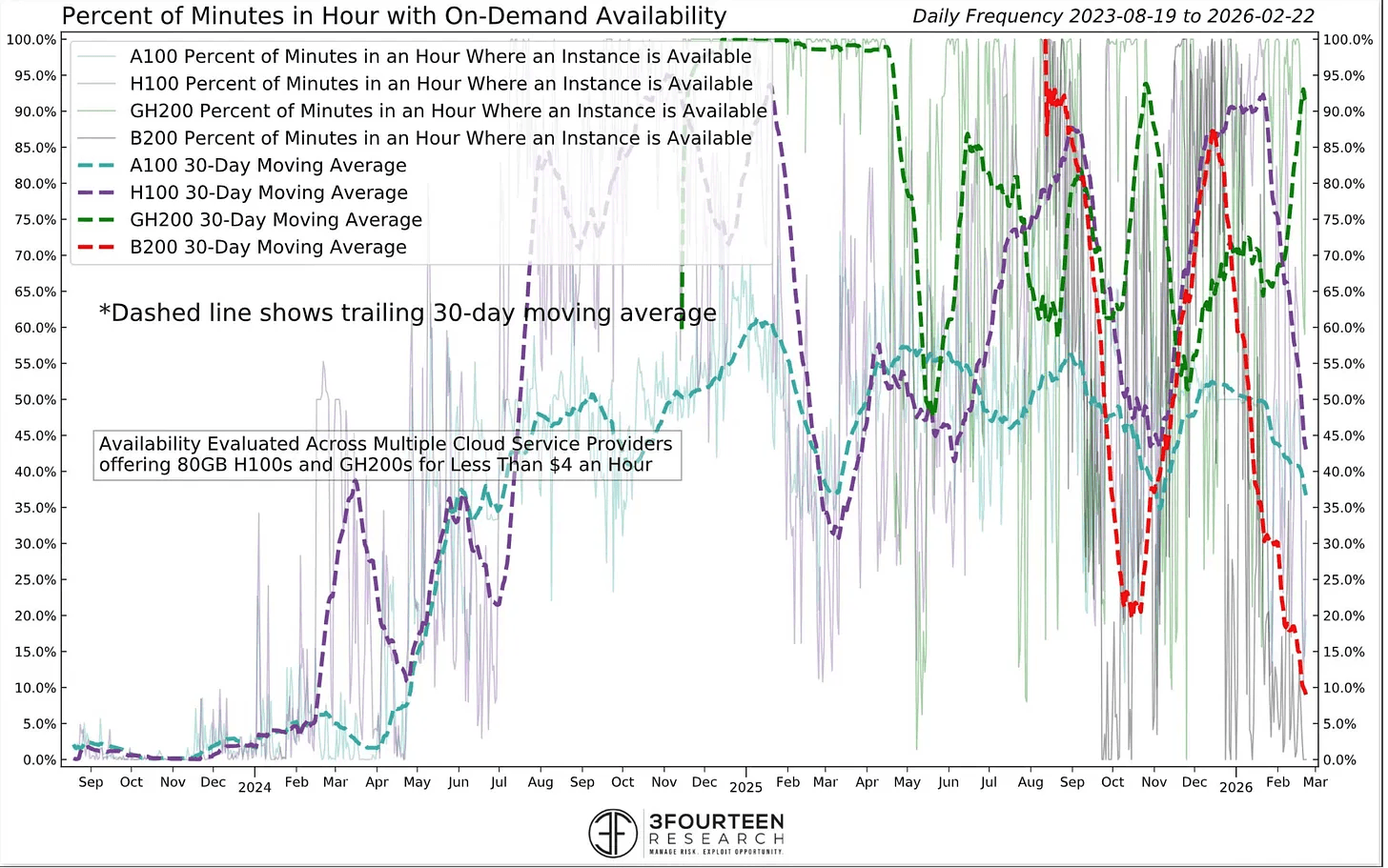
Look at the data. Nvidia’s B200 on demand availability has dropped to almost zero as of February 2026. A100 and H100 availability are not far behind. Across multiple cloud providers, there is almost nothing left to rent.
The demand continues to outstrip supply.
That’s why revenues is still up almost 80% year over year. Data center revenue is up 13x since ChatGPT launched. That does not look like a business in trouble.
All the big hyperscalers Microsoft, Google, Amazon, and Meta are not slowing down.
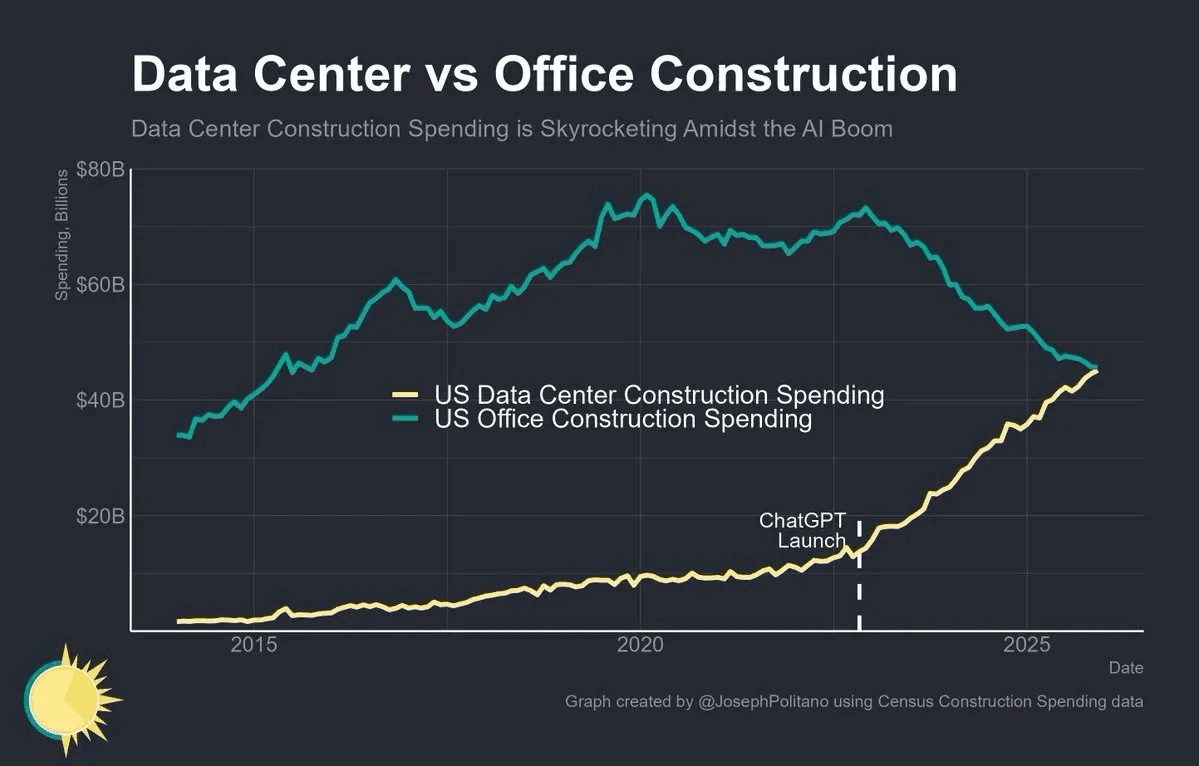
More money will be spent on new construction for data centers vs general office space for the first time ever. This is the fastest technological ramp up the world has ever seen. We’re increasing compute power, automation, and AI capacity at a massive scale. And we’ll need it.
There are tons of opportunities ahead of us but you have to patient.
So, it continues to make sense to stay cautious. That means holding some cash, using no leverage, and cutting back on high beta momentum stocks. This shouldn’t be a surprise. We’ve discussed this at length over the last few weeks.
The only areas that are really working are defensive and value sectors like gold, consumer staples, dividends, and oil and gas. That is not a supportive setup for growth and momentum investors. Many of last year’s most popular stocks and themes are now down 50%, 60%, or more in just a few weeks, even while the S&P 500 is still close to all time highs.
Even if the market does not correct in a big way, there just are not many strong upside drivers right now. This is a time for patience, not forcing trades. Corrections, when they come, create great opportunities. The goal is simply to protect capital and keep drawdowns small while you wait.
Previous Updates
View All
- Weekly Market Update: Earnings Season is Back
- Weekly Market Update: Big Tech Divergence
- Weekly Market Update: Accumulation
- Weekly Market Update: The Best Quarter
- Weekly Market Update: Rate Hikes
- Weekly Market Update: AI is Not Slowing Down
- Market Update: Has AGI Arrived?
- Weekly Market Update: Consolidation
- Weekly Market Update: September is Here
- Market Update: Nvidia Crushes Earnings
- Weekly Market Update: Yields
- Market Update: The Future of Biotech
- Weekly Market Update: Earnings Acceleration