Go Back

Lin
Weekly Market Update: The Bulls March On
Another week, another all-time closing high.
If the last few years have made anything clear, it is this: it usually pays much more to be an optimist than a pessimist in the market.
That does not mean you should ignore risk. It does not mean stocks only go up. And it definitely does not mean every pullback should be bought blindly. But over time, markets have rewarded people who stayed focused on progress, earnings, innovation and long-term growth instead of constantly looking for reasons why everything has to fall apart.
Statistically, stocks go up more often than they go down. You can see it clearly by looking at a long-term chart of the S&P 500 or the Nasdaq. Now add a transformational technology like AI into the mix, and that long-term bias becomes even more powerful. AI is not just another small theme. It is driving a major investment cycle across the entire value chain.
There will always be pullbacks. There will always be scary headlines. There will always be people saying the market has gone too far. But outside of the rare once-every-20-years type of crisis, looking at the market through a negative lens is usually not the best way to compound capital.
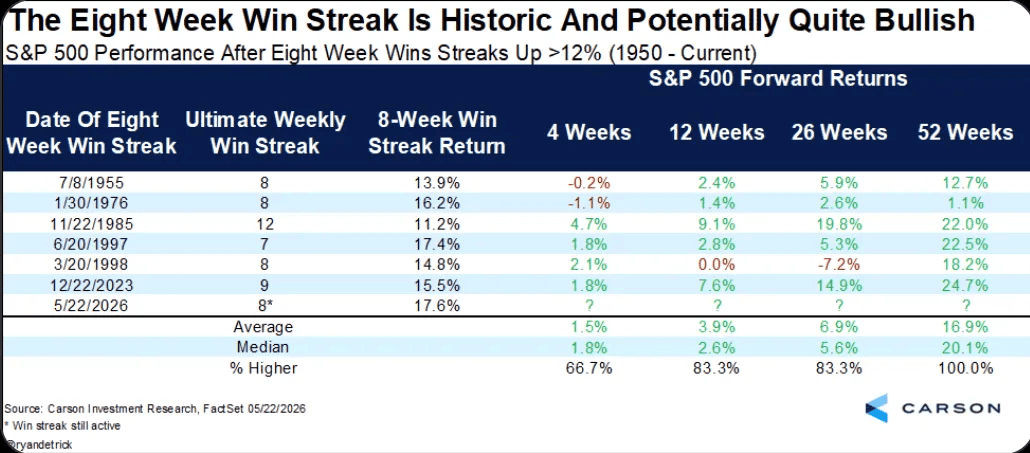
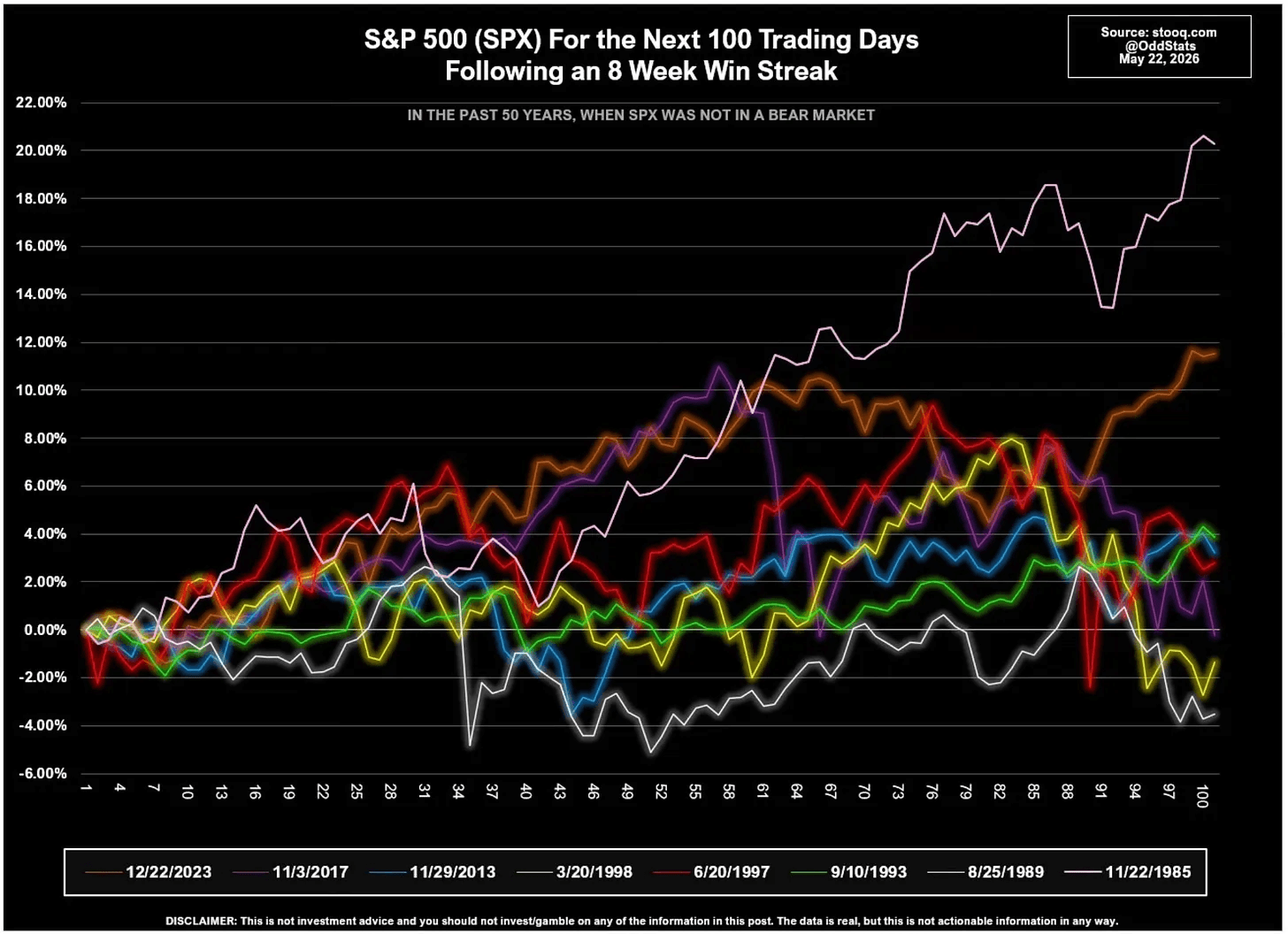
It’s been a historic eight week win streak for the S&P 500. After similar win streaks, the S&P 500 was higher 1 year later every single time, with an average gain of about 17%. For context, if SPY followed that average path again, it would put us around $8,500 in 1 year.
Big win streaks usually do not happen in weak markets. They happen when institutions are buying, sentiment is turning and the broader trend is improving.
Strength often leads to more strength.
This is one of the key lessons I’ve learned over the last 10 years.
Tech is leading all S&P 500 sectors year-to-date with a gain of +17%, but the important part is what is driving that move. This is not just investors paying higher multiples for the same earnings. Tech EPS is up +27.4%, while multiples are actually compressing, which means the sector’s earnings power is moving higher.
And the AI story is much broader than most people think. 263 companies in the S&P 500 are involved in the AI infrastructure buildout, which means more than half the index now has some connection to this theme. This is no longer just a narrow chip story. It is spreading across data centers, power, cooling, networking, software, industrial equipment and infrastructure.
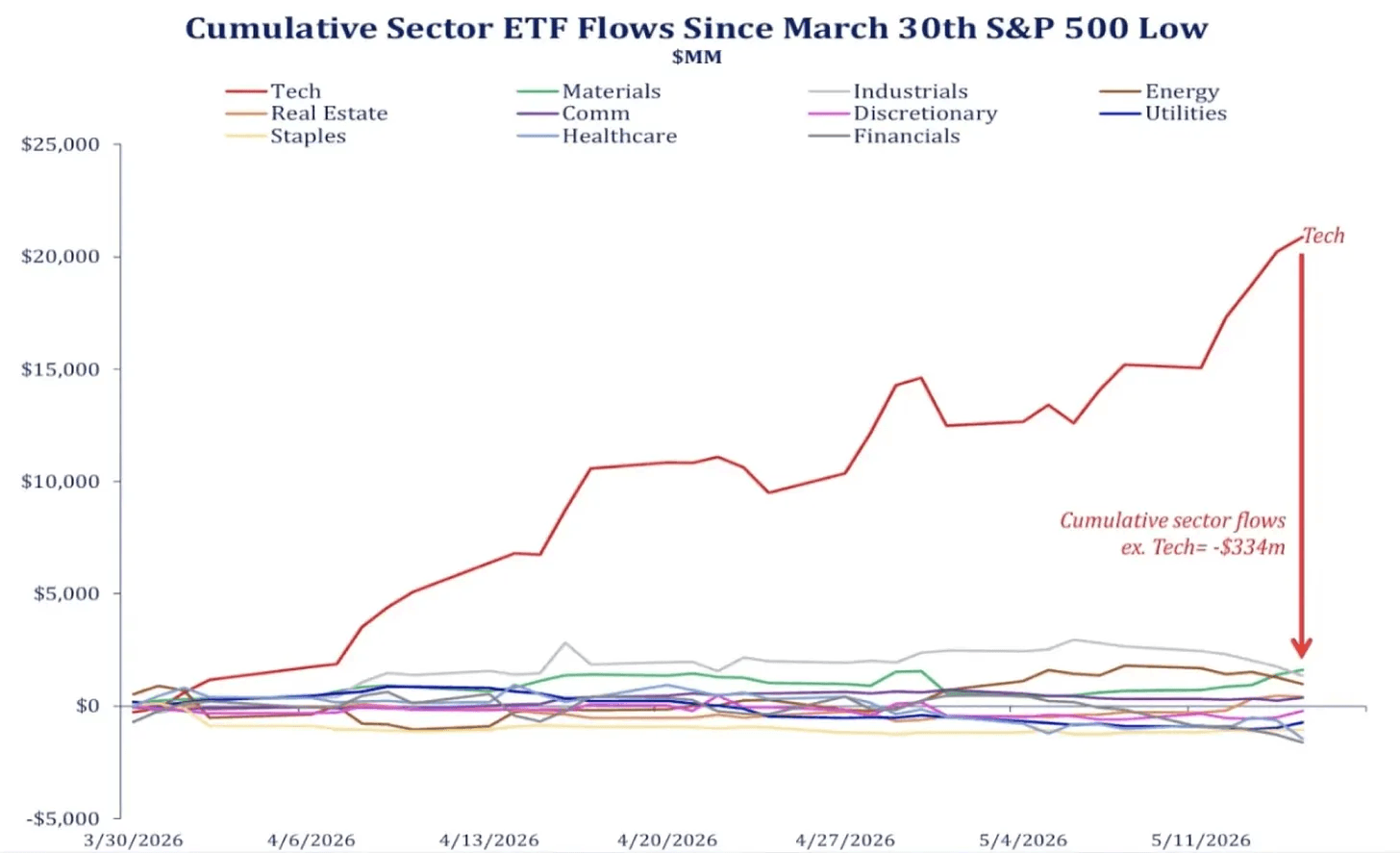
And that’s where investors want exposure. They are not spreading money evenly across the market. They are concentrating it in the sector with the strongest earnings revisions and the best AI tailwind. Since the March 30 lows, Tech has attracted more than $20 billion in cumulative sector inflows. Every other sector combined has seen negative $334 million. Of course, eventually crowded trades will correct. So, that is something to look out for. But strong trends like these last way longer than most people think.
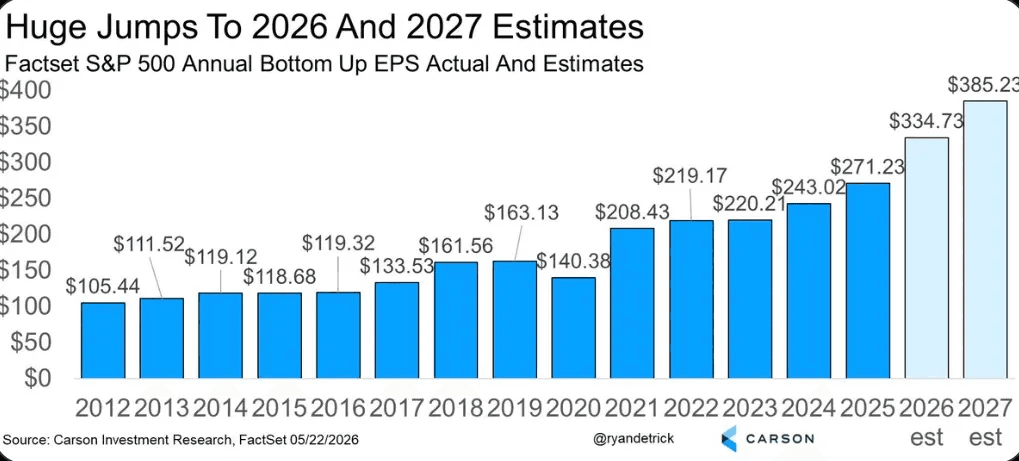
EPS estimates are exploding higher.
Just look at the jump expected in 2026 and 2027 compared to the years before. This is not a small improvement. This is a monster step-up in expected earnings power.
It pushes back against one of the biggest arguments against AI right now: that it is all hype and not showing up in real numbers.
We’ve discussed the AI infrastructure boom a lot over the last few years. And it is clear that AI is already turning into real revenue, real margins and real earnings growth for the companies best positioned in the value chain. This is major upgrade cycle where demand for compute, data centers, chips, power, software and infrastructure is flowing directly into earnings.
And Nvidia’s jaw-dropping quarter proved it again.
Record revenue of $81.6 billion, up 85% year over year and ahead of expectations. Adjusted EPS of $1.87, beat.
Q2 guidance of $89.2 to $92.8 billion, beat.
A new $80 billion share buyback.
A dividend increase from $0.01 to $0.25 per share. And total revenue growth of over 1,000% in three years.
There is no other company in the world putting up numbers like this.
Yet, it still traded down slightly right after earnings. In fact, that has been common for the last 2 years. But every single earnings dip was a great opportunity to buy. This time is likely not different.
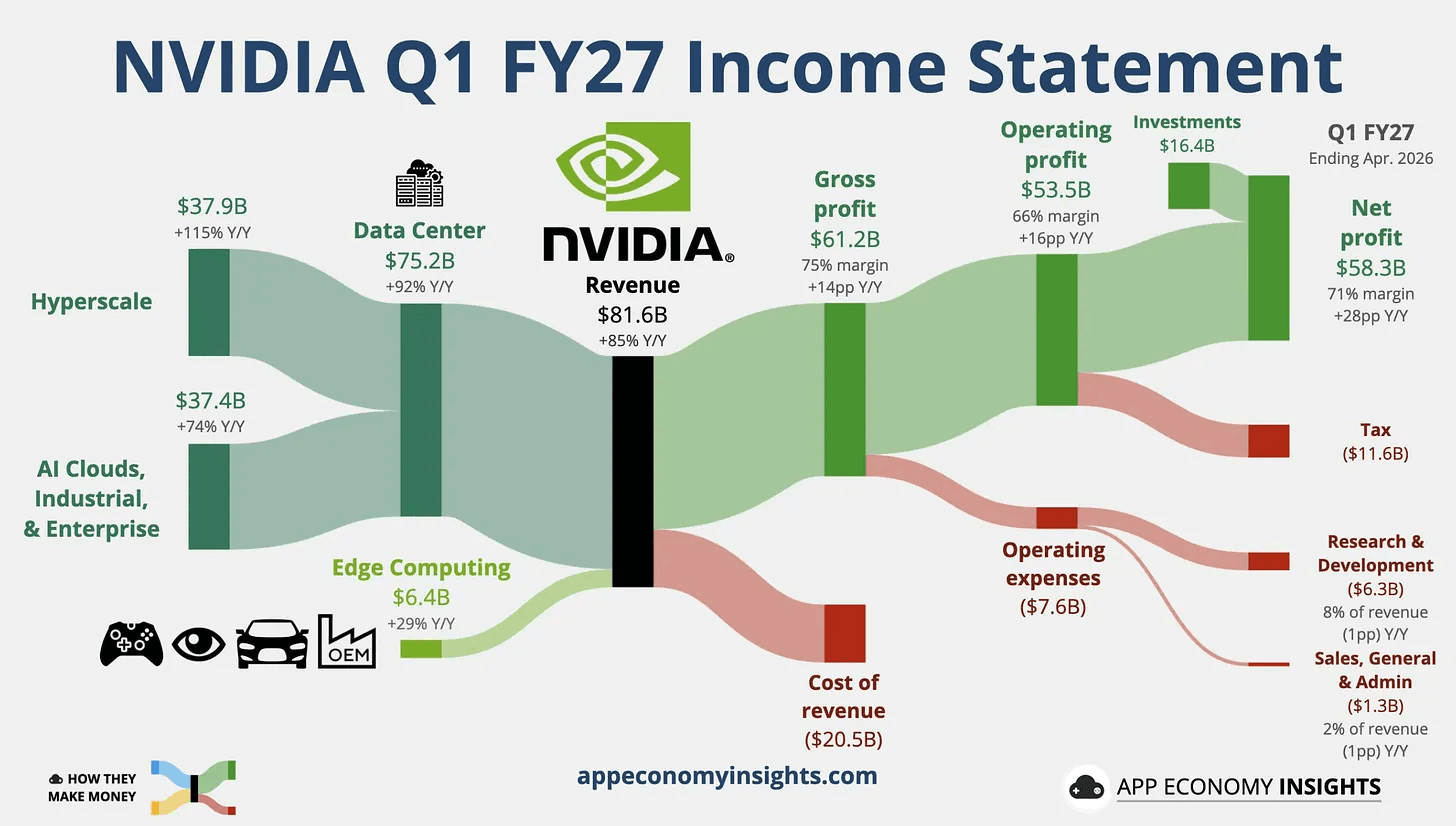
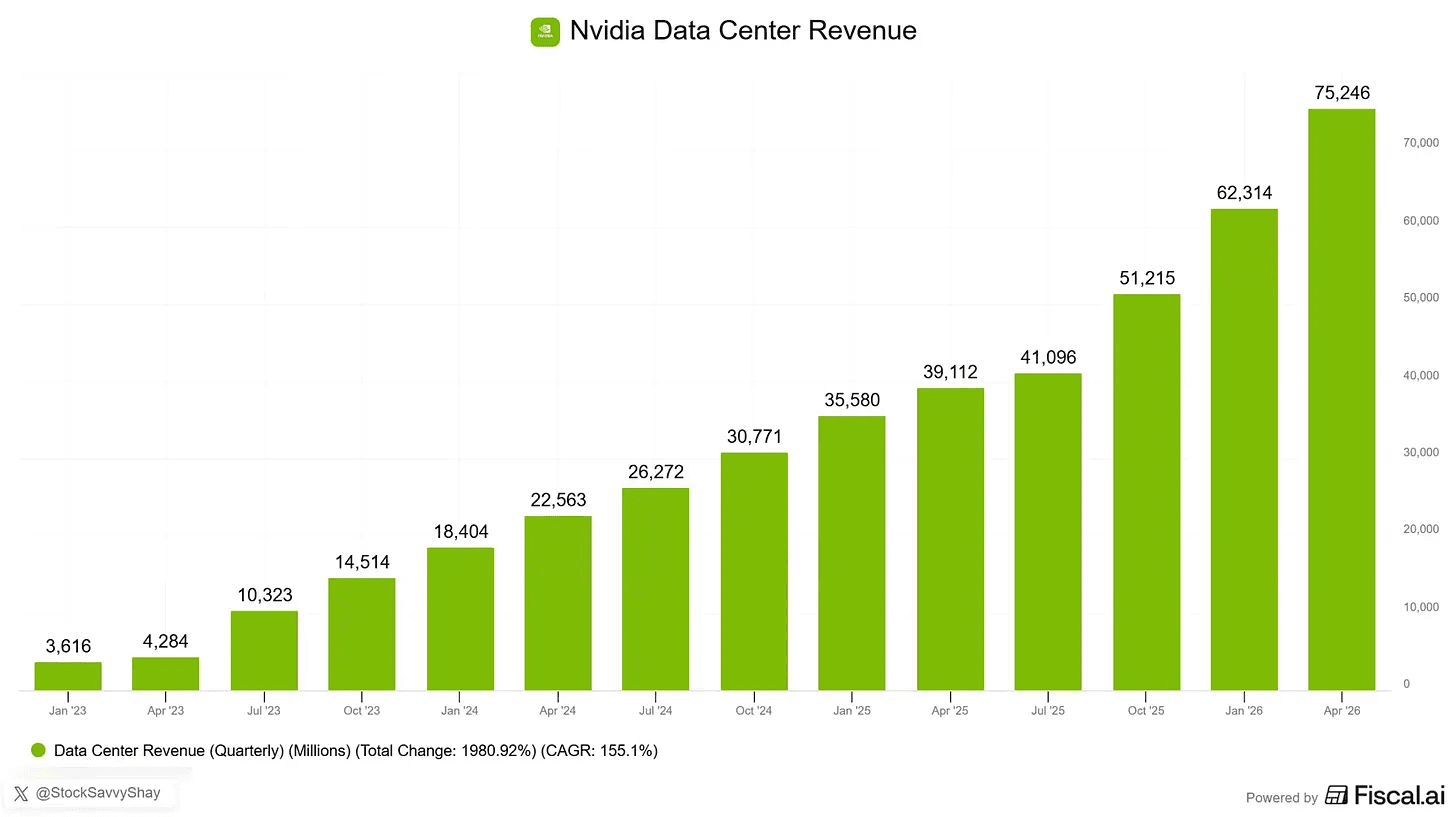
The data center business is the engine. Q1 data center revenue hit $75.2 billion, up 92% year over year, and has grown from $3.6 billion per quarter in early 2023 to where we are today. The Vera Rubin architecture remains on track for the second half of this year.
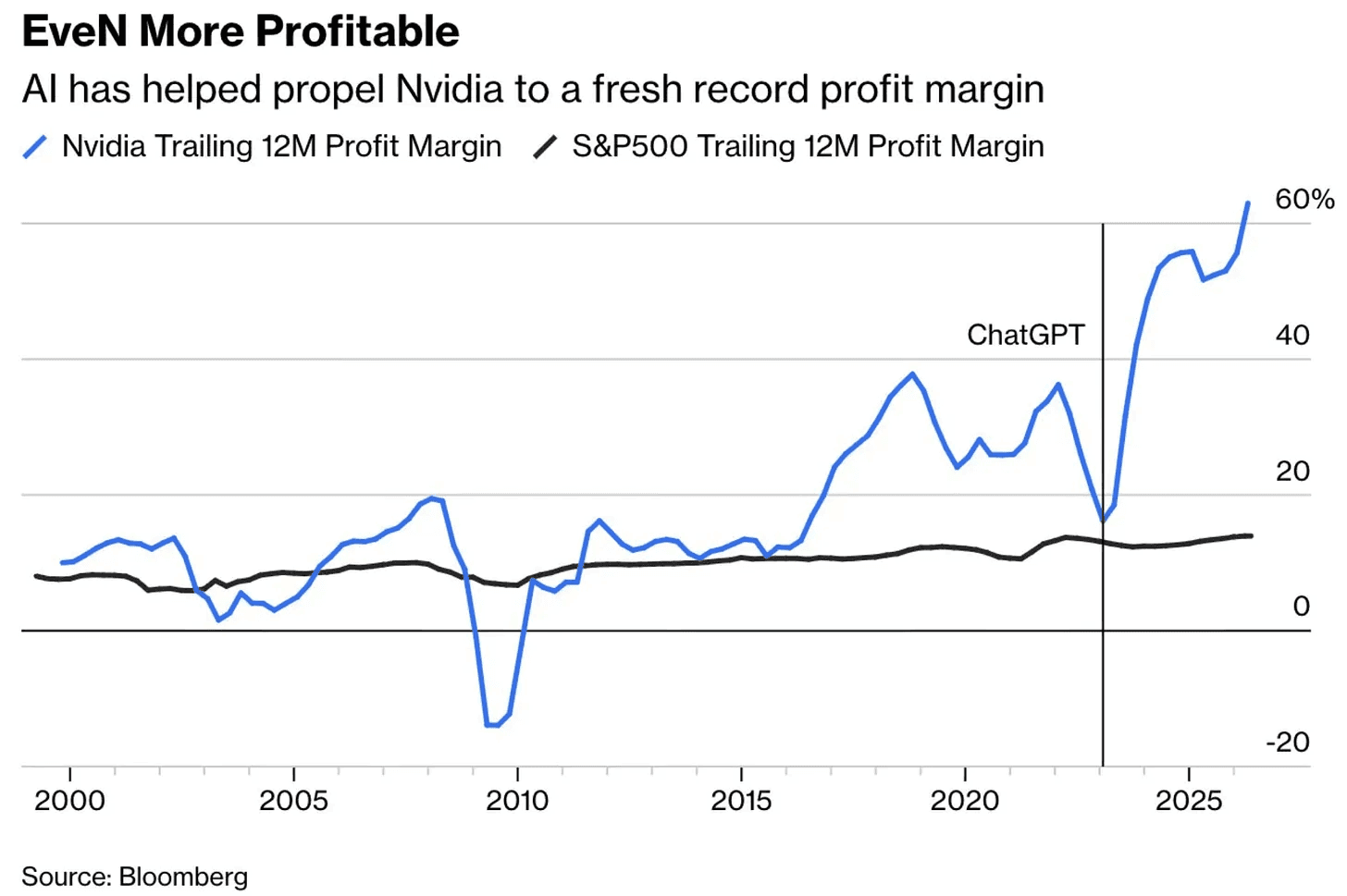
On the profit margin side, the AI era has taken Nvidia to a place no one could have predicted. Trailing 12-month profit margins are now approaching 60%, a record by a wide margin and in a completely different stratosphere from the broader S&P 500.
Jensen Huang closed with this statement during the earnings: “Demand has gone parabolic. The reason is simple: Agentic AI has arrived.”
If you’ve been following along for a while, this should not be surprising.
The current hyperscaler-driven boom is just one layer. Enterprise AI adoption, agentic AI infrastructure, and eventually physical AI in the form of robots and autonomous vehicles represent successive waves still ahead.
And then there’s the Vera CPU, which Huang framed as a potentially massive new market. Nvidia has already sold $20 billion in standalone Vera CPUs this year. His analogy, just as every human uses a PC, every AI agent will need its own compute. Billions of agents means billions of CPUs.
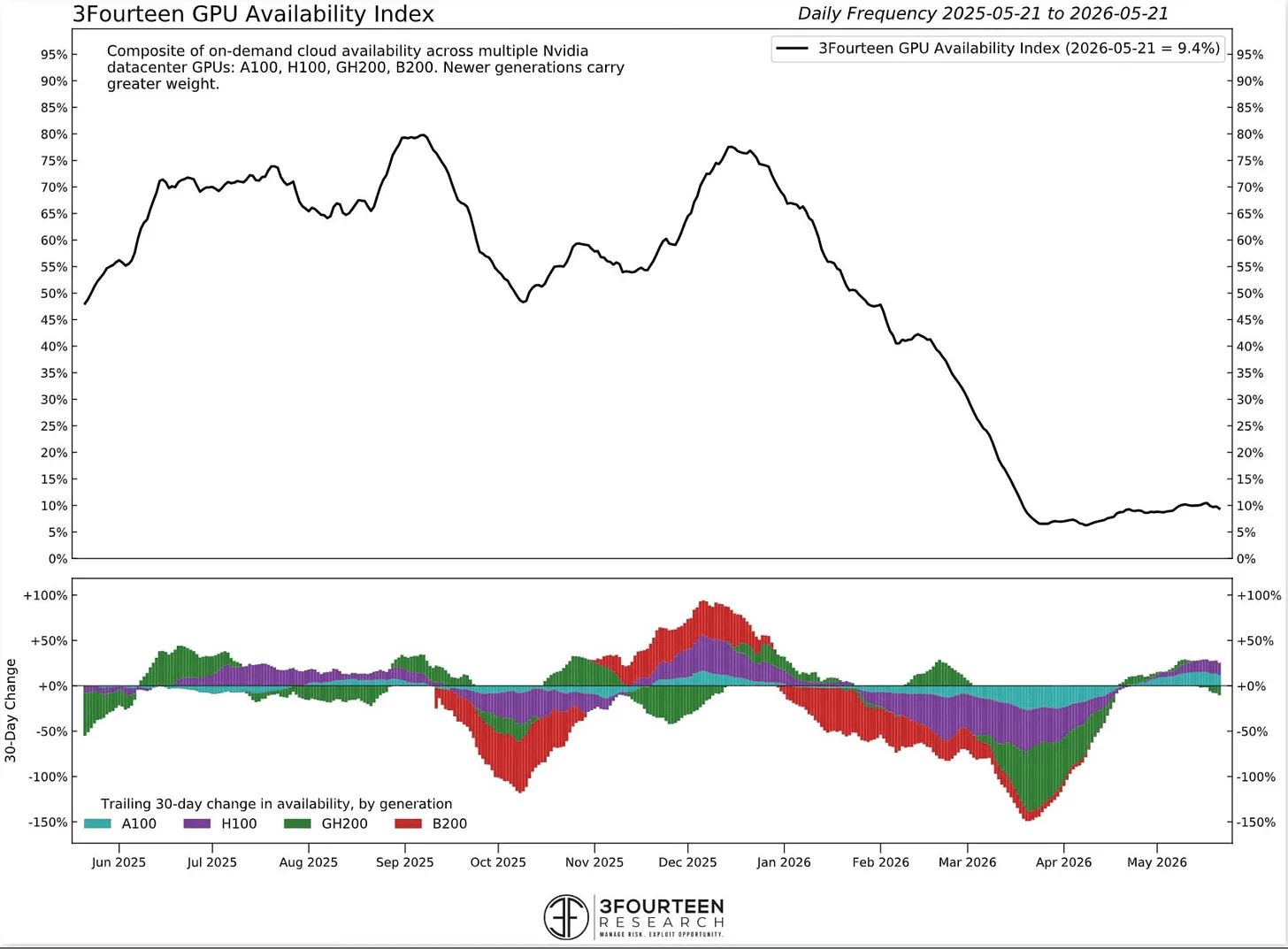
On the supply side, the GPU availability data reinforces the demand picture. The 3Fourteen GPU Availability Index has collapsed from roughly 80% availability at the start of the year to just 9.4% today. B200s are essentially unavailable. GH200 is scarce. Neoclouds like Nebius are even raising on-demand pricing by 29%.
The demand for compute continues to outstrip supply.
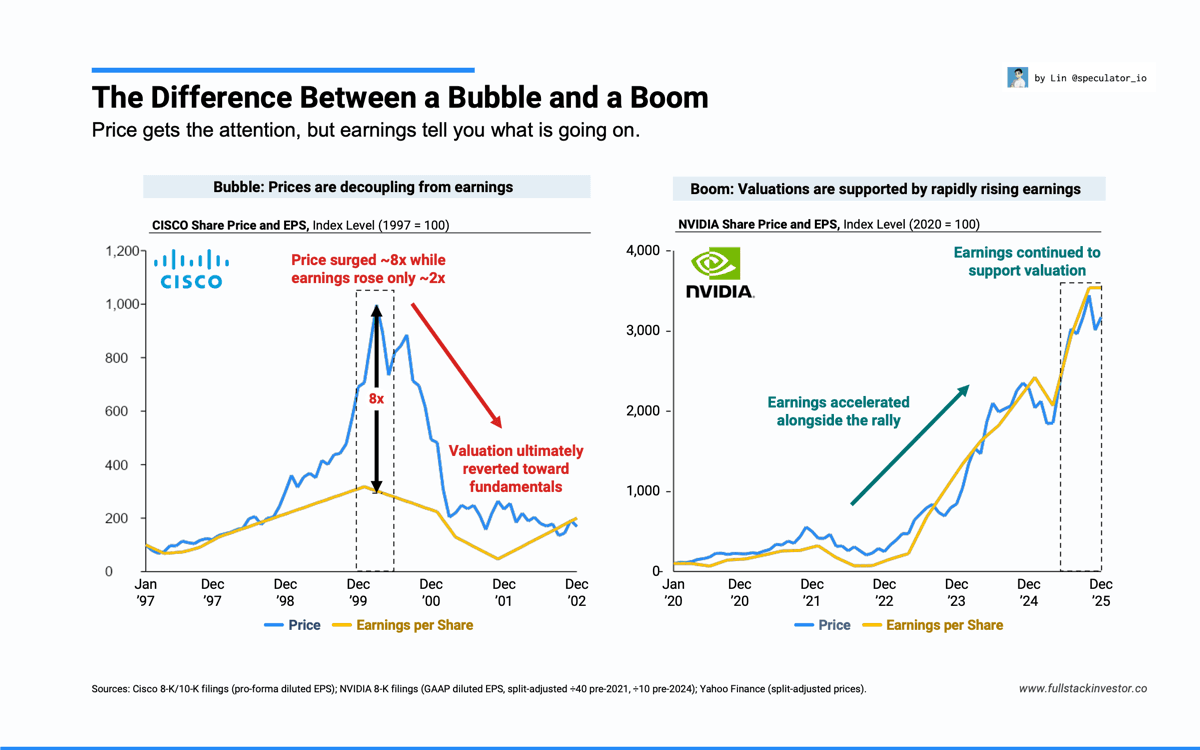
The difference between a bubble and a boom is not just the size of the price move. It is what happens underneath it.
In a bubble, prices run far ahead of the real business, and investors start paying more and more for earnings that are not keeping up. FOMO, momentum, and sentiment are driving the market. Eventually, the gap between expectations and reality gets too wide, and the market pulls the valuation back toward the fundamentals.
In a boom, the price can still rise a lot, but the move is supported by real growth. Revenue is rising, earnings are improving and the company is becoming more valuable for a real reason. That is why earnings matter so much.
And with Nvidia, you could even argue that the price is still trying to catch up to the earnings.
The market remains extremely strong. There is not much else to say.
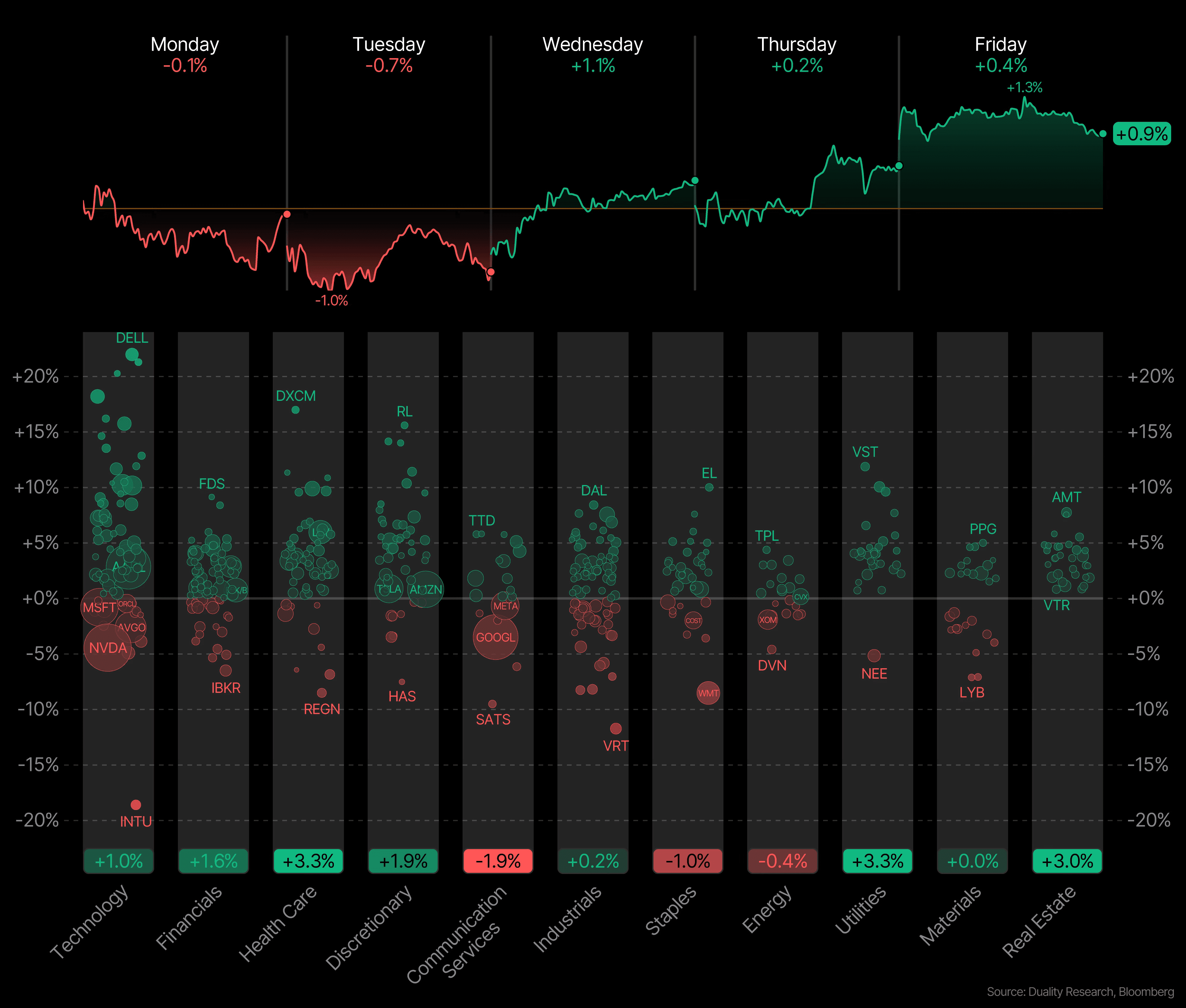
The S&P 500 just posted its 8th straight green week. The Nasdaq made a new all-time high. The Dow finally broke out to new highs. Small and mid caps bounced hard off the 10-week moving average. Semiconductors continue to lead. When you look across the board, the message is pretty clear: demand is still overwhelming supply.
That is one of the simplest ways to understand this market. Every dip keeps getting bought. Every small pullback attracts buyers almost immediately. That tells you investors are not waiting around for the perfect entry anymore. They want exposure, and they are willing to buy strength instead of weakness.
The bigger picture remains the same to me. This is a historic bull market, and pullbacks or consolidations should still be viewed as opportunities until the market gives us a clear and legitimate reason to think otherwise. Macro noise, scary headlines and short-term worries have not been enough to derail the trend. The market keeps absorbing them and moving higher.
That does not mean risk no longer exists. It always exists. But there is a big difference between respecting risk and fighting the tape. Right now, the tape is still bullish. The trend is still up. So the default stance has to remain bullish.
The goal is not to chase everything blindly. The goal is to stay focused on the major themes and the true market leaders. AI infrastructure remains the main theme. Compute, networking, energy, data centers, chips, robotics, rare earths and physical AI continue to look like the areas where the biggest opportunities are forming.
Previous Updates
View All
- Weekly Market Update: Accumulation
- Weekly Market Update: The Best Quarter
- Weekly Market Update: Rate Hikes
- Weekly Market Update: AI is Not Slowing Down
- Market Update: Has AGI Arrived?
- Weekly Market Update: Consolidation
- Weekly Market Update: September is Here
- Market Update: Nvidia Crushes Earnings
- Weekly Market Update: Yields
- Market Update: The Future of Biotech
- Weekly Market Update: Earnings Acceleration
- Market Update: The Next Generation of AI Infrastructure
- Weekly Market Update: New Highs