Go Back

Lin
Market Update: Managing Drawdowns (1)
One of the hardest aspects of being a long-term investor is that
even the best investments, or investment portfolios, suffer large
drawdowns.
Charlie Munger
has a take on drawdowns worth quoting in detail:
“I think it's in the nature of long-term shareholding with the normal
vicissitudes in worldly outcomes and in markets that the long-term
holder has his quoted value of his stock go down by say 50
percent. In fact, you can argue that if you’re not willing to react
with equanimity to a market price decline of 50 percent 2 or 3 times
a century, you’re not fit to be a common shareholder and you
deserve the mediocre result you are going to get—compared to
the people who do have the temperament who can be more
philosophical about these market fluctuations.”1
Munger not only argues that you have to be calm about these
declines, he goes further to suggest that if you cannot deal with
them “you deserve the mediocre result you are going to get.” In
other words, big drawdowns are a price to pay for superior long-
term investment returns.
The partnership that Munger managed produced a compound
annual growth rate of 19.8 percent from 1962 to 1975, but it
suffered a 53.4 percent drawdown in the 2 years ended in 1974.2
Long-term wealth creation for companies is also heavily skewed.
Hendrik Bessembinder, a professor of finance at Arizona State
University, studied the roughly 28,600 public companies that have
been listed in the U.S. from 1926 to 2024. Key to his definition of
wealth creation is that a stock produce returns in excess of one-
month Treasury bills.
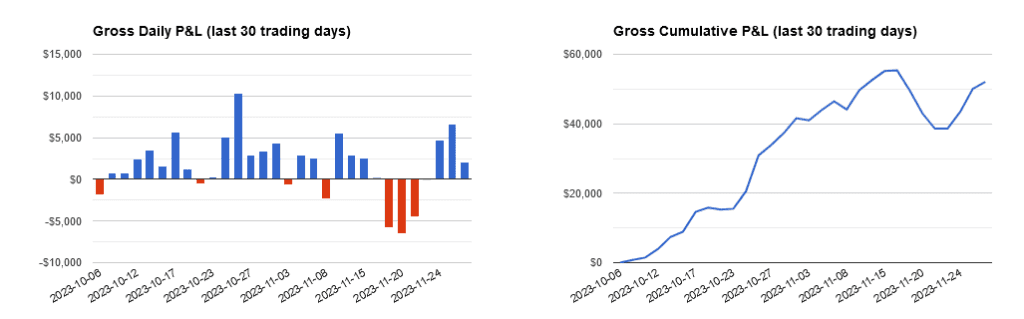
Over the last two weeks, I’ve been in a bit of a drawdown in my day trading,
meaning that I’ve been losing money and taking away from previous
gains. I dug myself a hole, and now I’m working on recovery. I have gone
through this more times than I could count, but I don’t know that it
gets easier. It is just never fun to be in a drawdown. It’s frustrating,
it’s disappointing, and it’s confusing. Nothing about it is good, but
it is an inevitable part of being an investor.
Types of Drawdowns
Not all drawdowns are the same. I would say
having one or two large red days that give back a week or so of progress
constitutes a drawdown. Having one or two red months that give back
months of progress also constitutes a drawdown but is certainly more
concerning and more substantial. On the other hand, drawdowns that
extend for years are not a drawdown but are just an indication that your
strategy is not working, as you can imagine. Over the years, I have
known traders who have experienced each of these types of drawdown
scenarios.
In the first scenario, which is the least severe, we’re talking about
a drawdown where you’re giving back perhaps a week or two of profit.
This is the type of drawdown that I experience the most frequently. It
happens several times a year that I dig myself a little bit of a hole,
and it takes a few weeks to recover. In my latest example that I’m
currently recovering from, I put together five consecutive red days.
It’s the second time I’ve done that this year. It’s certainly not fun.
My Latest Drawdown
It began with a red day on a Thursday, where I lost about $500. It
felt negligible, and I wouldn’t even consider that a drawdown. That’s
just a small red day. Then, on Friday, I proceeded to lose about $5000,
and I was 100% giving in to FOMO.
There was a stock that had made a really big move on Thursday. I had
missed it because the bulk of the move was later in the day, and I came
in bright and early on Friday morning. I jumped in with a 5 or 6000
share position. I thought I would catch a quick continuation trade, and
instead, I lost $5800 in just a few minutes of trading and I hit my max
loss. It was not a great way to go into the weekend. It was two red days
in a row, but not a significant drawdown either. It was just a little
disappointing.
Then, on Monday morning, I sat back down and had a third red day in a
row. It was not quite $5000, but it was a substantial red day. Come
Tuesday morning, I lost $4500 and had another red day. I tried to
exercise composure and hold it together, but I wasn’t able to do it. On
Wednesday, I finished green before commissions, but only by about $30. I
was red about $300 on the day after fees and commissions. On Thursday,
we had a market holiday for Thanksgiving, and on Friday, I bounced back
with a $5000 green day. I made another $5000 on Monday, and today, I was
up $2000. At this point, I’ve recovered about 80% of what I lost in my
drawdown. I’m ready to be a bit more aggressive going into the rest of
the week, as I’m feeling more confident.
Reducing Share Size
After my fourth red day in a row, I decided to reduce my share size
so I could only trade with a max of 10,000 shares. I think that was a
good decision to help me stay reined in. Ultimately, that decision is
what helped prevent me from having a multiweek drawdown. Usually, once
I’ve recovered about half of my profit or half of my loss is when I
start to size up, pull back the restrictions, and be a little bit more
aggressive. Since this drawdown only amounted to about $15,000 in
total, after I’d made back $7500, I was starting to feel like I was back
in the driver’s seat.
So now, let’s talk about what separates this drawdown from a trader
who might go on a multi-week or multi-month drawdown. I have known many
traders who have had many years of consistency but found themselves in
the midst of back-to-back red months, very poor accuracy, emotionally
fueled trading, and a substantial drawdown. These types of situations
always begin with one or two red days, just like my latest drawdown.
However, something happens here that makes it worse. Rather than enforce
guardrails and boundaries to slow down the bleeding, they will get
stubborn, frustrated, and emotionally hijacked. That leads them to trade
even more aggressively in the face of loss. This is a human response.
When something is being taken away, we reach for it, and we pull even
harder to get it back. This response, however, is not conducive to
success as a day trader.
Trade Smart, Not Hard
When gains become hard to capture, rather than trying harder, you
want to try less. This means when the market is cold, you want to ease
off the throttle and slow down, but the instinct is to double down to be
even more aggressive. That’s because now, not only are you trying to
make your daily goal, but you’re also trying to recoup what you
previously lost, which means in a poor market. You’re now trying to make
twice what you would make on average during a hot market. That’s gonna
be pretty hard to do. The more days that go by where you’re falling
short of this unrealistic goal, the more frustrated and emotionally
compromised you become. I say all this from a place of being very
empathetic to those who are in this position because I have been there
myself. I know the pain that comes with experiencing a large loss. It’s
important to note that a large loss is relative. What might be large to
me could be astronomical to you. What could be large to you could be
very small to someone else. It’s all relative. The point is that the
pain is the same.
If we gauged your response just based on how much pain you have, you
could be in as much pain from losing $100 as I might be in from losing
$10,000. That pain and discomfort is what will then lead to impulsive
trading. But, here’s the problem: if you get emotionally triggered when
you’re down $5000, imagine what’s gonna happen when you go into a
drawdown of $50,000 or $75,000. The more you lose, the deeper you fall
into a state of emotional hijack. That’s why it is so important to do
everything possible to preserve your emotional state. So, after having
one or two or three red days in a row, you have to acknowledge that what
you’re doing is not working. It doesn’t mean that your strategy doesn’t
work. It doesn’t mean that you’re no longer a profitable trader. It
just means, most likely, that there’s been a shift in the market that
you’re trading, and it’s not conducive to your strategy right now.
So, the things I do when I’m faced with 23 or four red days in a row
is I reduce my share size, and I begin doing a meditation before I start
trading. And what I’m meditating on is being okay with the discomfort
that I’m feeling at that moment, being okay with not taking any trades
today, and being okay with focusing on the best quality setups, even if
that means there’s only one or two of them this week. I will tell you
that it is a struggle. On Tuesday morning, I told myself I was going to
be calm, cool, and collected. The next thing you know, within a period
of 12 seconds, I incurred a $5000 loss. It was instantaneous. For just a
moment, I gave in to my emotional impulse to chase a stock and press
that buy button. It flushed down, and I lost over a dollar a share. I
lost my discipline in that moment. I came into the day with discipline,
and then I suddenly stopped being disciplined, and that was on me. I
should have been more disciplined.
The Dangers of Emotional Capitulation
One of the biggest dangers of falling into a multi-week and a
multi-month drawdown is when you emotionally capitulate. Emotionally
capitulating means you basically say, “screw it, I have nothing left to
lose.” At that point, you’re taking tremendous amounts of risk, and
you’re positioning yourself, unfortunately, to take catastrophic
losses. What will ultimately happen if you continue down that path is
you will be faced with a trade that could blow up your account because
your account keeps getting smaller and smaller and smaller until it’s
finally gone. Now, once you’ve hit rock bottom, then there’s a whole
different conversation about how you got there. A multi-month drawdown
turns into an annual or a multiyear drawdown when a trader digs their
heels in and refuses to acknowledge that what they’re doing is not
working. I have watched traders make millions and millions of dollars
only to lose it because they refused to adapt to a change in the market.
It’s important to know when to walk away and when to take profit off
the table. That is true on an intra-day basis, on a weekly basis, on an
annual basis, and when it comes to your career as a trader. However,
many people, when faced with loss, begin chasing the loss. They struggle
with the sunk cost fallacy that because they already have so much
invested, they feel they are justified in chasing those losses to try to
recover.
Hitting Rock Bottom
Somebody recently asked me what my turning point was in my career. My
turning point was when I hit rock bottom. I didn’t have to lose half a
million dollars to hit rock bottom. I didn’t make 5 million and then
lose 5 million. For me, rock bottom was accumulating $30,000 of credit
card debt and spending 18 months trying to learn how to trade with
nothing to show for it. I had made about $30,000, and then I lost it. In
the meantime, I’d accumulated credit card debt by paying for my cost of
living on a credit card instead of taking money out of my account. So
every time I would lose money in my account, I was losing the ability to
continue to trade. My turning point came after a final big loss that
made it so I couldn’t trade in my account until I added more money. The
reason this was a turning point was because it forced me to look very
carefully at what I was doing that was working and what I was doing that
was causing me so much trouble. Hitting rock bottom also forced me to
come to the table with a sense of discipline that I didn’t have before. I
knew that this was going to be my final chance to make it work and that
I had to do everything the right way. I could not continue to give in
to my emotional impulses. Had I not hit rock bottom, I think I would
have likely continued to lose money if I had added more money to the
account.
Necessity is the Mother of Invention
There’s a quote that “Necessity is the mother of invention.” In my
case, I simply could not afford to make another mistake. I did a lot of
interesting things during my period of recovering from those losses. I
remember putting a tack on my shoe so I would feel uncomfortable while I
was standing and trading. It helped remind me to walk away sooner, and,
of course, I would take the tack out of my shoe once I was finished
with trading. I couldn’t afford home heating oil since I was putting
that money into my trading account, and I had to collect and split
firewood to be able to keep the house warm through the winter. I spent
my afternoons outdoors doing this type of manual labor instead of
staring at the computer gambling during the hours of the market, where I
generally lost money. Trading did not come naturally to me. I didn’t
have much beginner’s luck, and I found myself easily giving in to the
fear of missing out. So, for those who are in any of the phases of
drawdown, I think it’s important to realize that to stop spiraling, you
seriously need to stop doing what you’re doing right now in your
trading. That requires having a very high level of discipline. The
bigger the drawdown, the more discipline it requires.
You may only be able to sit in front of your computer without falling victim to FOMO
for half an hour a day, but if that’s all you can manage, then you
should just do the 30 minutes of trading and then come back and try
again tomorrow. The last thing you wanna do is continue the downward
spiral and the cycle of getting more and more aggressive to try to
compensate for losses. I know from experience that that is a path to
hitting rock bottom. It’s just not worth it. So, while being in a
drawdown is never fun, the depth of your drawdown is within your
control. No matter how deep in the red you are right now, you have a
choice to take a step back. Look at what you’re doing that’s working,
and look at what you’re doing that’s not working, and create a set of
guard rails that you will follow to keep you on the track to recovery.
In my new book, How To Day Trade: The Plain Truth,
I lay out 20 guard rails that I’ve implemented in my trading that have
helped me during periods of drawdown. I used these just this past week
to help me recover and get back on track before I dug myself a
multi-week or a multi-month drawdown. I encourage you guys to pick up a
copy of the book and take a look at these guardrails.
Previous Updates
View All
- Weekly Market Update: Earnings Season is Back
- Weekly Market Update: Big Tech Divergence
- Weekly Market Update: Accumulation
- Weekly Market Update: The Best Quarter
- Weekly Market Update: Rate Hikes
- Weekly Market Update: AI is Not Slowing Down
- Market Update: Has AGI Arrived?
- Weekly Market Update: Consolidation
- Weekly Market Update: September is Here
- Market Update: Nvidia Crushes Earnings
- Weekly Market Update: Yields
- Market Update: The Future of Biotech
- Weekly Market Update: Earnings Acceleration