Go Back

Lin
Market Update: Nvidia Couldn’t Save the Market
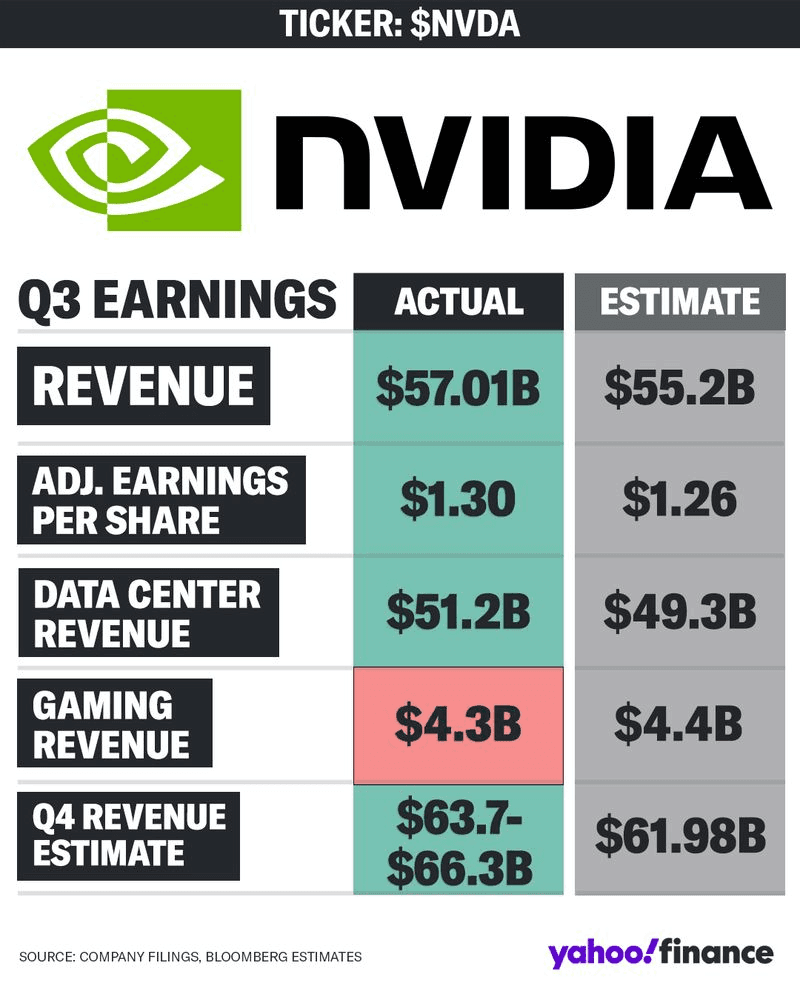
Nvidia delivered another historic quarter.
Revenue came in at $57B, up 62% YoY, and they raised Q4 guidance to $63.7B to $66.3B. Data center revenue hit $51.2B, up 66% YoY, so demand for accelerated computing is still running way ahead of supply. Net income jumped to about $32B, up 65% YoY. Gross margins were a huge 73.4%.
They also announced more multi year orders worth hundreds of thousands of GPUs from governments, hyperscalers, and big enterprises. Most software companies never see numbers like this. And Nvidia does it with hardware, networking, and software all at once. The whole thing runs with margins that look like cloud SaaS. It’s unreal.
But even numbers like that couldn’t save the market.
That’s when you know the market needs to more time to reset.
For the past few weeks I kept coming back to one idea. Patience. I have reduced my activity a lot because the environment changed and the risk reward shifted. You could see it in how the speculative names, volatility increasing, crypto getting crushed, and the market starting to trend down. It was on us to notice that shift and the signs were there.
Everyone wants to know what to buy and when to buy. But the hardest part is knowing when to exit. Selling is the most difficult part of investing. It makes you emotional. Because there is no perfect way to sell. You will always feel stupid. Either you sell too early and the stock goes higher. Or you sell too late and it goes lower.
It’s a game of imperfect decisions and no matter what we do, hindsight will always make us feel like we could’ve done better. The only thing we can control is making consistent, rational choices that protect our capital and keep us in a position to win long term.
At the end there is only one thing that matters and that is how much you make when you're right and how much you lose when you're wrong. Nothing else. That’s why having clear sell rules is important. Hence, I’ve continued to reduce exposure, or rather I got forced to sell because some stop losses hit.
Here are a few fundamental and technical guiding principles on when to sell. Selling is never easy, but these ideas help you make better decisions and stay objective:
Fundamentals:
1. Management changes
Leadership shift often signals deeper problems.
The culture and direction of the company can change fast.
A new CEO introduces unknowns.
2. Worsening earnings
One bad quarter is fine, a trend of weak results is not.
Stocks follow earnings over time.
You must check if weakness is temporary or structural.
If the core business weakens, exit the position.
3. Better opportunities
Capital is limited.
Sometimes selling a good stock makes sense if a better one appears.
It is normal if the old stock continues higher.
The key question is where your money works hardest today.
4. Legal issues or fraud concerns
Immediate sell. No questions.
You cannot trust the numbers anymore.
Too many clean companies exist to stay in one with scandals.
Fraud destroys investor trust for years.
Technicals:
Closing below key moving averages
Strong trends ride the 21 day EMA and 50 day SMA.
A close below them is a red flag and signals the trend is reversing.
This is a signal to start reducing or cutting the position entirely.
2. Closing back below a breakout level
A failed breakout traps buyers.
Once price closes below the breakout zone, sentiment flips negative.
Often leads to heavy downside.
3. Multiple high volume red days & weeks
Suggests institutions are selling.
After big money leaves, rallies weaken.
The trend usually slows or reverses.
4. Lower highs and lower lows
Classic sign of a trend reversal.
First lower high is often the warning.
Do not stay once the trend starts breaking down.
5. Relative weakness
If the market or sector is strong but your stock is declining, something is wrong.
Leaders outperform. Weak names lag early.
That’s an early signal to exit.
Previous Updates
View All
- Weekly Market Update: Big Tech Divergence
- Weekly Market Update: Accumulation
- Weekly Market Update: The Best Quarter
- Weekly Market Update: Rate Hikes
- Weekly Market Update: AI is Not Slowing Down
- Market Update: Has AGI Arrived?
- Weekly Market Update: Consolidation
- Weekly Market Update: September is Here
- Market Update: Nvidia Crushes Earnings
- Weekly Market Update: Yields
- Market Update: The Future of Biotech
- Weekly Market Update: Earnings Acceleration
- Market Update: The Next Generation of AI Infrastructure