Market Opportunities
Market Opportunities
Actionable Real-Time Market Setups
Actionable Real-Time Market Setups

Lin
AAPL
Lumentum $LITE
Lumentum $LITE
AI infrastructure is becoming increasingly constrained by networking.
Lumentum builds the optical components that allow massive AI clusters to move data fast enough to keep those systems working efficiently.
A modern AI cluster can contain tens of thousands of GPUs. Those GPUs constantly exchange enormous amounts of data with each other. As clusters get larger and bandwidth requirements rise, electrical connections become less practical over distance because they consume more power and lose signal quality.
Lumentum makes high-speed optical transceivers, laser transmitters, photonic integrated circuits, photodiodes, coherent components, and high-power laser sources used inside data centers and between data centers. These products convert electrical signals into light, transmit that data over fiber, and then convert it back again.
Basically, Lumentum provides the optical technology that allows those networks to move enormous amounts of data at extremely high speeds. And the amount of optics required per AI cluster keeps increasing.
Lumentum is already moving from 800G products toward 1.6T optical modules, with 3.2T becoming the next step. Its current 1.6T DR4 design uses 4 x 400G EML lasers and is specifically targeted at hyperscale AI data centers.
Every time hyperscalers add more GPUs, they also need more switches, more fiber, more transceivers, and more lasers.
Today, optical transceivers generally sit at the front of a switch and connect back to the switch chip electrically. As bandwidth moves toward 3.2T and beyond, those electrical connections become increasingly inefficient. Co-packaged optics moves the optical engine much closer to the switch or accelerator itself. That reduces electrical distance and can lower power consumption, which is becoming extremely important as AI clusters consume more power.
But those optical engines still need lasers.
Lumentum is developing external laser source modules for these architectures, including ultra-high-power lasers designed specifically for CPO and near-packaged optics. The company recently demonstrated an 8-wavelength external laser module aimed at next-generation AI scale-up infrastructure, with initial availability expected in the first half of 2027.
The financial acceleration already shows how powerful that demand has become.
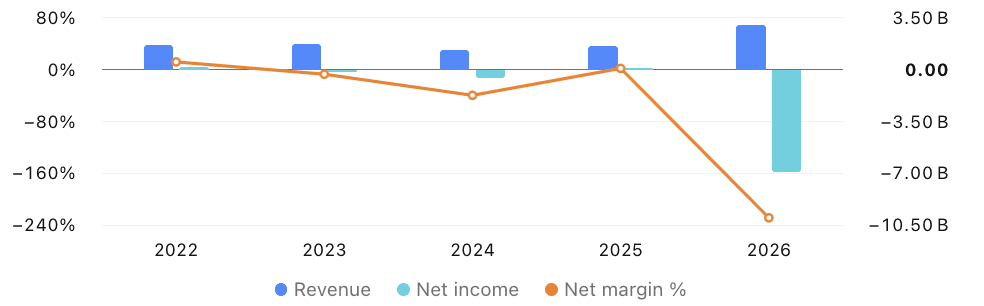
Fiscal 2026 revenue reached $3.0 billion, up 83% from $1.65 billion the year before.
In Q4 alone, revenue reached $1.01 billion, up 109% year over year and 25% sequentially.
Non-GAAP gross margin expanded from 37.8% to 50.4% year over year.
Non-GAAP operating margin went from 15.0% to 36.6%.
For fiscal 2026, Lumentum reported a GAAP net loss of $6.94B, but that was driven by a $7.76B non-cash loss on debt extinguishment related to convertible notes. So that does not reflect the underlying operating performance of the business.
The better number is non-GAAP net income.
Lumentum generated $782.3M of non-GAAP net income in FY2026, up from $146.4M in FY2025. That is more than a 5x increase in 1 year. Non-GAAP EPS increased from $2.06 to $8.67.
For the next quarter, management guided to $1.225 billion to $1.275 billion of revenue and roughly 40% non-GAAP operating margins.
And the current numbers are still relatively early in the product cycle.
Capacity is just starting to expand. Lumentum is building out a new 240,000-square-foot manufacturing facility in North Carolina for advanced indium phosphide optical products, including CW and ultra-high-power lasers used in large AI data centers.
You don’t add major manufacturing capacity for a temporary 1 or 2 quarter spike.
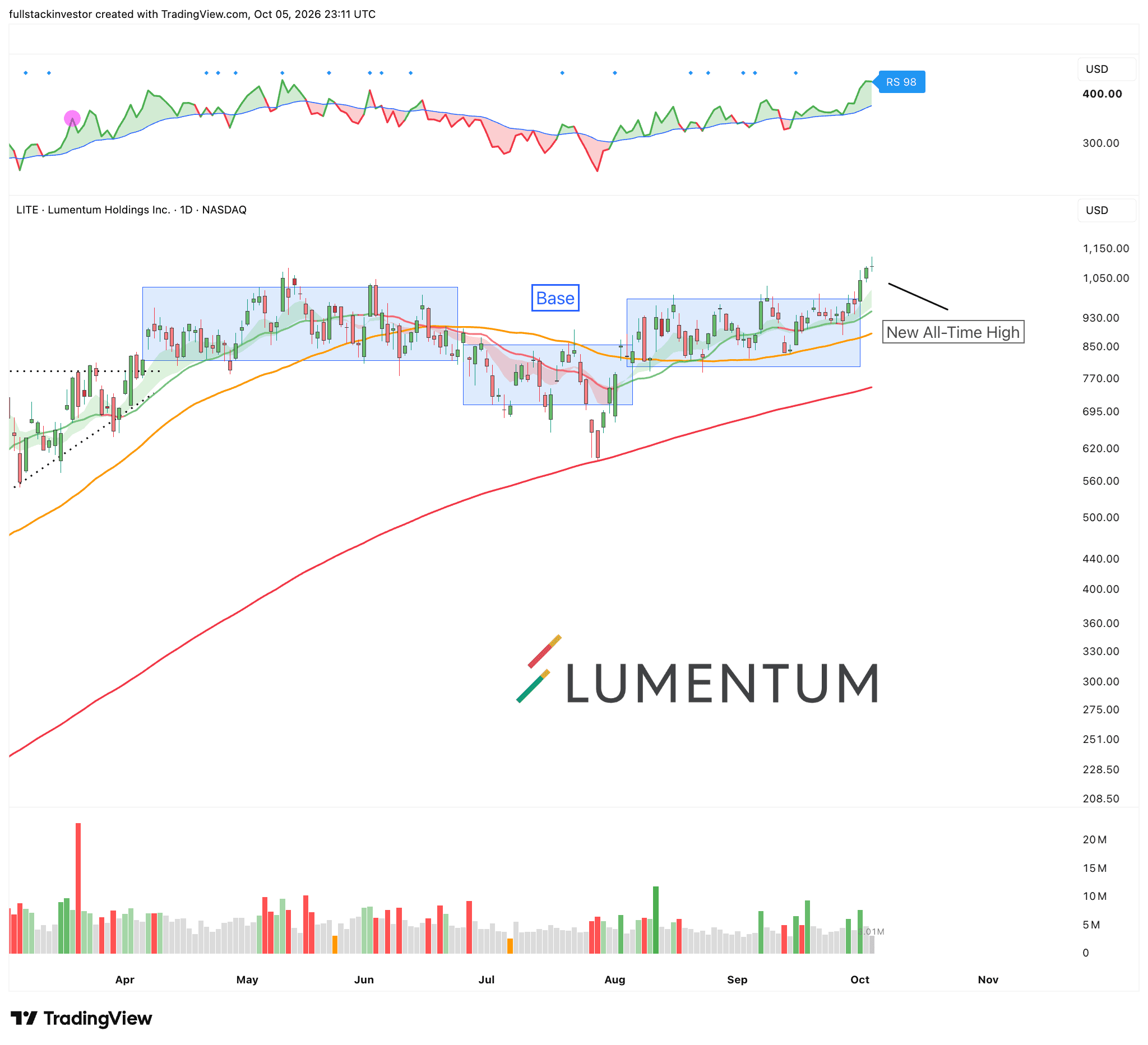
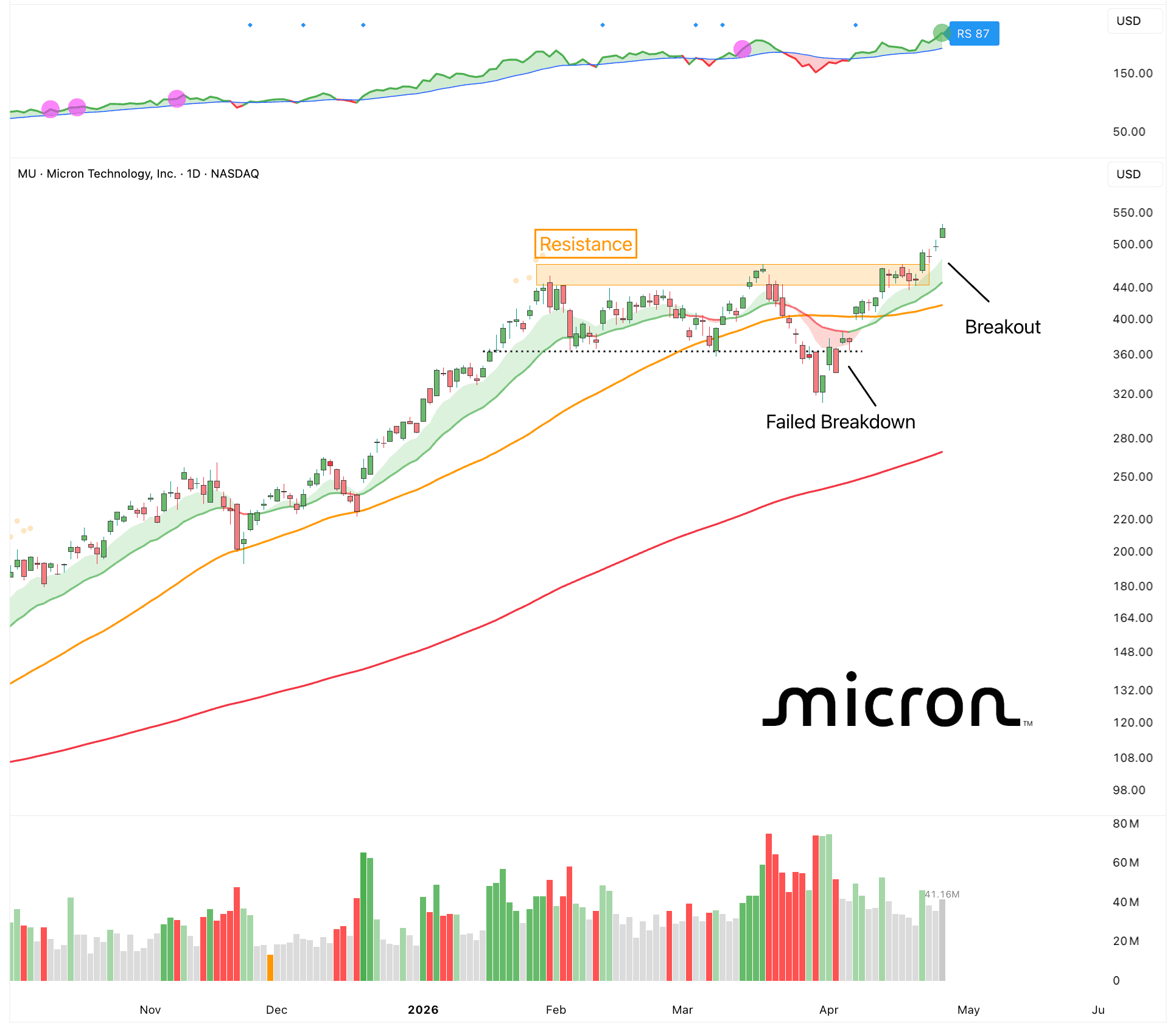
It’s been consolidating since March and now just broke out to new all-time highs. It’s still light on volume but if the general market is supportive this could be an incredible setup.
Lin
AAPL
Zeta $ZETA
Zeta $ZETA
Zeta helps large companies use customer data to decide who to target, what message to send, where to spend marketing dollars, and increasingly, which actions should be handled automatically by AI agents.
At the center of the business is the Zeta Marketing Platform.
The platform combines customer data, identity resolution, analytics, campaign management, media activation, and AI inside one system. Companies can use it to build customer profiles, predict behavior, create audiences, run campaigns across channels like email, social, CTV, display, and mobile, and then measure which campaigns actually drove revenue.
Enterprise marketing is still incredibly fragmented.
A large company may have customer data sitting across CRM systems, websites, apps, loyalty programs, ad platforms, email tools, and offline transactions.
Connecting all of that data to one person and then deciding what to do with it, is incredibly difficult.
Zeta’s advantage is that it tries to own that entire loop.
Data comes in. Zeta identifies the customer. Its models predict what that customer is likely to do. The platform decides what action to take. Then it activates the campaign and measures the result.
Zeta’s biggest AI product is Athena.
Athena acts as an intelligent interface on top of the platform. Instead of marketers manually digging through dashboards, building segments, and testing campaigns, they can ask questions in natural language and let Athena turn those questions into actions.
Zeta says Athena can analyze customer signals, identify opportunities, recommend what to do next, and help execute campaigns. It became generally available in March 2026.
Traditional marketing software mostly helps humans do work faster.
Agentic marketing software can start doing parts of the work itself.
Zeta already offers agents for tasks such as audience building, campaign creation, customer analysis, content optimization, and workflow automation. Its agentic workflows can chain multiple agents together so an entire marketing process can run with much less manual work.
The company has also started building around some very strong partners. OpenAI models are powering parts of Athena’s conversational and agentic capabilities.
And in June, Zeta announced a strategic partnership with Palantir. Zeta plans to rearchitect its Data Cloud on Palantir Foundry, combining customer intelligence from Zeta with Palantir’s broader enterprise data infrastructure.
Zeta’s SuperGraph contains signals across roughly 245 million U.S. individuals. That gives its models a large identity and behavioral dataset to work with when customers are trying to understand audiences or predict behavior.
And the financials are now starting to reflect the product momentum.
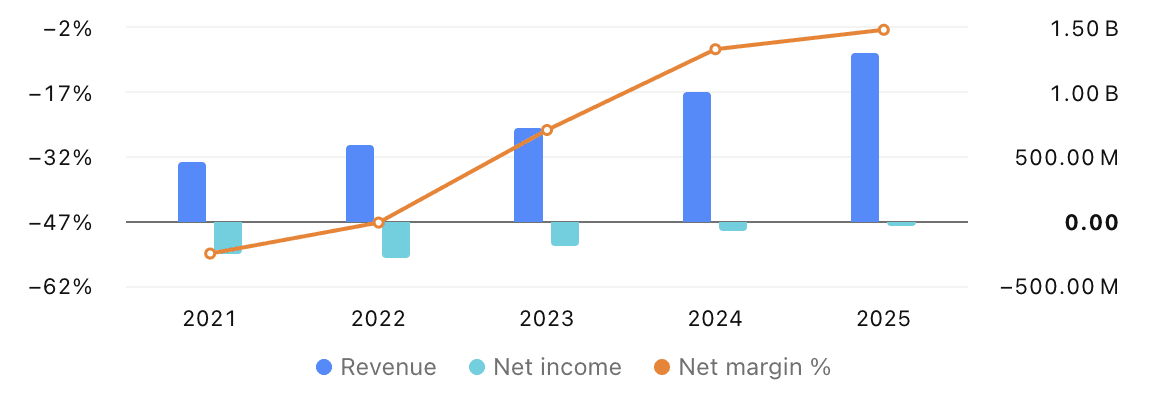
Revenue reached $443 million in Q2 2026, up 44% year over year. That was Zeta’s 20th consecutive quarter of beating and raising expectations.
Its largest customer cohort is also expanding. Super-Scaled Customers reached 197, up 17%, while average revenue per Super-Scaled Customer increased another 17% to $1.8 million.
Profitability is improving quickly as well. Adjusted EBITDA reached $92 million in Q2, up with an adjusted EBITDA margin of 20.7%, expanding 170 basis points year over year.
Free cash flow increased 73% to $58 million.
And for the first time, Zeta generated positive quarterly GAAP net income.
Management now expects around $1.82 billion of 2026 revenue at the midpoint, representing roughly 39% reported growth. Some of that comes from the Marigold acquisition, so the underlying growth rate could be faster, but still very strong.
Zeta can become much more valuable if Athena successfully automates enterprise marketing.
The moat has to come from data, identity resolution, workflow integration, customer relationships, and measurable performance, not simply from adding an AI chatbot to the product. The stronger Zeta becomes as a data and decision layer, the harder it becomes to replace.
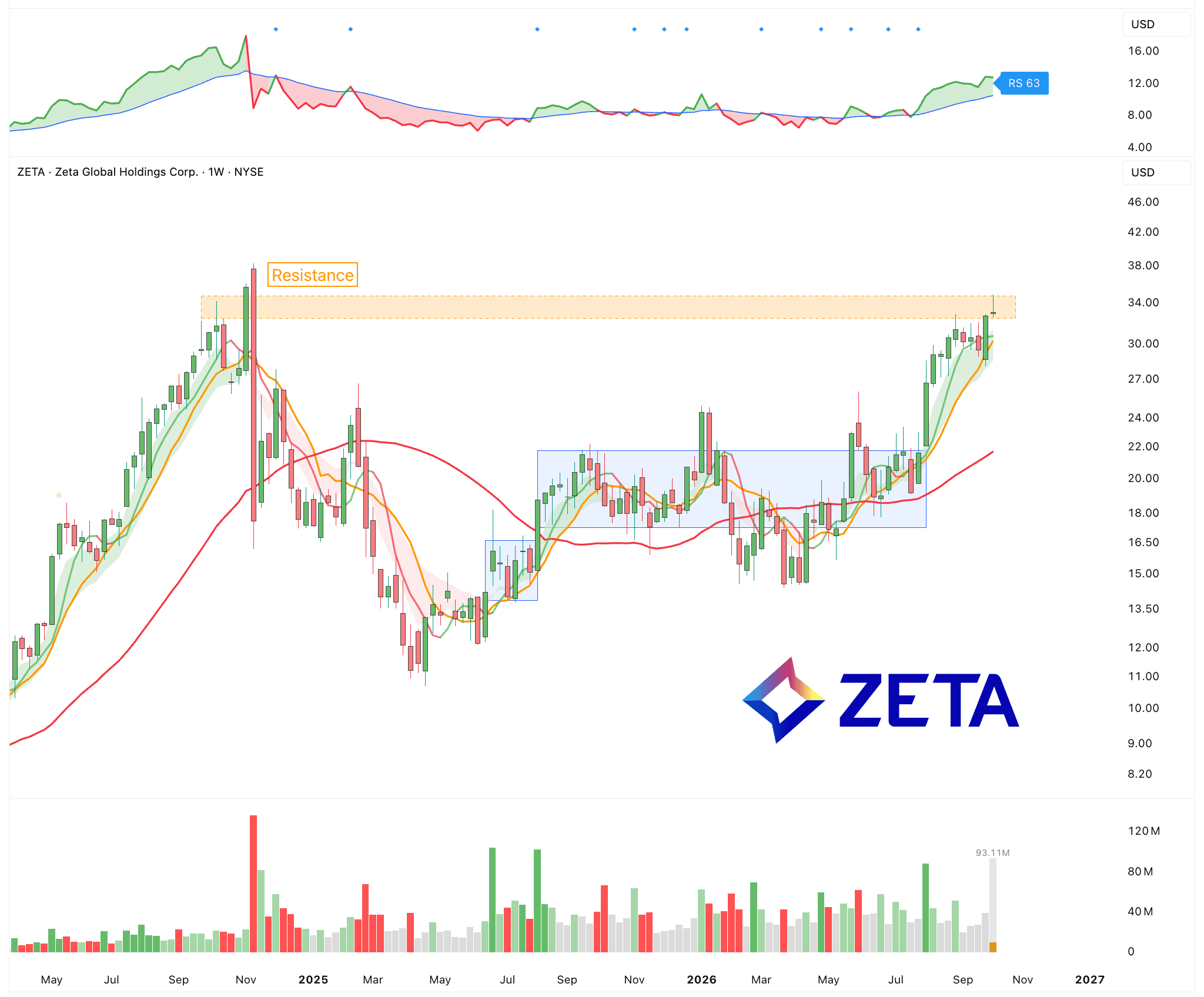
It’s trying to break out to new all-time highs. Right now, it’s consolidating nicely just below its highs from last year. If it can break out here that would be an attractive buying opportunity.
Lin
AAPL
Five9 $FIVN
Five9 $FIVN
Customer service is one of the biggest areas of enterprise spending that AI can directly automate.
Large companies still employ thousands of people to answer calls, reply to messages, verify customers, look up information, update accounts, process requests, and solve fairly repetitive problems.
So far, most of this work has been hard to automate because customer conversations are unpredictable. Traditional chatbots and phone systems could follow predefined decision trees, but they struggled as soon as a customer asked something outside the script.
AI models can now understand natural language, keep track of context throughout a conversation, search company knowledge, access customer data, and generate increasingly human-like responses. And instead of just answering questions, an AI agent can authenticate a customer, access backend systems, check an account, update information, run workflows, and complete the request without needing a human employee.
That’s why customer service is one of the best real-world applications for AI agents, and this is exactly what Five9 does.
Five9 originally built its business around cloud contact center software. Its platform handles the infrastructure companies use to communicate with customers across voice and digital channels, including routing calls, managing agents, recording interactions, workforce management, analytics, and integrations with systems like CRM software.
Five9 already serves more than 3,000 customers and works with more than 1,400 partners globally. This allows Five9 to introduce AI directly into the contact centers companies already use.
Five9's Voice AI Agents can understand what a customer wants, work through the request, and take actions across enterprise systems. An orchestrator agent decides what needs to happen, while specialized agents can handle tasks such as identity verification, retrieving information from backend systems, and carrying out actions. If the AI cannot complete the request, the conversation can be transferred to a human agent while keeping the full context.
For the interactions that still require humans, Five9 is using AI to make those employees more productive. Agent Assist can transcribe calls, surface relevant information, provide real-time guidance, and automatically generate summaries after a conversation. Five9 also offers AI Knowledge, conversational analytics, workflow automation, and tools for managing these AI systems.
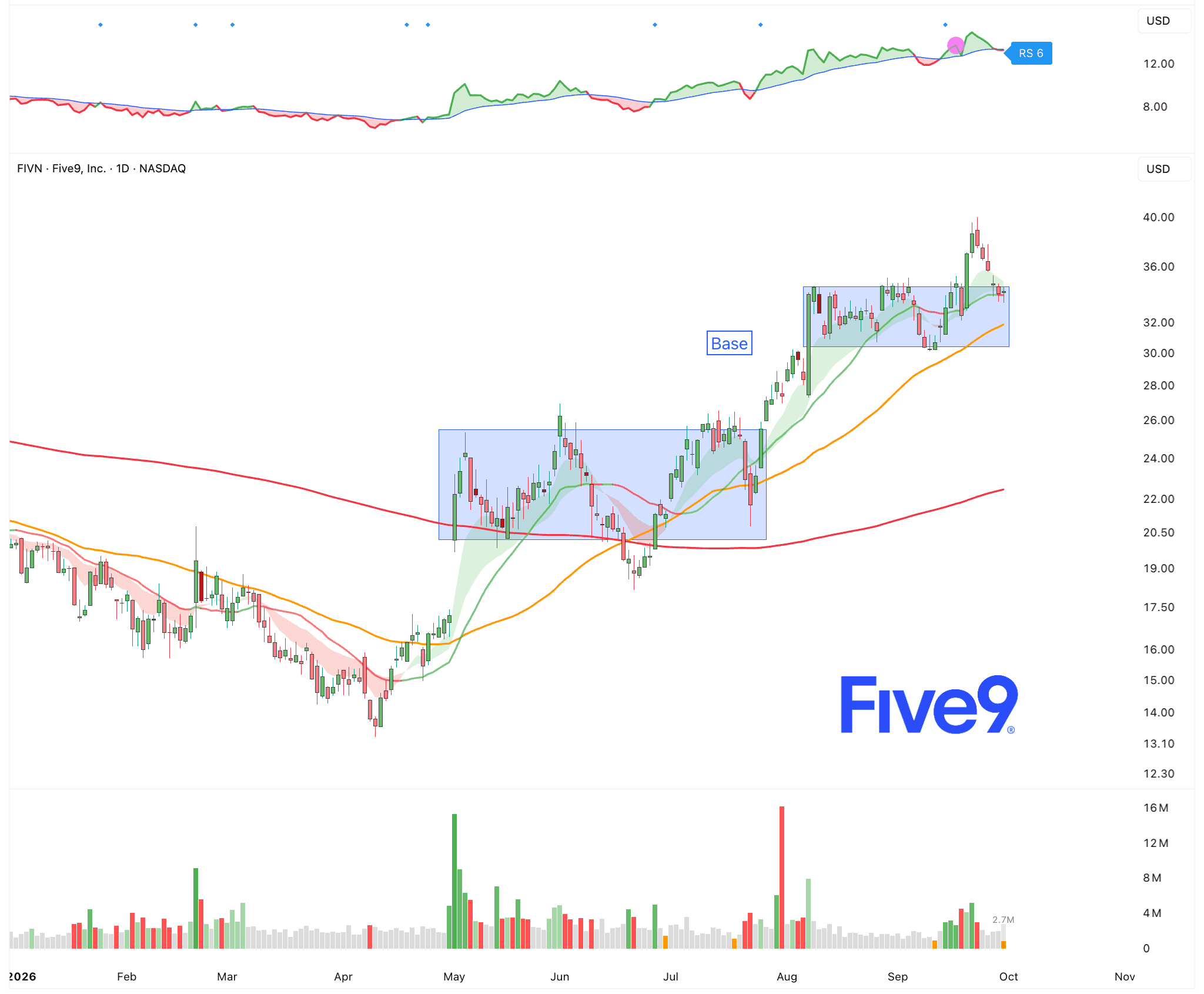
Five9 generated $312M of revenue in Q2 2026, up 10% year over year, while subscription revenue grew 14%. More importantly, AI revenue grew 78% year over year to approximately $39M during the quarter. That puts AI above a $150M annualized revenue run rate and means AI already represents around 15% of subscription revenue, compared with roughly 9% a year earlier.
The company is also starting to win much larger enterprise deployments. During Q2, Five9 announced a new customer agreement worth approximately $100M in total contract value through Google Cloud Marketplace.
Five9 has historically grown faster than its profitability suggested, but the company is now starting to show meaningful operating leverage. Q1 adjusted EBITDA reached $74.5M, or a 24.4% margin, compared with 18.8% one year earlier. Q2 adjusted EBITDA remained strong at $70.1M, or 22.4% of revenue, even as the company continued investing heavily to speed up AI implementations.
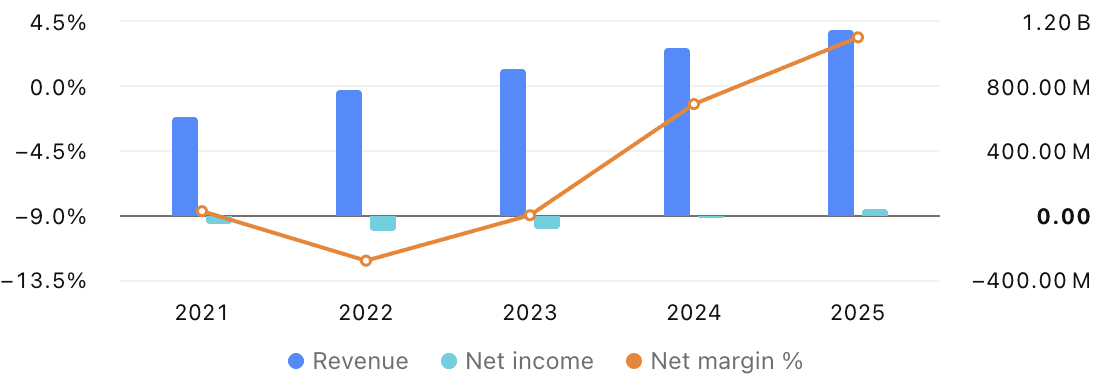
Five9 was one of the companies that benefited heavily during COVID, similar to Zoom. Its stock peaked during that period and then fell more than 90% from the highs at its lowest point, even though the business continued to grow. Now, it looks like it may have finally found a bottom which is driven by the new acceleration thanks to AI.
Lin
AAPL
Rubrik $RBRK
Rubrik $RBRK
Cybersecurity is one of the sectors we’ve already discussed as key beneficiary from AI. That’s because AI dramatically increases both the number of systems that can be attacked and the speed at which damage can spread.
Companies are connecting large language models to internal data, databases, code repositories, cloud infrastructure, SaaS applications, and operational systems.
At the same time, AI agents are moving from passive assistants toward software that can actually take actions. They can modify files, query databases, deploy code, change permissions, call APIs, move data between systems, and interact with other agents without waiting for a human to approve every step.
That creates a much larger attack surface.
Every model connection, API permission, agent credential, data pipeline, and autonomous workflow becomes another potential entry point or failure point. Attackers can also use AI to automate reconnaissance, phishing, vulnerability discovery, social engineering, malware development, and lateral movement.
Historically, enterprise backups were mainly insurance against hardware failures, accidental deletion, or software problems. But modern ransomware operators understand that encrypting production data is much less effective if the victim can restore everything immediately. Sophisticated attackers therefore increasingly try to compromise the recovery infrastructure itself.
Prevention will remain important, but prevention alone becomes less sufficient as systems become more autonomous. Enterprises increasingly need to assume that some attacks, mistakes, or agent failures will get through. The critical question then becomes whether the company can identify exactly what changed, determine the last trusted state, contain the damage, and restore the environment quickly.
This is what Rubrik has specialized in. Rubrik started as an enterprise backup and recovery company, but the business has become much broader. Since then it’s increasingly positioned around cyber resilience.
Rubrik protects enterprise data, maintains immutable recovery points, analyzes whether those recovery points are secure, helps recover identity infrastructure, and is now extending the same architecture toward AI agents. Rubrik's identity security products are designed around detecting changes to identity infrastructure and restoring trusted identity state.
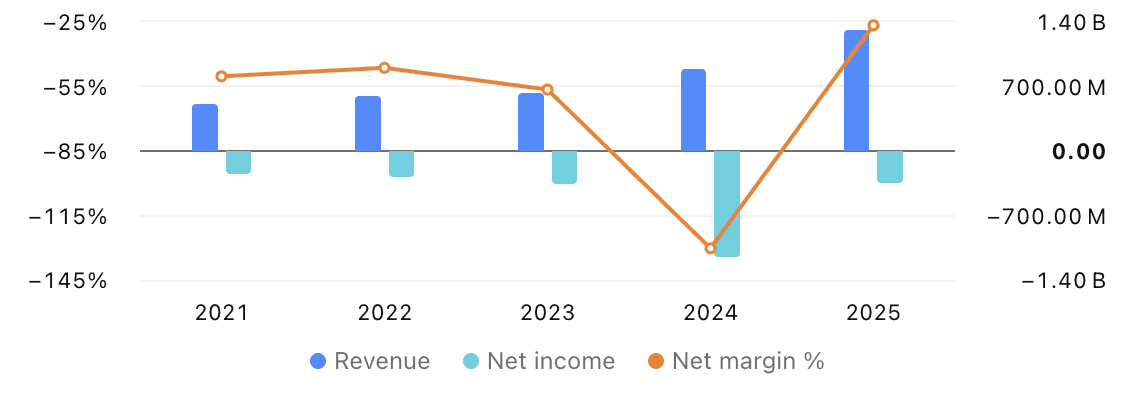
Revenue grew 39% in Q1 FY27 while sales and marketing expenses grew much more slowly. Subscription gross margins above 80% give the company substantial long-term margin potential if operating expenses continue scaling more slowly than revenue.
Free cash flow reached $73.6M in Q1 FY27, equivalent to roughly a 19% quarterly FCF margin. Management currently expects around $298M of free cash flow for FY27, or roughly an 18% margin.
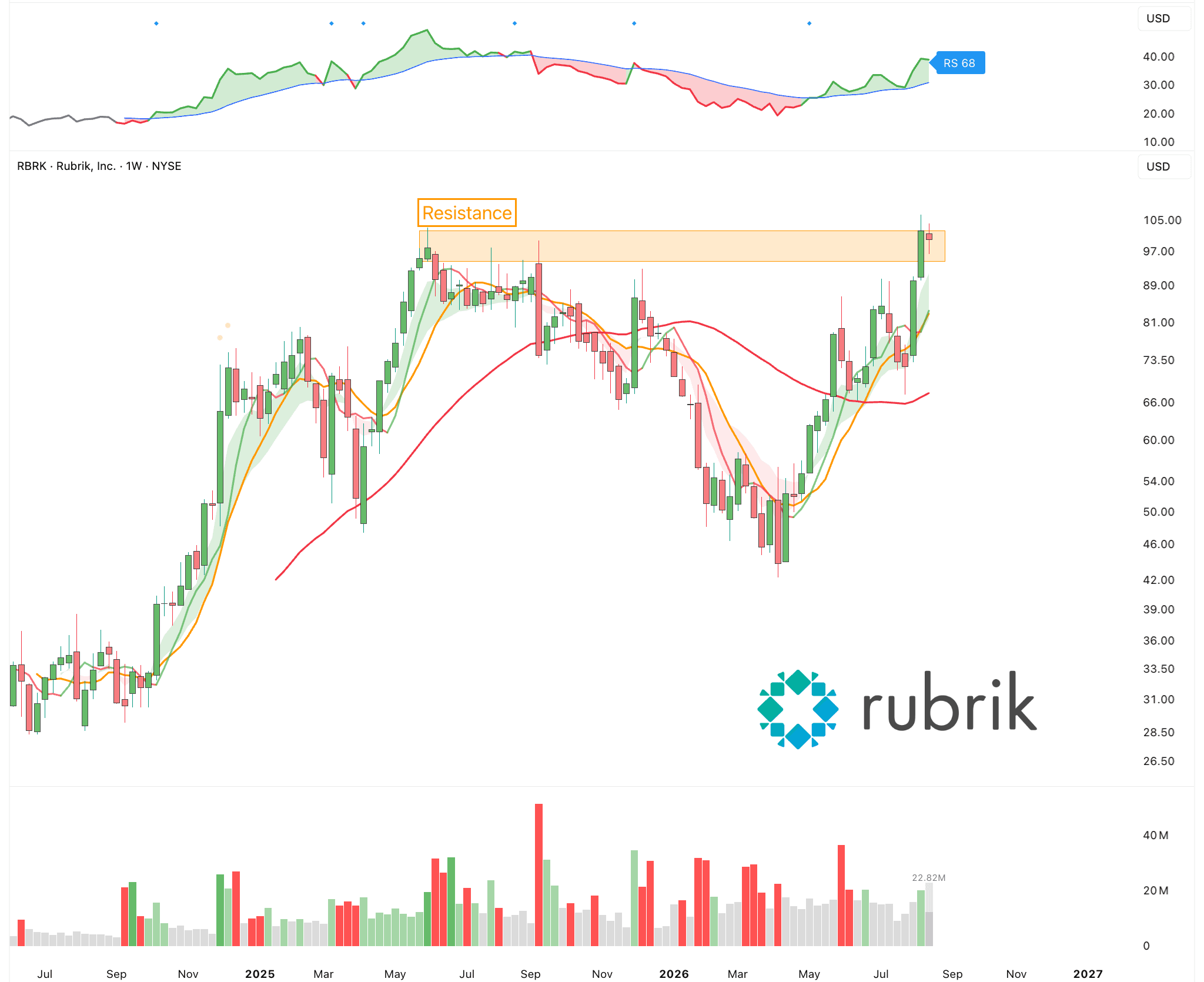
They are reporting Q2 earnings next week, so we’ll see if they manage to translate that momentum into actual revenue and earnings acceleration. Right now, the stock is setting up just below its previous highs from May. Earnings could be the catalyst that propels it to new heights and triggers a breakout to all-time highs.
Lin
AAPL
Arista Networks $ANET
Arista Networks $ANET
Arista Networks builds the high-speed switches, routers, network operating software, and management tools that connect servers, GPUs, storage systems, and, most importantly, data centers.
A modern AI data center contains thousands of servers. Each server may contain several GPUs or other accelerators. These systems constantly send model parameters, activations, training data, and storage traffic back and forth. The switches decide where each packet goes and move it through the network.
As AI clusters become larger, networking becomes a major challenge and accounts for a growing share of the total infrastructure budget.
One of Arista’s biggest advantages is its software architecture.
Its core operating system is called EOS, or Extensible Operating System. EOS runs across Arista’s entire product portfolio, giving customers one consistent software environment across different generations and types of equipment.
EOS uses a modular design, meaning different networking functions run as separate processes. If one process fails, it can restart without forcing the entire switch to reboot. This helps improve uptime and makes software changes less disruptive. It becomes especially valuable in large data centers, where a hyperscaler may operate hundreds of thousands of network ports.
That is why the world’s largest cloud companies work with Arista. Microsoft and Meta are among its biggest customers. They have accounted for about 10% of revenue each.
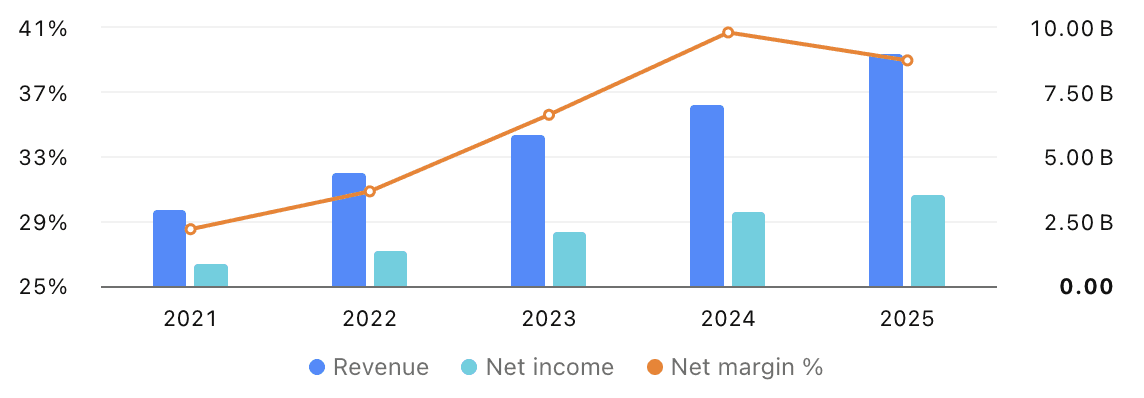
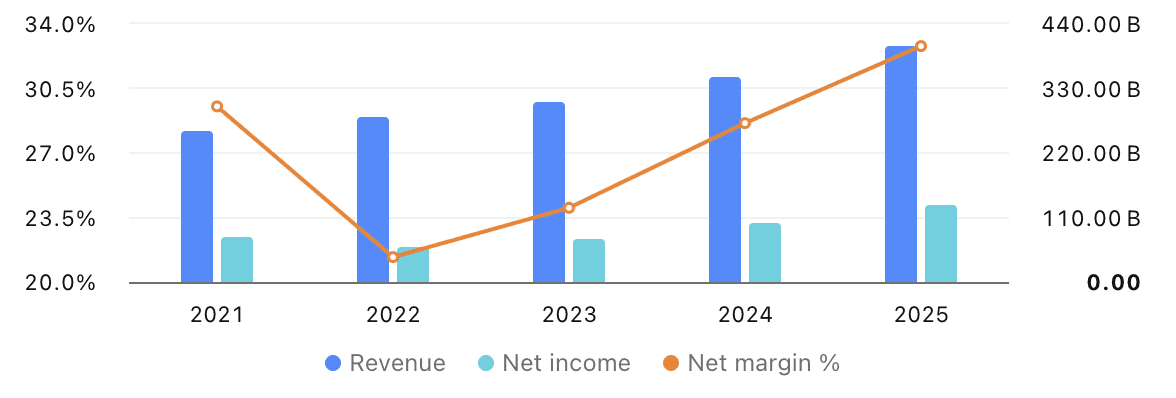
Its growth has also remained surprisingly consistent. Arista generated annual revenue growth of at least 19.5% every year from 2021 through 2025. At the same time, its margins and profitability continued to improve.
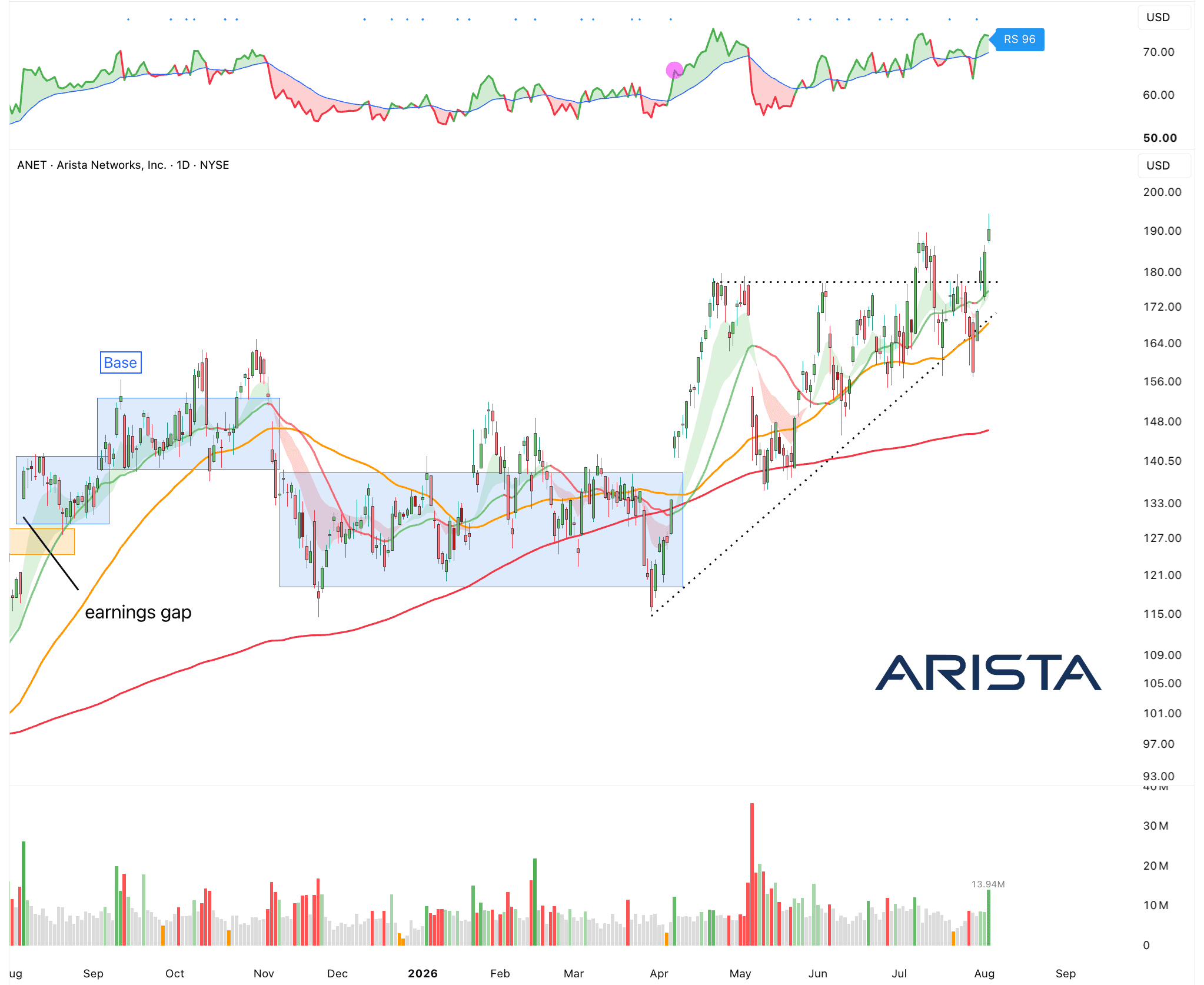
The stock has also held up incredibly well over the last few weeks and just broke out again ahead of its earnings report today.
Lin
AAPL
Dell $DELL
Dell $DELL
One of the few names that continues to stand out is Dell. We’ve already heard Trump mention it as a buy several times.
What’s especially remarkable is how well the stock has held up over the past few weeks while many other AI names have completely fallen apart.
It’s still one of the biggest beneficiaries of the AI buildout.
Nvidia supplies the GPUs, but obviously customers need much more than chips. They need servers, CPUs, memory, networking, storage, cooling, power equipment, software integration, financing, installation, and long-term support.
Dell combines these parts into complete systems that can be deployed at scale. Many companies would rather buy a tested Dell rack than coordinate 10 different suppliers themselves.
And demand for its AI servers is exploding.
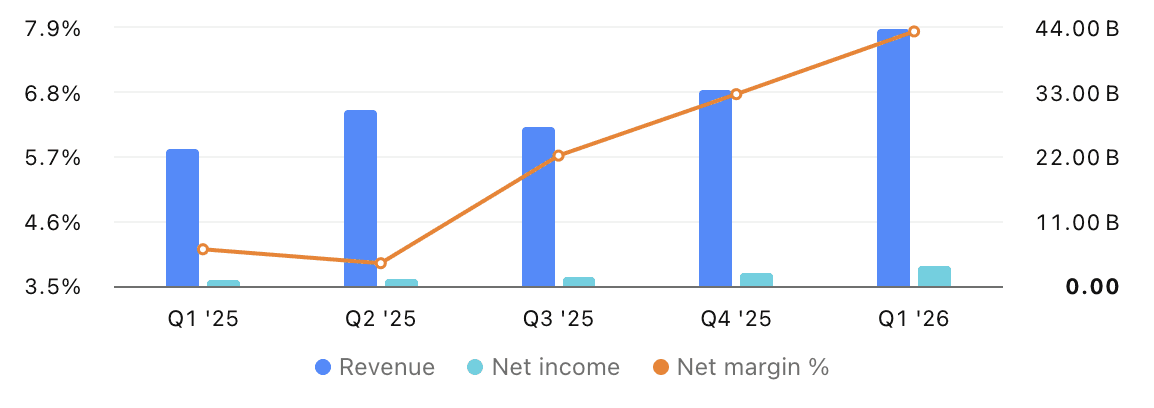
Dell generated $16.1 billion of AI-optimized server revenue in its latest reported quarter, up from $1.9 billion a year earlier. Total quarterly revenue reached a record $43.8 billion, up 88%, while adjusted EPS increased to $4.86. Dell also raised its full-year revenue outlook to around $167 billion.
The order book provides unusually strong visibility. Dell entered fiscal 2027 with $43 billion of AI server backlog after receiving more than $64 billion of AI server orders during the previous year. Basically much of its future revenue has already been ordered.
And one of its biggest advantage is its scale. Dell is one of the world’s largest technology hardware buyers in the world. Many smaller server manufacturers struggle to secure enough supply. However, Dell’s purchasing scale, relationships, and manufacturing capacity give it better access to constrained parts.
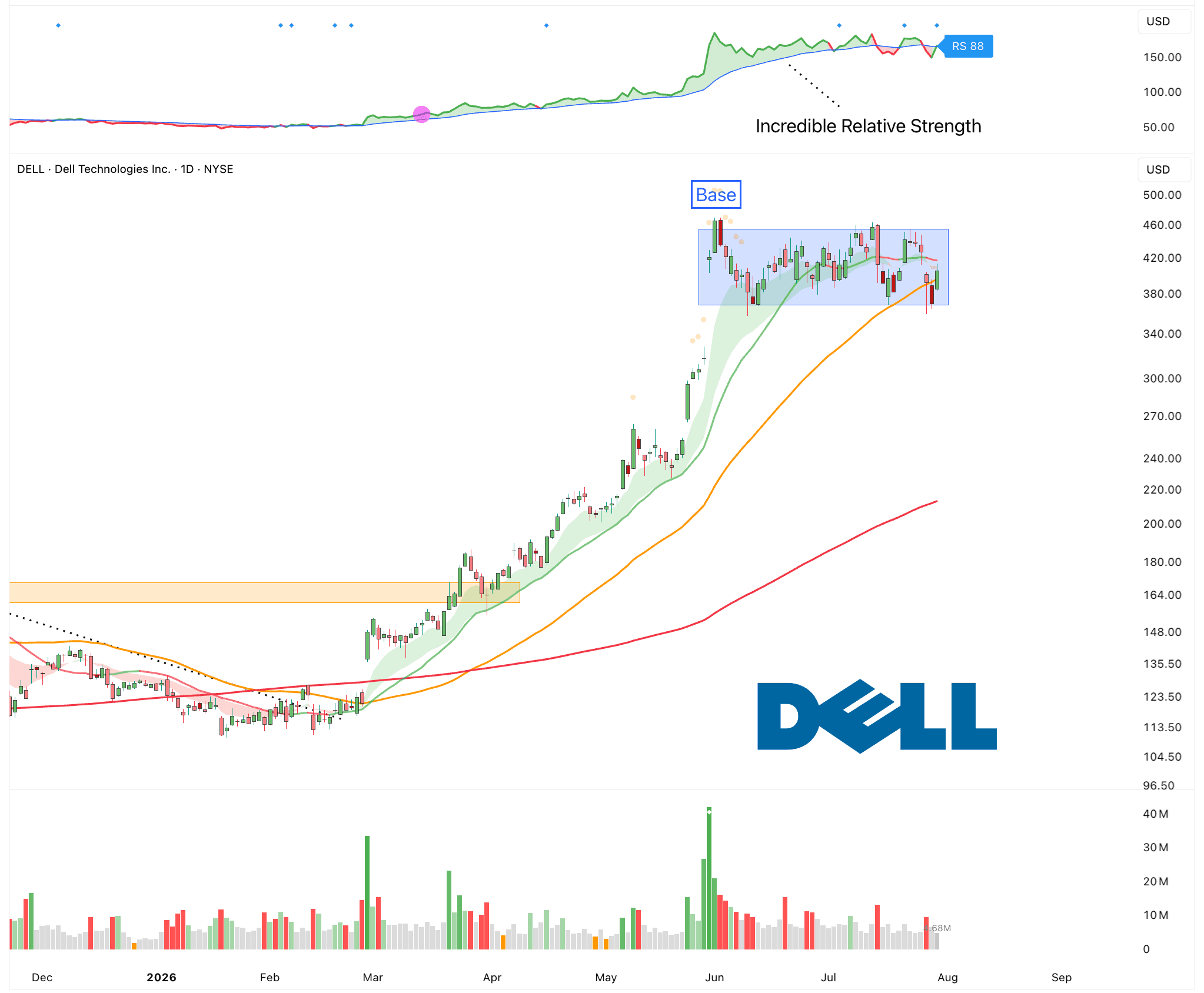
Since its blowout earnings report at the end of May, the stock has been consolidating near its highs. There has never been any meaningful selling pressure. No one wants to sell. Even as the broader AI trade came under heavy pressure, Dell refused to break down. Instead, the stock only moved sideways. So, this is a top watch.
Lin
AAPL
PACS Group $PACS
PACS Group $PACS
PACS Group is one of the fastest-growing public care platforms in the U.S. They operate skilled nursing facilities and assisted living facilities. Its facilities care for patients after they leave the hospital but still need nursing support, rehab, therapy, wound care, medication management, or longer clinical monitoring.
The key to its growth is a better operating model for a very difficult asset class.. PACS buys or leases skilled nursing facilities, improves how they are run, raises occupancy, improves care quality, manages staffing better, and tries to earn more profit from the same building. High occupancy is critical. A facility that is 95% full can be much more profitable than a facility that is 80% full because the extra patients use the same building and much of the same infrastructure. PACS reported 90.8% overall occupancy, compared with an industry average of around 79%.
Skilled nursing is hard to run. Many facilities are owned by smaller operators that may struggle with staffing, compliance, purchasing, reimbursement, training, technology, and quality reporting. PACS can bring stronger systems, better reimbursement knowledge, local operating discipline, and scale benefits.
They now operate 323 healthcare facilities across 17 U.S. states, with 32,757 skilled nursing beds and 2,759 assisted living beds.
PACS makes money mainly from Medicare, Medicaid, managed care insurers, and private-pay patients. These payers have different margin profiles. Medicare and higher-acuity short-stay patients are usually more attractive than long-stay Medicaid patients, while managed care depends heavily on contract terms, authorization rules, denial behavior, and length of stay.
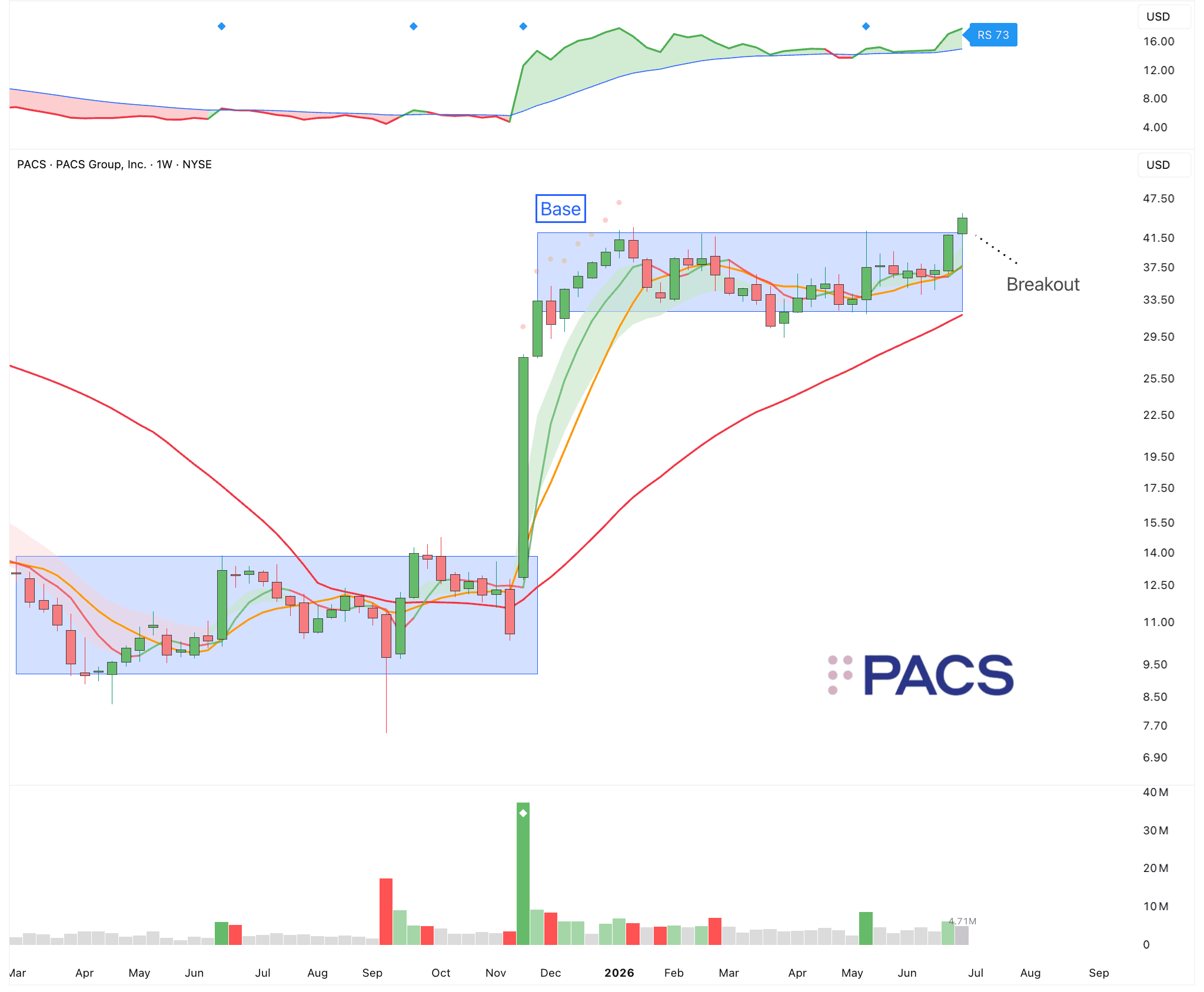
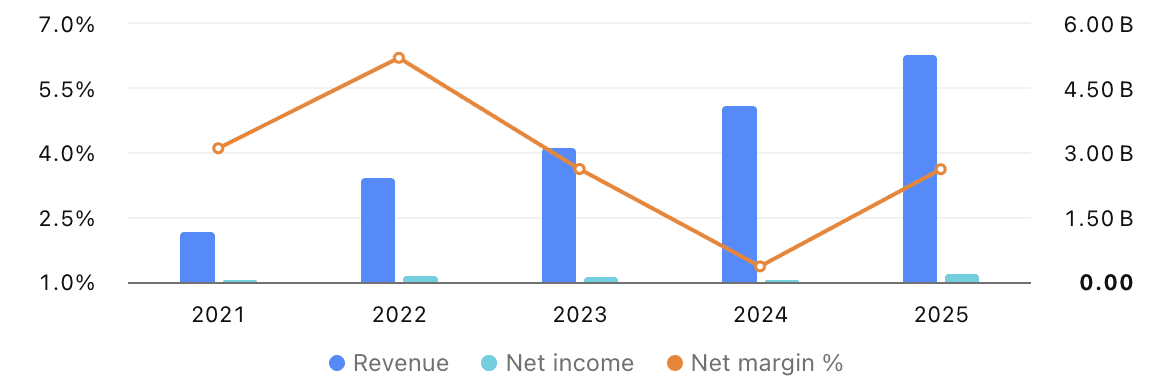
The company has been growing quickly. In FY 2025, PACS reported $5.29B of revenue, up 29.3% year over year, with $191.5M of net income and $505M of adjusted EBITDA. In Q1 2026, revenue was $1.42B, net income was $80.7M, adjusted EBITDA was $170.4M.
After a huge move in November, it spent 7 months building a base. And is starting breakout to new all-time highs as the market continues to rotate into new sectors.
Lin
AAPL
Vishay Precision Group $VPG
Vishay Precision Group $VPG
Vishay Precision Group is a precision measurement company. It builds sensors and measurement systems that help machines understand the physical world through force, weight, pressure, stress, torque, and movement.
Thus becomes extremely important as machines become more advanced. A robot needs to know how hard it is gripping an object. A factory machine needs to know whether a part is under too much stress. A medical device needs to measure force with extreme accuracy. These are all areas where physical measurement becomes critical.
VPG operates through 3 main segments: Sensors, Weighing Solutions, and Measurement Systems. Across these segments, the company makes products such as strain gages, force sensors, load cells, precision resistors, weighing modules, and measurement systems. These components turn physical changes into electrical signals. That signal becomes data, and that data allows a machine to understand what is happening in the real world.
This is especially important in robotics. Vision can show a robot what an object looks like, but force sensing tells the robot what happens when it touches that object. Both are absolutely critical. A simple robot arm can follow a fixed path, but a more advanced robot arm needs to feel contact, measure pressure, detect slipping, and recognize when force is too high before it damages the object, the machine, or the person nearby.
The business has been stagnant for a few years. But they are finally starting to reaccelerate again. In Q1 2026, VPG reported revenue of $84.4 million, up 17.6% year over year. Orders reached $102.1 million, creating a book-to-bill ratio of 1.21, which means new orders were coming in faster than the company was converting them into revenue.
The Sensors segment was especially strong. Revenue in that segment grew 23.1% year over year in Q1 2026, helped by better demand in precision resistors, robotics, aerospace, military, and space.
Humanoid robotics is still a very early opportunity for VPG. The company reported about $1 million of humanoid orders in Q1 2026. That is still small compared with total revenue. There is still a long way to go. But if robotics takes off, VPG’s business will definitely benefit.
Lin
AAPL
Cognex $CGNX
Cognex $CGNX
Cognex builds machine vision systems, sensors, and software that allow factories, warehouses, robots, and production lines to operate in the physical world.
Its products are used across factory automation, logistics, consumer electronics, packaging, automotive, semiconductors, medical lab automation, and other industrial end markets. It already serves more than 30,000 customers in over 30 countries.
Now, AI is the catalyst for robotics and machines. AI is changing what machine vision can do. Traditional vision systems were powerful, but often hard to deploy. They needed controlled lighting, expert setup, and a lot of tuning. AI-powered vision systems can handle more complex, messy, real-world environments. That makes the technology easier to use and opens more use cases.
Cognex wants to become the top provider of AI-powered machine vision. New products like OneVision, DataMan 290, and SLX are designed to make vision systems easier to deploy and more scalable.
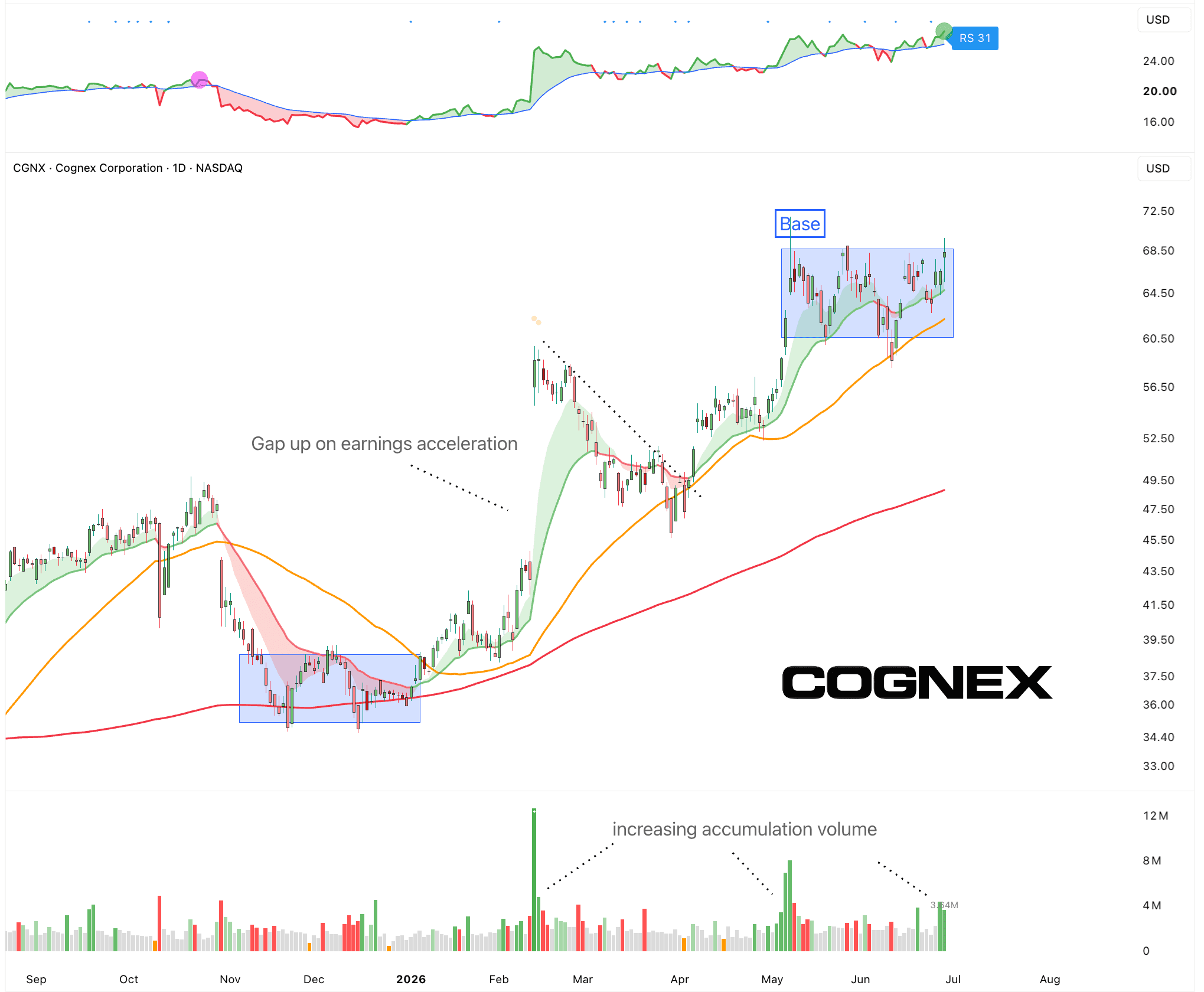
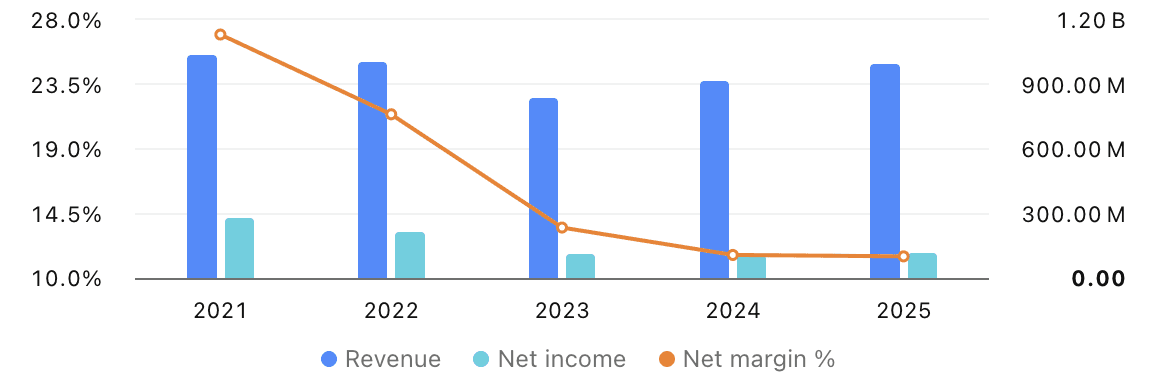
After a few years of declining revenues, 2025 was a turning point. Revenue returned to growth, adjusted EPS grew 38%, and management began cutting low-growth, low-margin revenue from the portfolio. Q1 2026 showed a clear inflection. Revenue grew 24% year over year to $268M, gross margin improved to 71.1%, operating margin reached 22.3%, and adjusted EPS more than doubled to $0.34. The company also guided Q2 2026 revenue to $280M to $300M.
It’s been building consolidating for two months now. And the recent market pullback barely left a dent. There’s also increasing investor interest in robotics with since the humanoid maker Agility Robotics is going public via a SPAC merger $CCXI under the ticker $AGLT from which companies the entire sector should benefit. Companies like AEVA and Ouster, which were highlighted recently, are back in focus.
My believe is that Physical AI and robotics will be one of the biggest beneficiaries of this tech boom.
Lin
AAPL
Tower Semiconductor $TSEM
Tower Semiconductor $TSEM
Tower Semiconductor is a specialty foundry.
It manufactures chips for other companies, but it does not compete directly with TSMC at the most advanced logic nodes. Tower focuses on high-value specialty processes like silicon photonics, silicon germanium, RF, analog, power management, image sensors, and mixed-signal chips.
The most important part is silicon photonics.
AI data centers need to move huge amounts of data between GPUs, switches, racks, and data centers. Every training run needs constant communication between GPUs, memory, switches, racks, and storage. The bigger the AI model gets, the more important the network becomes.
Inside a normal data center, data often moves through copper wires and electrical signals. Copper works well over short distances, but it becomes less efficient as speeds rise. At very high bandwidth, copper creates more signal loss, more heat, more power consumption, and more complexity. That’s why current copper cables struggle as bandwidth and power demands rise (read more on optical AI infrastructure chain in the Photonics theme). Optical connections solve part of that problem by moving data with light and Tower Semiconductors manufactures the photonic chips that make this possible.
Its Q1 2026 earnings result was decent.
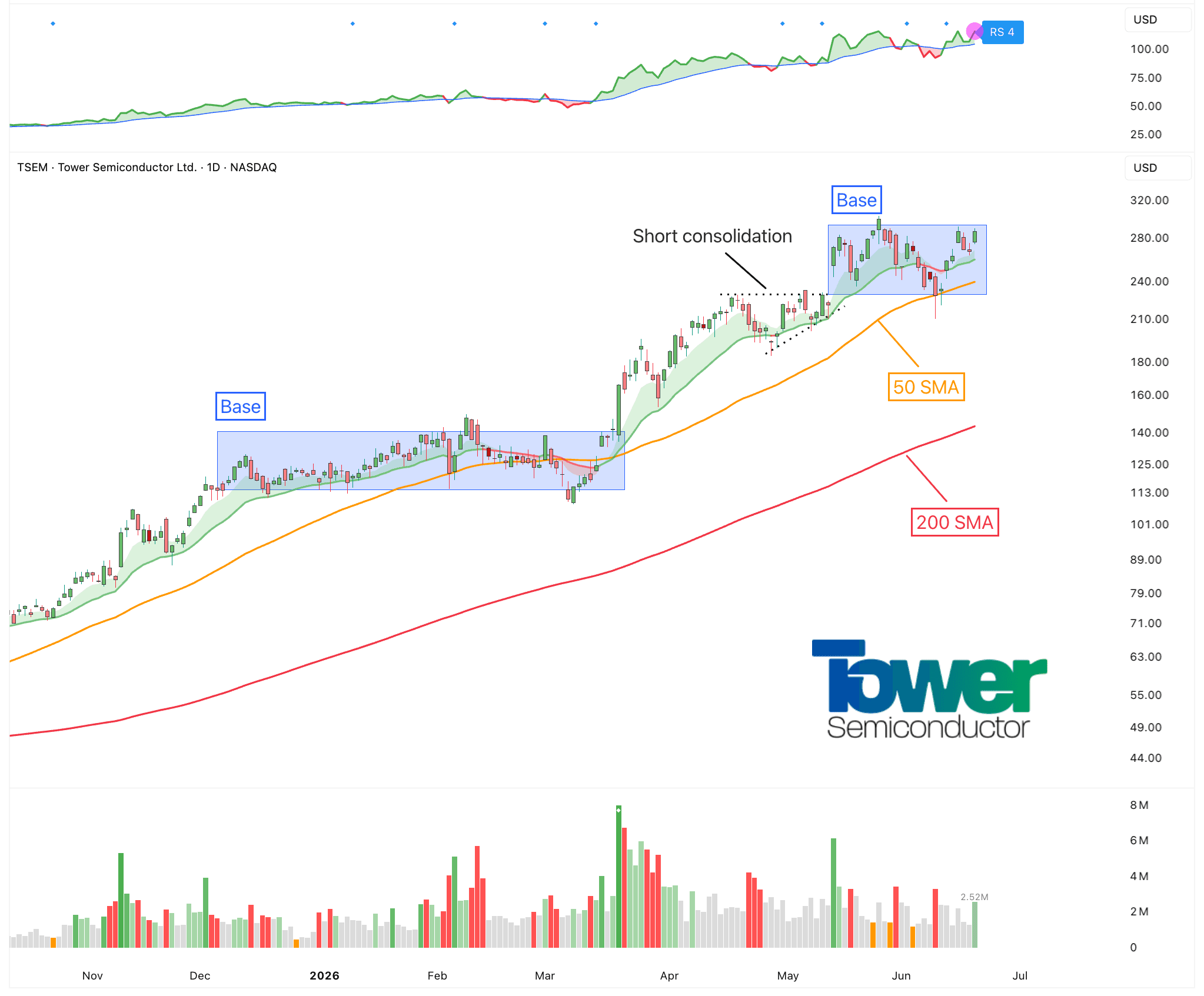
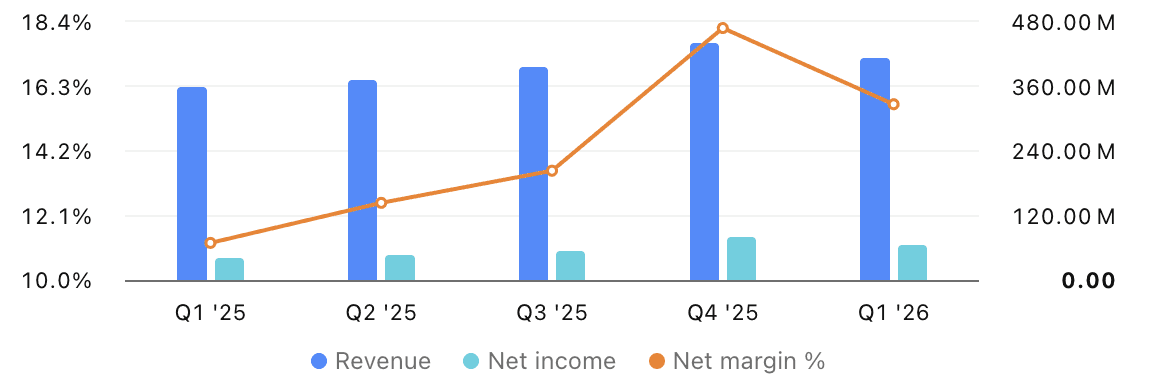
Revenue was $414 million, up 15% year over year. Gross profit was $111 million, up 52%. Operating profit was $65 million, up 96%. Net profit was $65 million, up from $40 million last year. The company guided Q2 revenue to a record $455 million, up 22% year over year and 10% sequentially.
The numbers weren’t mind-blowing. There are definitely faster growing companies. But the most important number was not revenue.
It was the silicon photonics contract book.
TSEM signed customer contracts for $1.3 billion of silicon photonics revenue for 2027. Customers also paid $290 million in prepayments to reserve capacity. That is an incredibly strong signal. Customers do not pay upfront unless they really really need the capacity.
That’s why it is expanding aggressively. It is investing heavily in silicon photonics and silicon germanium capacity, with total planned investment around $920 million.
Right now, it’s building another base and setting up a potential breakout to new all-time highs.
Lin
AAPL
Sterling Infrastructure $STRL
Sterling Infrastructure $STRL
Tower Semiconductor is a specialty foundry.
It manufactures chips for other companies, but it does not compete directly with TSMC at the most advanced logic nodes. Tower focuses on high-value specialty processes like silicon photonics, silicon germanium, RF, analog, power management, image sensors, and mixed-signal chips.
The most important part is silicon photonics.
AI data centers need to move huge amounts of data between GPUs, switches, racks, and data centers. Every training run needs constant communication between GPUs, memory, switches, racks, and storage. The bigger the AI model gets, the more important the network becomes.
Inside a normal data center, data often moves through copper wires and electrical signals. Copper works well over short distances, but it becomes less efficient as speeds rise. At very high bandwidth, copper creates more signal loss, more heat, more power consumption, and more complexity. That’s why current copper cables struggle as bandwidth and power demands rise (read more on optical AI infrastructure chain in the Photonics theme). Optical connections solve part of that problem by moving data with light and Tower Semiconductors manufactures the photonic chips that make this possible.
Its Q1 2026 earnings result was decent.
Revenue was $414 million, up 15% year over year. Gross profit was $111 million, up 52%. Operating profit was $65 million, up 96%. Net profit was $65 million, up from $40 million last year. The company guided Q2 revenue to a record $455 million, up 22% year over year and 10% sequentially.
The numbers weren’t mind-blowing. There are definitely faster growing companies. But the most important number was not revenue.
It was the silicon photonics contract book.
TSEM signed customer contracts for $1.3 billion of silicon photonics revenue for 2027. Customers also paid $290 million in prepayments to reserve capacity. That is an incredibly strong signal. Customers do not pay upfront unless they really really need the capacity.
That’s why it is expanding aggressively. It is investing heavily in silicon photonics and silicon germanium capacity, with total planned investment around $920 million.
Right now, it’s building another base and setting up a potential breakout to new all-time highs.
Lin
AAPL
nVent Electric $NVT
nVent Electric $NVT
AI needs physical infrastructure. Chips are critical, but chips alone are not enough. AI computer requires power, racks, cooling, enclosures, and protection.
nVent makes electrical connection and protection products that sit inside mission-critical infrastructure. That includes enclosures, racks, power connections, fastening systems, liquid cooling infrastructure, modular electrical buildings, and protection solutions for data centers, utilities, industrial facilities, and commercial buildings.
AI workloads require dense compute clusters. Dense compute creates more heat, more electrical load, and more complexity inside the data center. That creates demand for liquid cooling, racks, enclosures, power distribution, and protection systems. nVent sells into all of that. It help customers connect, protect, cool, and manage electrical systems safely.
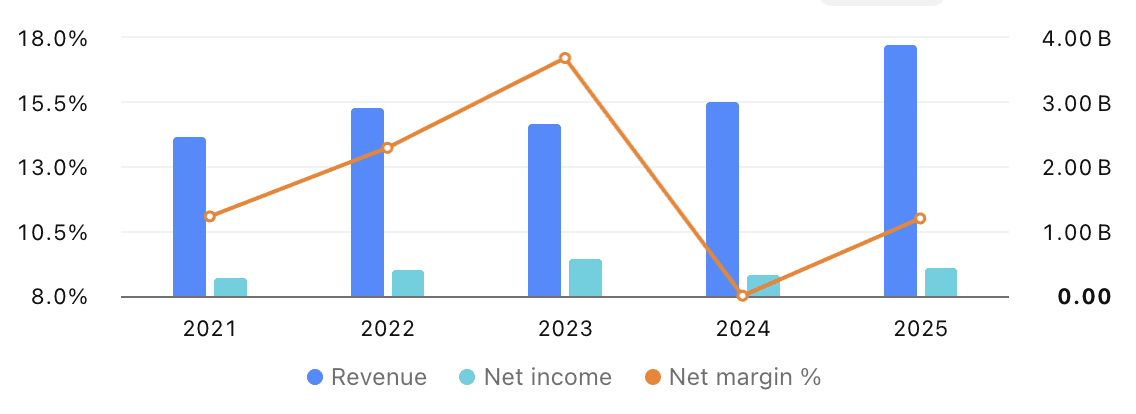
It’s Q1 2026 earnings result was very strong.
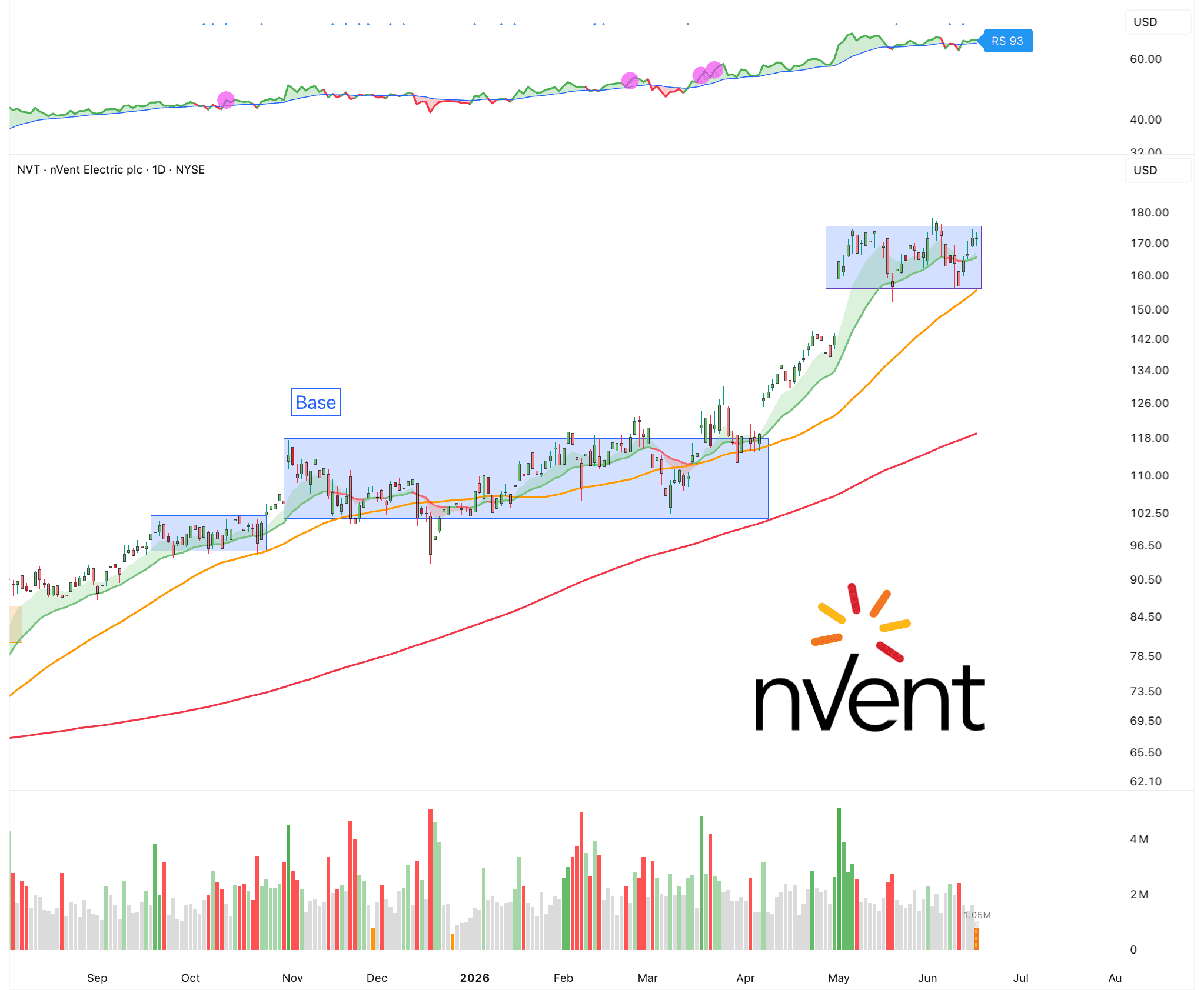
Revenue was $1.2 billion, up 53% year over year. Organic growth was 34%. Adjusted EPS was $1.09, up 63%. Adjusted operating margin stayed at 20%. The standout segment was Systems Protection. Sales grew 76%, with 50% organic growth. Segment income grew 95%, and margin expanded to 22.7%.
But The most important number was backlog: $2.6 billion. Data center demand is clearly propelling demand for the company to new heights.
And right now it’s been building a textbook base and setting up for a breakout.
Lin
AAPL
Viavi Solutions $VIAV
Viavi Solutions $VIAV
AI needs physical infrastructure. Chips are critical, but chips alone are not enough. AI computer requires power, racks, cooling, enclosures, and protection.
nVent makes electrical connection and protection products that sit inside mission-critical infrastructure. That includes enclosures, racks, power connections, fastening systems, liquid cooling infrastructure, modular electrical buildings, and protection solutions for data centers, utilities, industrial facilities, and commercial buildings.
AI workloads require dense compute clusters. Dense compute creates more heat, more electrical load, and more complexity inside the data center. That creates demand for liquid cooling, racks, enclosures, power distribution, and protection systems. nVent sells into all of that. It help customers connect, protect, cool, and manage electrical systems safely.
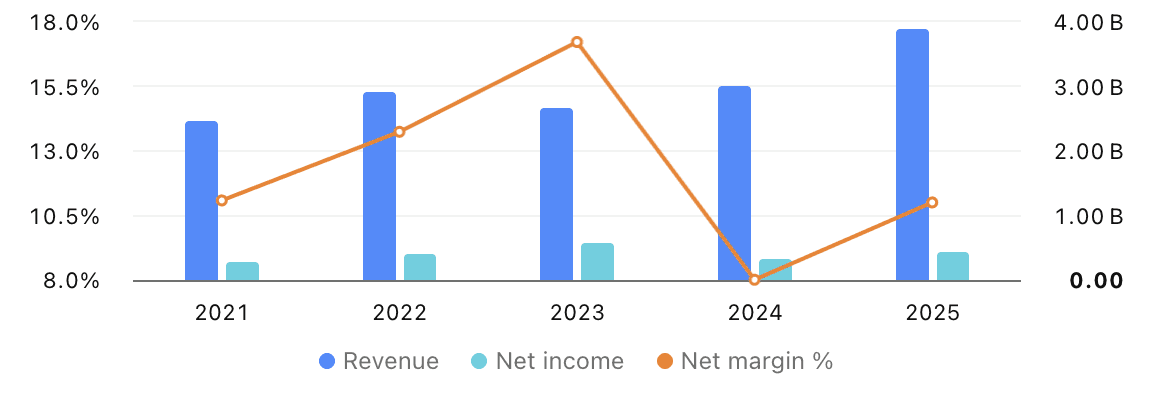
It’s Q1 2026 earnings result was very strong.
Revenue was $1.2 billion, up 53% year over year. Organic growth was 34%. Adjusted EPS was $1.09, up 63%. Adjusted operating margin stayed at 20%. The standout segment was Systems Protection. Sales grew 76%, with 50% organic growth. Segment income grew 95%, and margin expanded to 22.7%.
But The most important number was backlog: $2.6 billion. Data center demand is clearly propelling demand for the company to new heights.
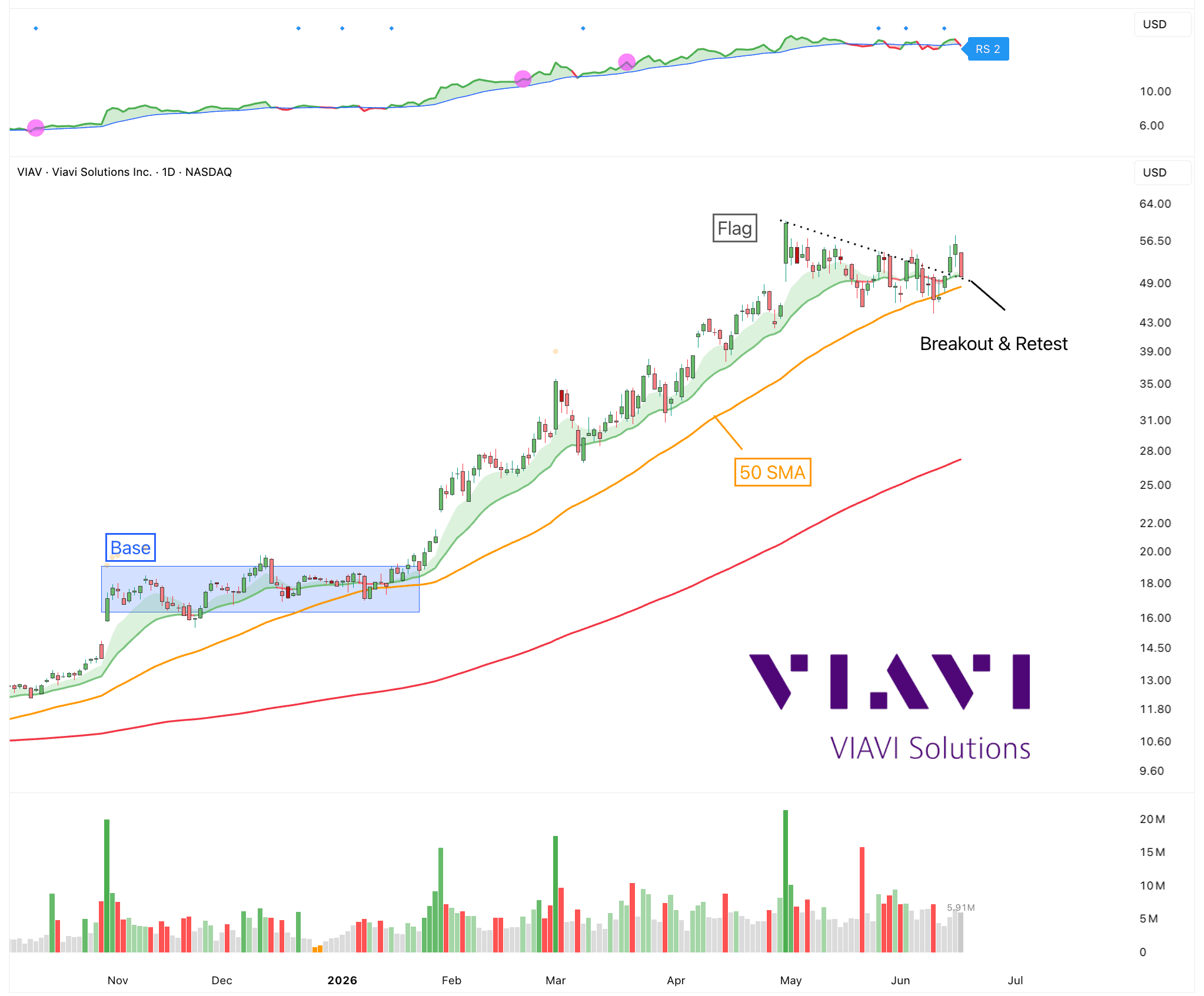
And right now it’s been building a textbook base and setting up for a breakout.
Lin
AAPL
Applied Optoelectronics $AAOI
Applied Optoelectronics $AAOI
Applied Optoelectronics $AAOI is one of the more interesting picks-and-shovels names in the AI infrastructure trade.
Every new AI data center needs more GPUs, more power, more cooling, and much faster connections between servers. The larger the clusters get, the more important optical networking becomes. As AI models get bigger and training clusters scale, the amount of data moving through the network explodes. That makes optical networking less of a boring hardware category and more of a core AI infrastructure layer.
Applied Optoelectronics makes optical transceivers, laser components, and networking products used in AI data centers, cable networks, telecom, and fiber access. AI workloads are forcing hyperscalers to upgrade their networks faster, and AAOI is becoming one of the suppliers tied directly to that upgrade cycle. The key product cycle is 800G, with 1.6T coming after that. These are high-speed optical transceivers that help move massive amounts of data inside and between data centers.
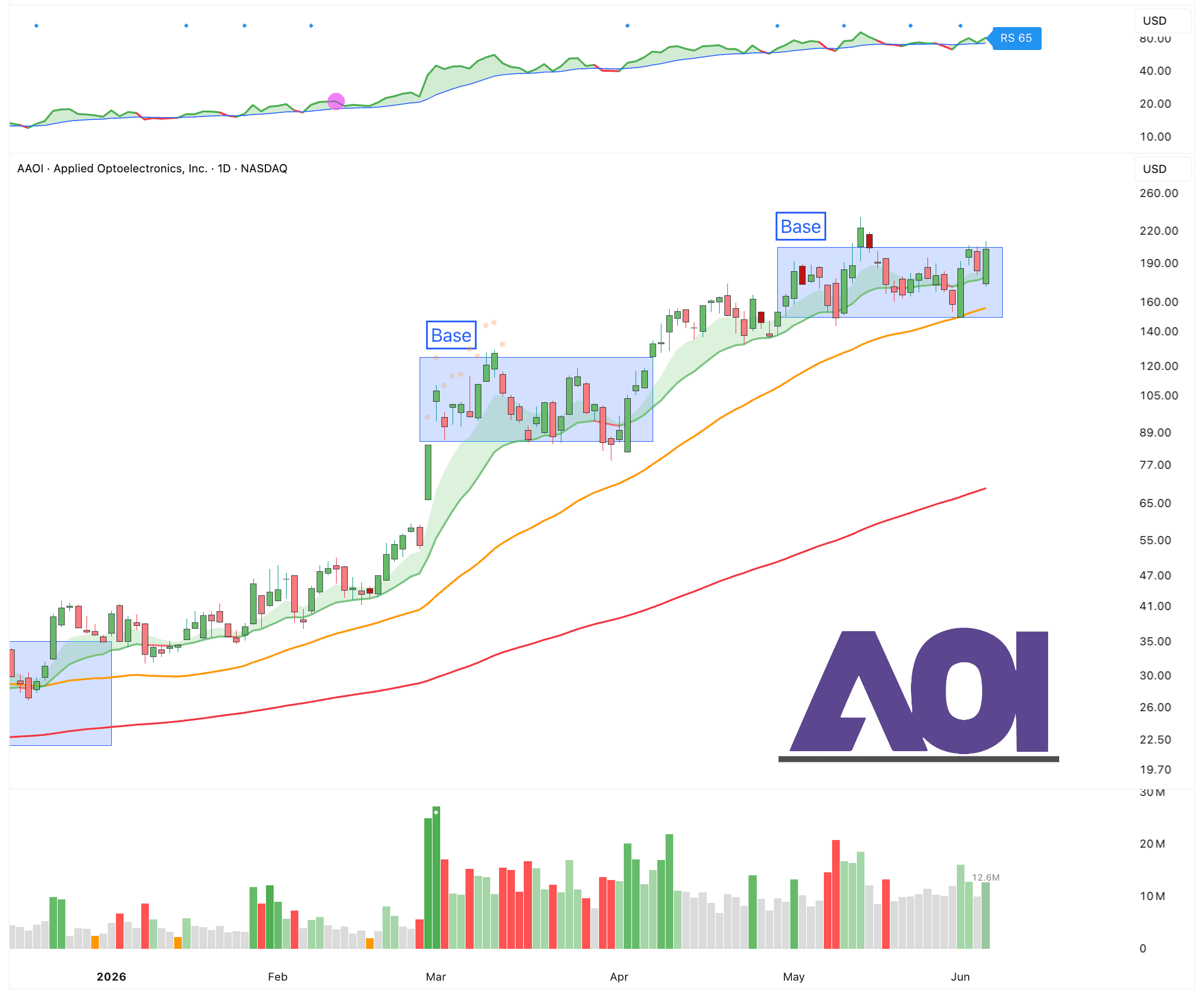
The numbers are starting to show that shift. In Q1 2026, AAOI reported record revenue of about $151 million, up from about $100 million in the prior year period. Data center revenue was about $81 million, making it the largest segment in the quarter.
The most important part of the earnings story was the ramp. Management said it completed the first volume shipment of 800G products to a large hyperscale customer in Q1 and expects a stronger volume ramp starting in Q2. They also guided for Q2 revenue of $180 million to $198 million, which implies another step up from Q1. Even more important, management expects sequential growth through the year, with bigger growth starting in Q3 as more capacity comes online.
This is not a small company selling into weak end markets. It is selling into the biggest AI infrastructure buyers in the world. The company has received new 800G orders from major hyperscale customers, including a $71 million order announced in April 2026. These customers demand quality, volume, reliability, and price. So, this is a meaningful validation point.
It is not the safest way to play AI, but it may be one of the most direct ways to play the optical networking bottleneck. So far, the stock has also been holding up incredibly well and now looks like it is setting up for a potential breakout for its next leg higher.
Lin
AAPL
Digital Ocean $DOCN
Digital Ocean $DOCN
AI infrastructure demand is outrunning the physical world.
Hyperscalers and AI cloud companies need massive amounts of compute capacity. Today, the constraint has moved beyond GPUs. It is power, speed, and location. Applied Digital is building large-scale AI data center campuses in places where power is available and land is easier to develop.
The winners in this cycle will not only be the companies with the best chips or models. They will also be the companies that can supply the most compute. And for that they need to secure land, power, cooling, permitting, construction capacity, and long-term customers.
Old data center model was built around internet traffic, cloud storage, SaaS workloads, and proximity to population centers. That is no longer true for AI.
Training and inference workloads do not always need to sit next to major cities. What they need most is cheap power, available grid capacity, cooling efficiency, and the ability to deploy thousands of GPUs at scale.
In June 2025, the company announced 2 roughly 15-year lease agreements with CoreWeave for 250 MW at its Ellendale, North Dakota campus. Reuters reported that the leases were worth about $7 billion over the term.
And in its fiscal Q3 2026 update, Applied Digital said Polaris Forge 2 is a 200 MW investment-grade hyperscaler campus, while Delta Forge 1 is a 300 MW AI factory campus backed by a high investment-grade hyperscaler, with initial operations expected in mid-calendar 2027.
What’s important is that Applied Digital has moved past 1 GW of contracted capacity.
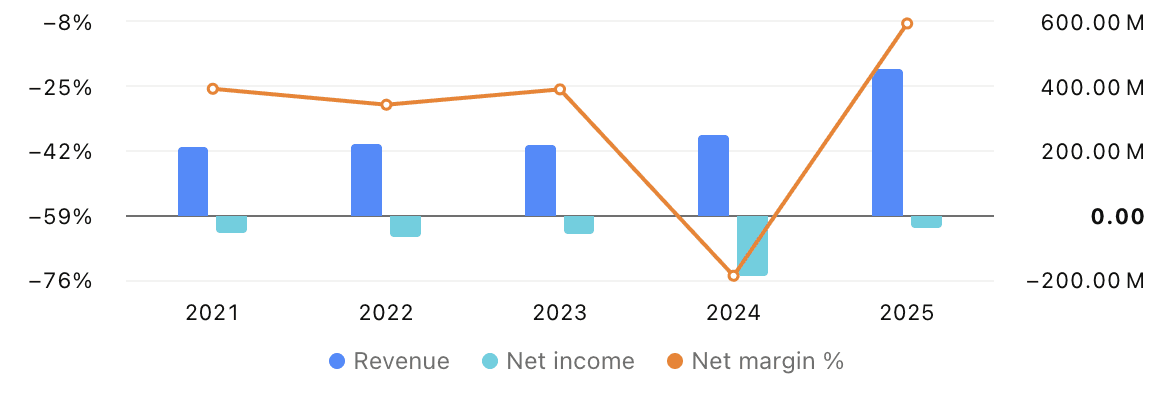
In fiscal Q3 2026, revenue was $126.6 million, up 139% year over year from $52.9 million. Revenue is starting to scale as more nad more facilities come online. Adjusted revenue, which excludes the Cloud Services business, was $108.6 million. Adjusted EBITDA was $44.1 million, compared with $6.3 million in the prior-year quarter.
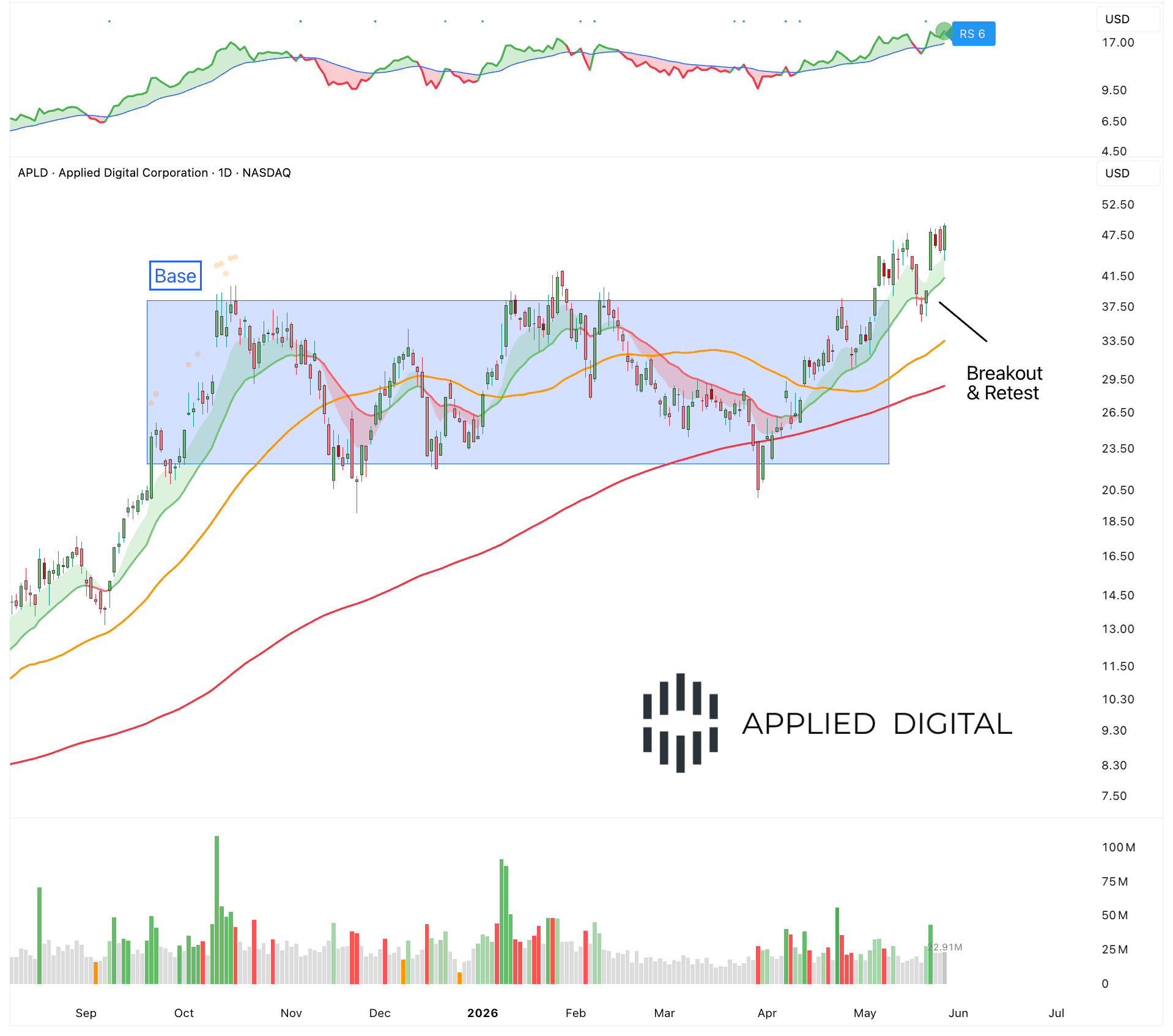
Now the setup looks even more interesting. Applied Digital just broke out of a 10-month base and then came back to retest the breakout area almost perfectly.
And it’s not just Applied Digital. The whole sector is starting to lead, and that is exactly what you want to see. The best moves usually happen when the stock is not moving in isolation, but together with the entire sector - as mentioned here.
Lin
AAPL
Robinhood $HOOD
Robinhood $HOOD
Robinhood is one of my key long-term holdings.
It’s the closest thing to a financial super app, with a huge market, an expanding moat, a visionary founder, a growing ecosystem, and a relentless speed of innovation.
But one of the key things I try to convey here is that timing is critical. Even great companies can get way ahead of themselves simply because of sentiment. Sometimes, fundamentals need time to catch up.
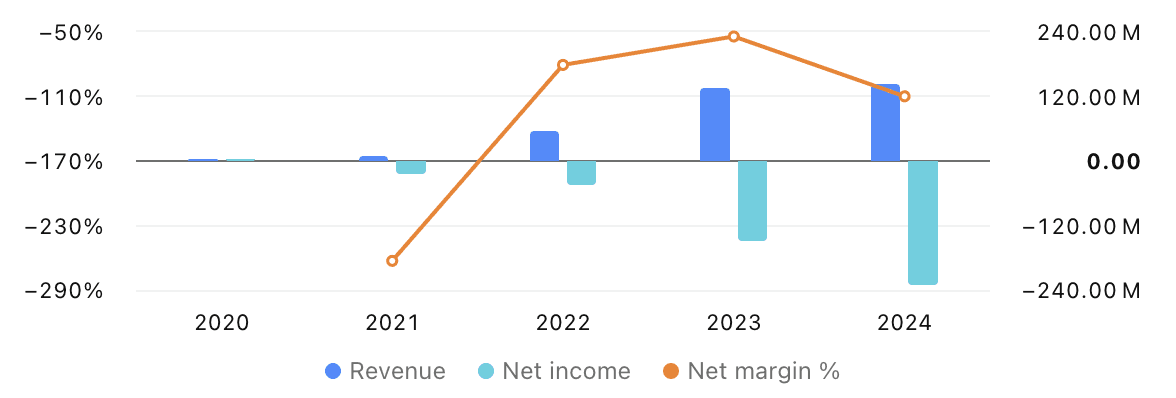
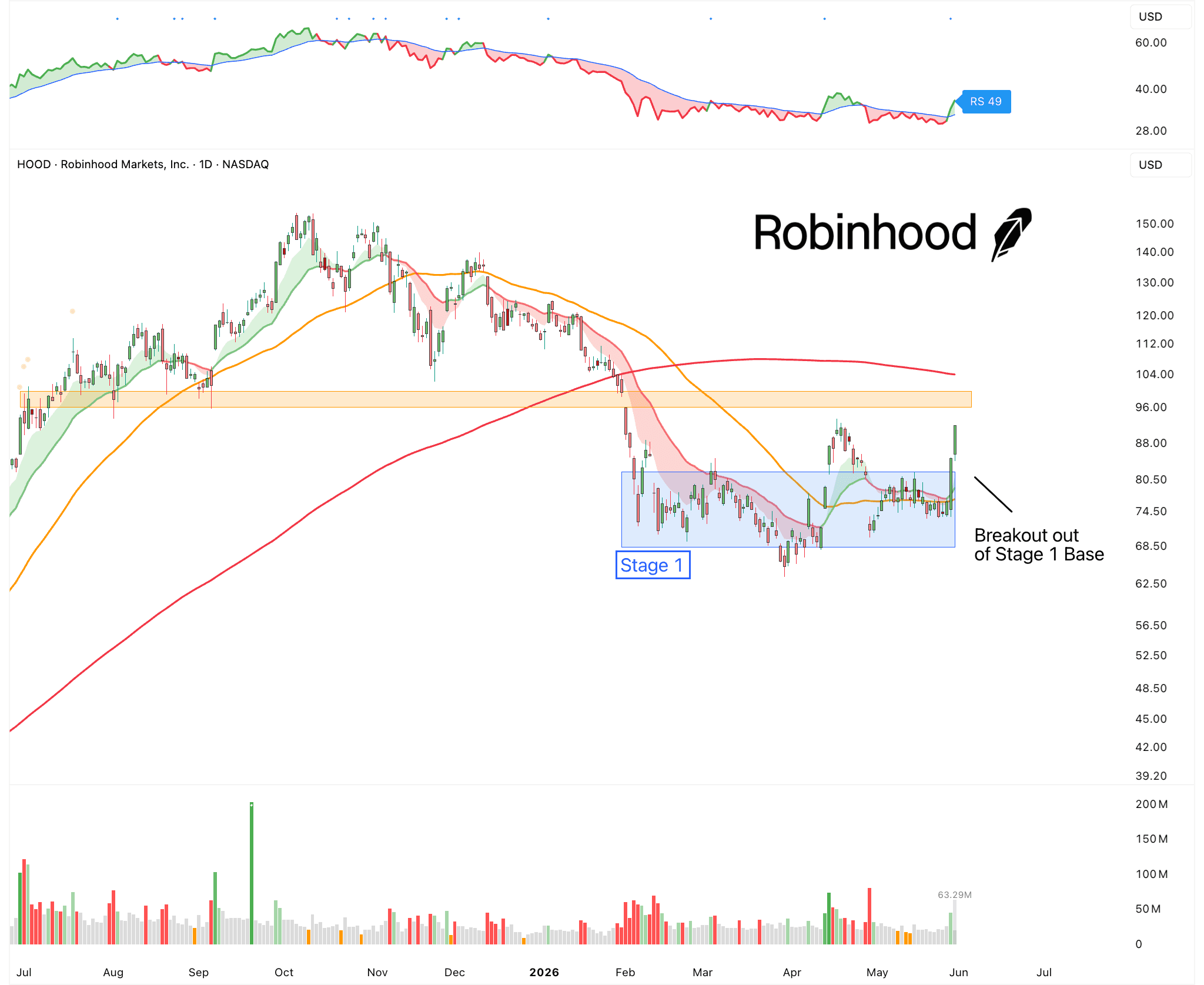
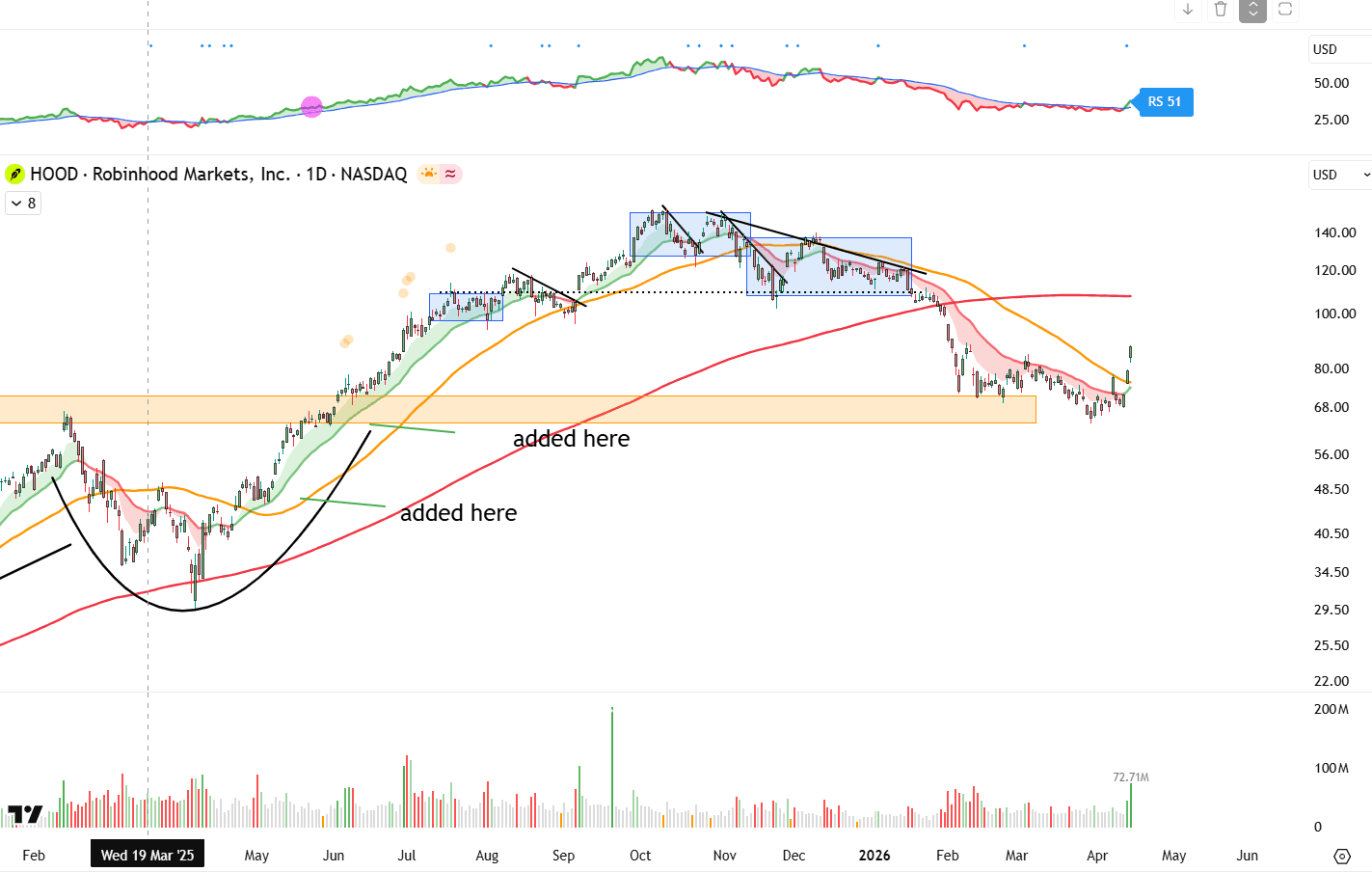
Robinhood has been in a correction since October last year. From peak to trough, it was down over 50%. That is a good lesson that even great companies routinely correct, and exactly why risk management is so critical, even for long-term positions. That means reducing your position when the technicals deteriorate and increasing it when they improve.
Right now, it’s finally starting to reemerge from an early-stage base, and the catalyst are the new Trump Accounts.

On launch day, the app hit #1 in finance and #4 overall in the App Store. The fastest-growing app outside of AI.
Trump Accounts are investment accounts for children, with eligible newborns from 2025 to 2028 receiving a $1,000 government contribution. The app was built with Robinhood and BNY, and funding starts on July 4, 2026. That gives Robinhood a direct role in a large government-backed savings program.
It is becoming financial infrastructure for the next generation.
Lin
AAPL
Applied Digital $APLD
Applied Digital $APLD
AI infrastructure demand is outrunning the physical world.
Hyperscalers and AI cloud companies need massive amounts of compute capacity. Today, the constraint has moved beyond GPUs. It is power, speed, and location. Applied Digital is building large-scale AI data center campuses in places where power is available and land is easier to develop.
The winners in this cycle will not only be the companies with the best chips or models. They will also be the companies that can supply the most compute. And for that they need to secure land, power, cooling, permitting, construction capacity, and long-term customers.
Old data center model was built around internet traffic, cloud storage, SaaS workloads, and proximity to population centers. That is no longer true for AI.
Training and inference workloads do not always need to sit next to major cities. What they need most is cheap power, available grid capacity, cooling efficiency, and the ability to deploy thousands of GPUs at scale.
In June 2025, the company announced 2 roughly 15-year lease agreements with CoreWeave for 250 MW at its Ellendale, North Dakota campus. Reuters reported that the leases were worth about $7 billion over the term.
And in its fiscal Q3 2026 update, Applied Digital said Polaris Forge 2 is a 200 MW investment-grade hyperscaler campus, while Delta Forge 1 is a 300 MW AI factory campus backed by a high investment-grade hyperscaler, with initial operations expected in mid-calendar 2027.
What’s important is that Applied Digital has moved past 1 GW of contracted capacity.
In fiscal Q3 2026, revenue was $126.6 million, up 139% year over year from $52.9 million. Revenue is starting to scale as more nad more facilities come online. Adjusted revenue, which excludes the Cloud Services business, was $108.6 million. Adjusted EBITDA was $44.1 million, compared with $6.3 million in the prior-year quarter.
Now the setup looks even more interesting. Applied Digital just broke out of a 10-month base and then came back to retest the breakout area almost perfectly.
And it’s not just Applied Digital. The whole sector is starting to lead, and that is exactly what you want to see. The best moves usually happen when the stock is not moving in isolation, but together with the entire sector - as mentioned here.
Lin
AAPL
AEVA $AEVA
AEVA $AEVA
Aeva is one of the more interesting small-cap names in the lidar space. It has a lot of similarities to Ouster.
Ouster is building digital lidar sensors that help machines create a precise 3D map of the physical world, while Aeva is building 4D lidar sensors that add instant velocity data, helping machines understand not just where objects are, but how fast they are moving and where they may go next.
It’s basically motion intelligence.
As AI moves from software into the physical world, machines will need a much deeper understanding of their environment. A robot, autonomous truck, drone, or industrial machine does not just need to know what is around it. It needs to know how far away objects are, how fast they are moving, and how that movement is changing in real time.
Aeva’s technology is built around 4D lidar. Traditional lidar gives machines a 3D map of the environment. Aeva’s FMCW lidar adds direct velocity measurement. That means its sensors can measure both distance and speed at the same time.
And motion is one of the hardest problems in autonomy.
A camera can identify objects. Radar can detect speed, but with less precision. Traditional lidar can map depth. Aeva is trying to combine high-resolution depth and instant velocity into one sensing layer.
That makes the company a potential beneficiary of several major trends at once: autonomous trucking, advanced driver assistance, robotics, industrial automation, defense, smart infrastructure, aerospace, and factory inspection.
The company already has early validation from important partners. Aeva is working with Daimler Truck and Torc Robotics in autonomous trucking. It has been selected for Nvidia DRIVE Hyperion. It is also used in Nikon’s APDIS industrial inspection platform, which gives the company exposure beyond just automotive.
Many lidar companies have been too dependent on the slow adoption curve of autonomous vehicles. Aeva’s opportunity is broader. If its sensors can become useful in industrial automation, infrastructure monitoring, defense systems, and factory inspection, the company has more ways to grow while the automotive market develops.
Atlas Ultra is Aeva’s newest long-range 4D lidar sensor for Level 3 and Level 4 automated driving. It is designed to sit behind the windshield and help vehicles detect objects at highway speeds. That could make adoption easier for OEMs because the sensor is more integrated and less intrusive.
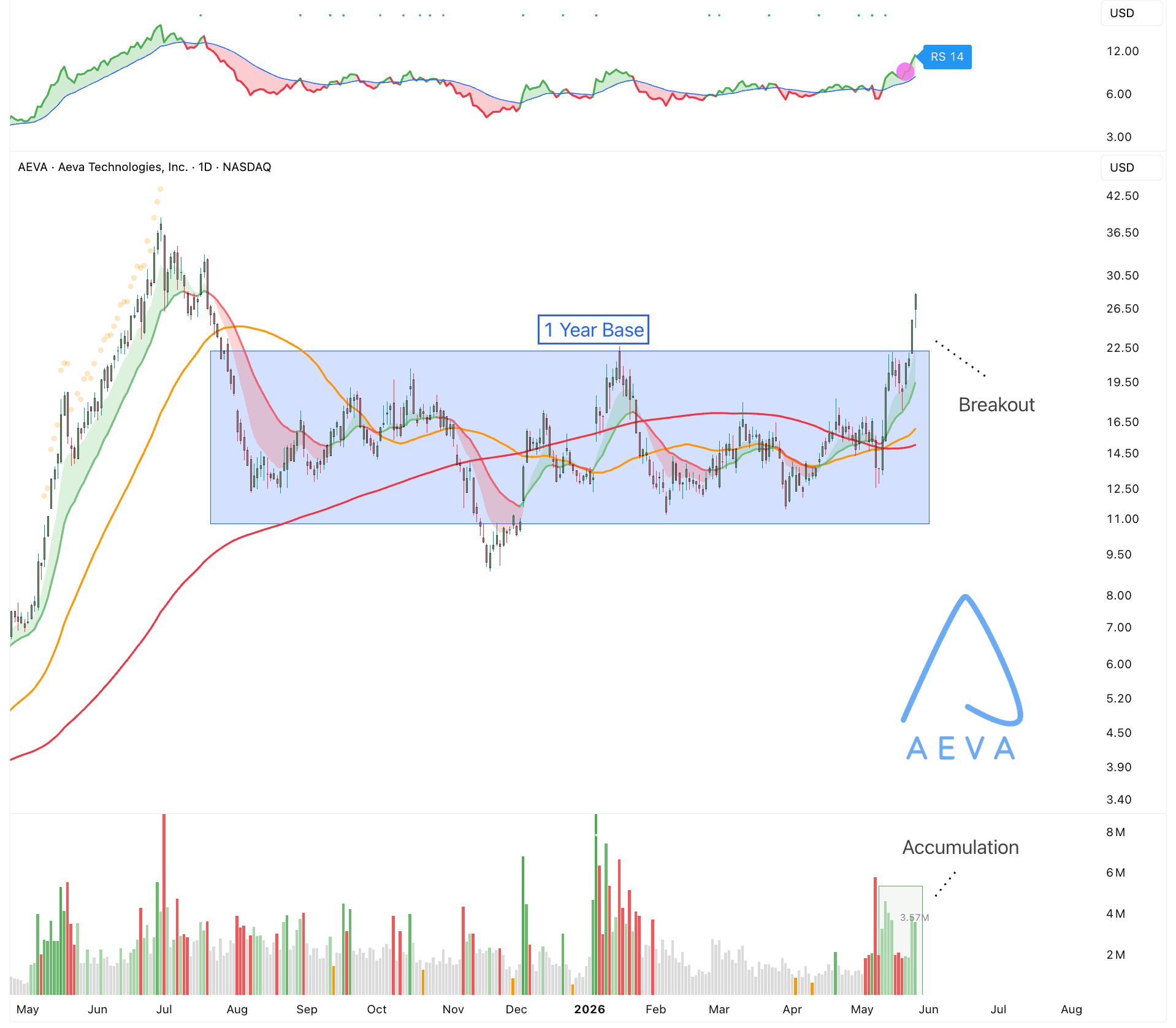
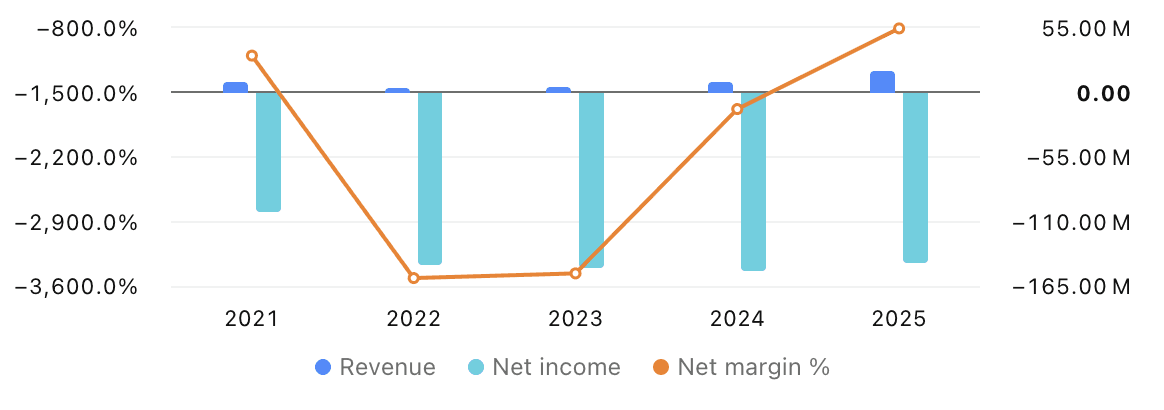
In Q1 2026, revenue was $6.3 million, up about 90% year over year. Management is guiding for 70% to 100% revenue growth in 2026. That is strong growth, but from a small base.
It’s the definitely on the more speculative end. But it’s breaking out of a year long base that could be a good opportunity to initiate a position if you manage the risk accordingly.
Lin
AAPL
Ouster $OUST
Ouster $OUST
Ouster is a lidar company. It makes sensors that help machines see the real world in 3D.
The next big AI wave is not just chatbots or ai agents. It is robots, autonomous vehicles, drones, industrial machines, smart cities, warehouses, ports, security systems, and infrastructure that can understand what is happening around them.
Its core product is digital lidar. Lidar sends out light pulses and measures how long they take to return. That creates a 3D map of the environment. A camera sees color and texture. Radar sees rough distance and speed. Lidar gives machines precise depth. And is critical for autonomy.
Ouster sells into 4 main markets: industrial, robotics, automotive, and smart infrastructure. It’s goal is to create a platform for Physical AI combining lidar, cameras, AI compute, sensor fusion, perception software, and AI models.
Its sensors can be used in warehouses, factories, mining, ports, traffic intersections, security, delivery robots, mapping, agriculture, construction, and autonomous machines.
And just recently it launched Rev8. Rev8 is the world’s first mass-produced native color lidar sensor. So, instead of needing separate camera and lidar systems, Rev8 can capture 3D depth and color together in one sensor. That can reduce hardware complexity and make sensor fusion easier for robots and autonomous systems
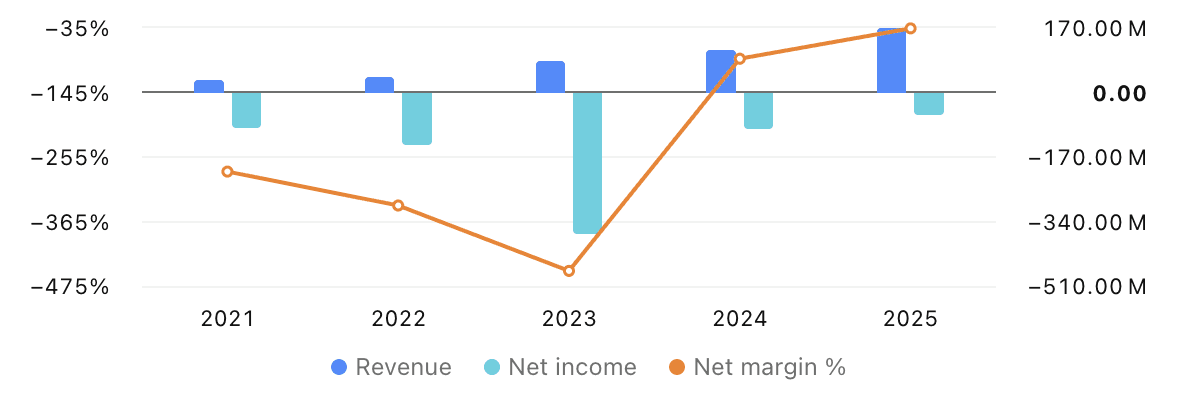
In Q1 2026, revenue was $49 million, up 49% year over year. Product revenue was $48 million, up 55% year over year and 18% sequentially. The company also shipped more than 12,600 lidar and camera sensors, with lidar making up around 65% of the total.
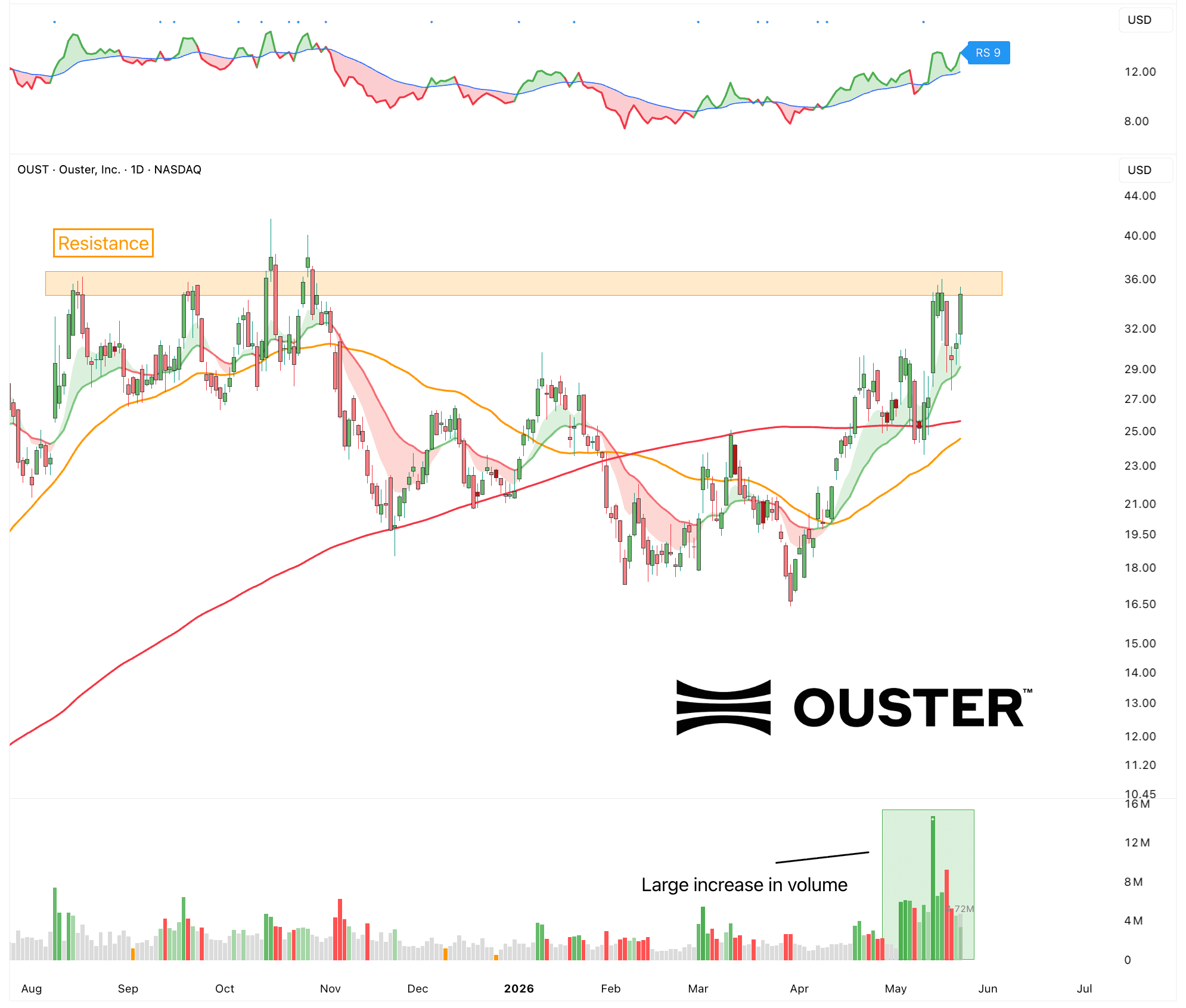
That’s why it’s become a pretty popular name among retail and institutional investors recently. And that is clearly showing in the massive increase in accumulation volume. It’s one the verge of a breakout. But keep in mind that it can be very volatile.
Lin
AAPL
Solstice $SOLS
Solstice $SOLS
At first glance, Solstice looks like a specialty materials and chemicals company. It was spun out of Honeywell and has businesses across refrigerants, advanced materials, electronic materials, healthcare packaging, and industrial chemistry. But I think that simple view misses one of the most interesting parts of the company.
The key part is Metropolis Works in Illinois. This is the only uranium conversion facility in the United States. It converts uranium oxide into uranium hexafluoride, which is a required step between uranium mining and enrichment. As nuclear energy becomes more important again, especially because AI data centers need reliable power, this asset could become much more important than the market currently reflects.
Right now, Solstice is still mostly being valued like a chemicals company. That may be fair on the surface, but I think it may understate the value of the nuclear conversion business. If investors start looking at Solstice as a mix of specialty materials, nuclear infrastructure, refrigerants, electronic materials, and AI related thermal management, the valuation framework could change over time.
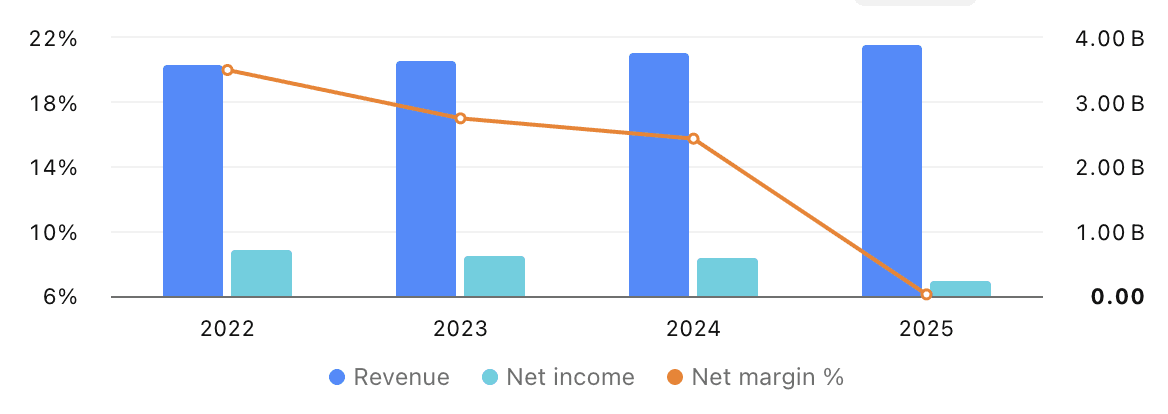
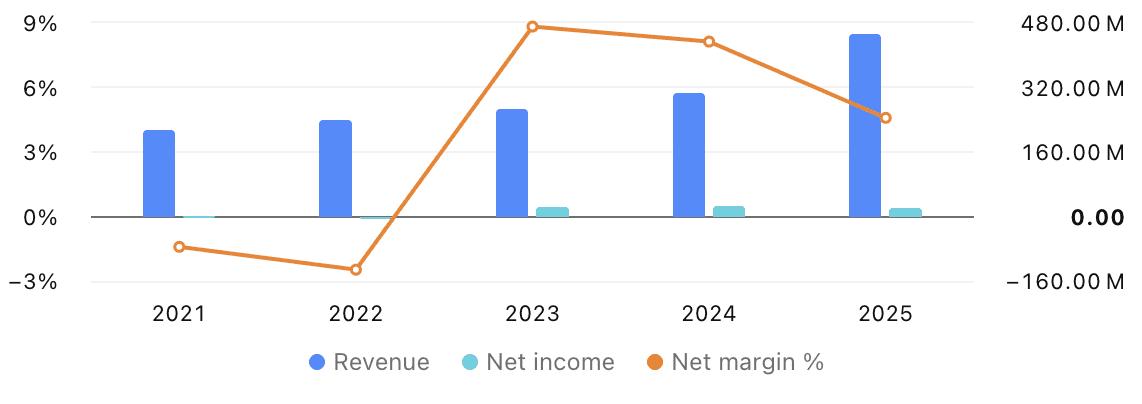
The recent Q1 2026 results were solid. Sales grew, guidance was reaffirmed, and the strongest growth came from the areas that matter most to my thesis: Nuclear, Electronic Materials, and Refrigerants. Nuclear revenue grew 27% year over year, helped by both pricing and volume.
The nuclear business is the main reason I’m interested, but the rest of the portfolio also adds value. Refrigerants could benefit from the transition to next generation products and the growing cooling needs of AI data centers. Electronic materials give $SOLS exposure to advanced semiconductor manufacturing. Thermal management could become more important as AI moves into robots, autonomous systems, drones, and other physical machines.
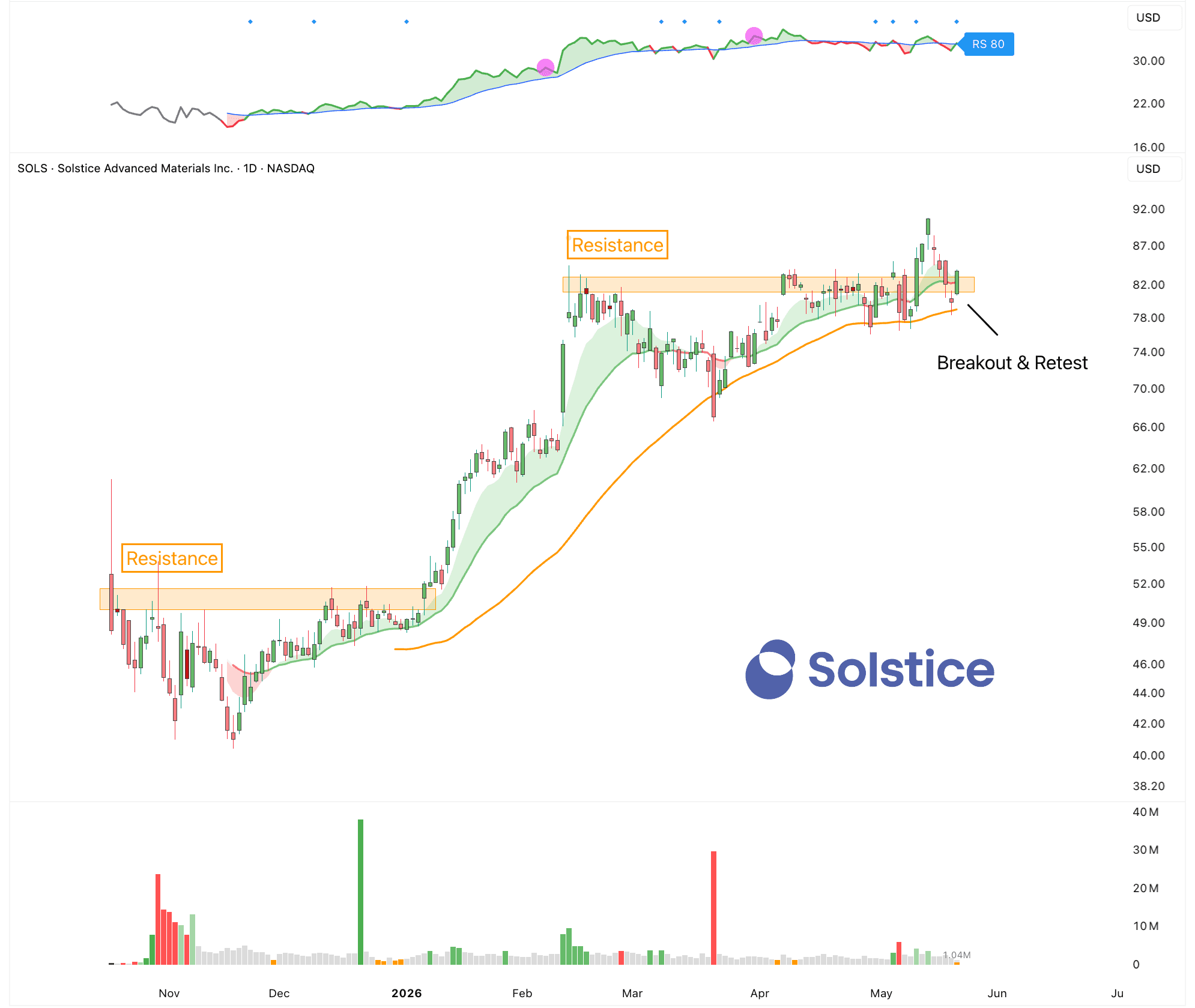
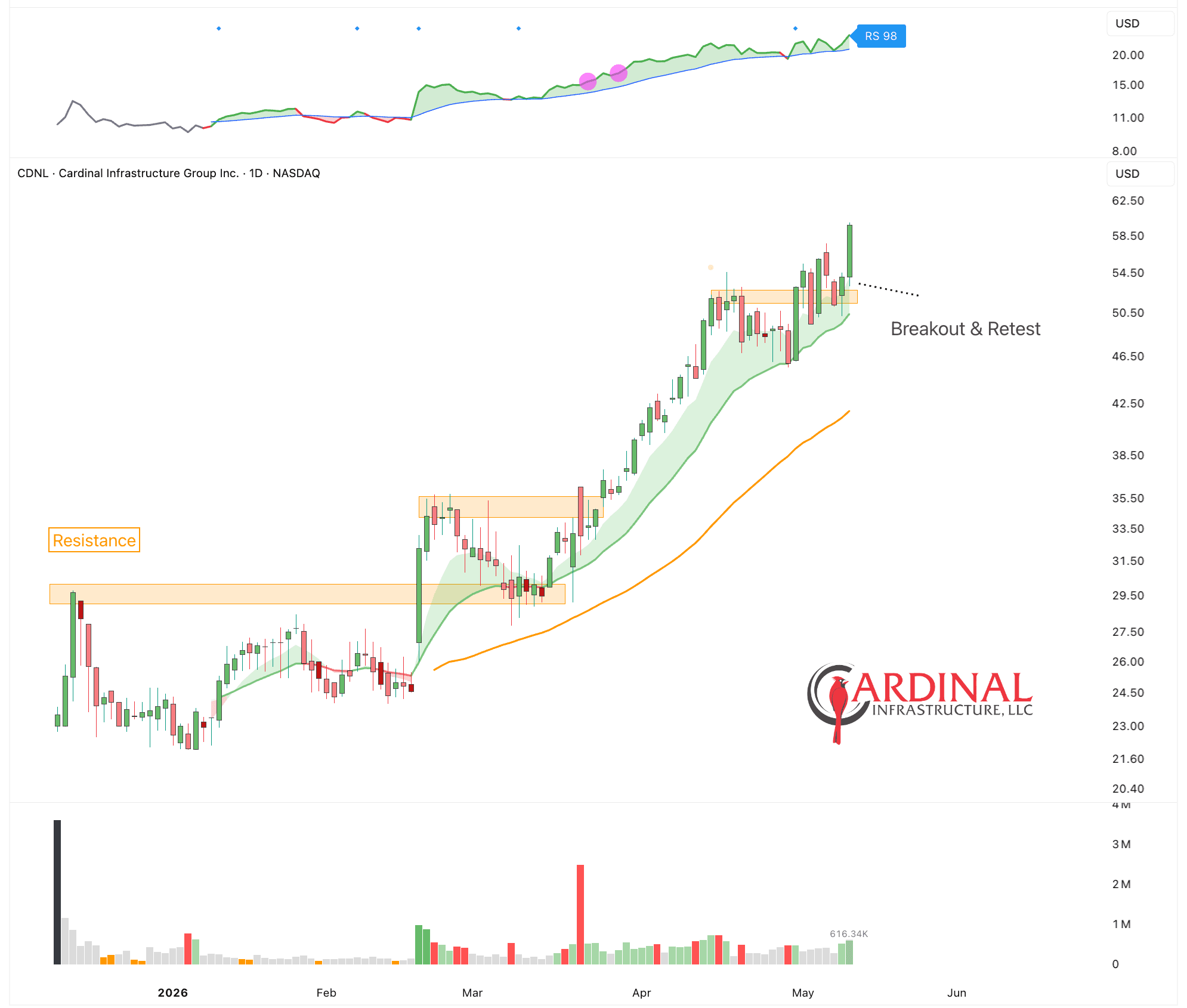
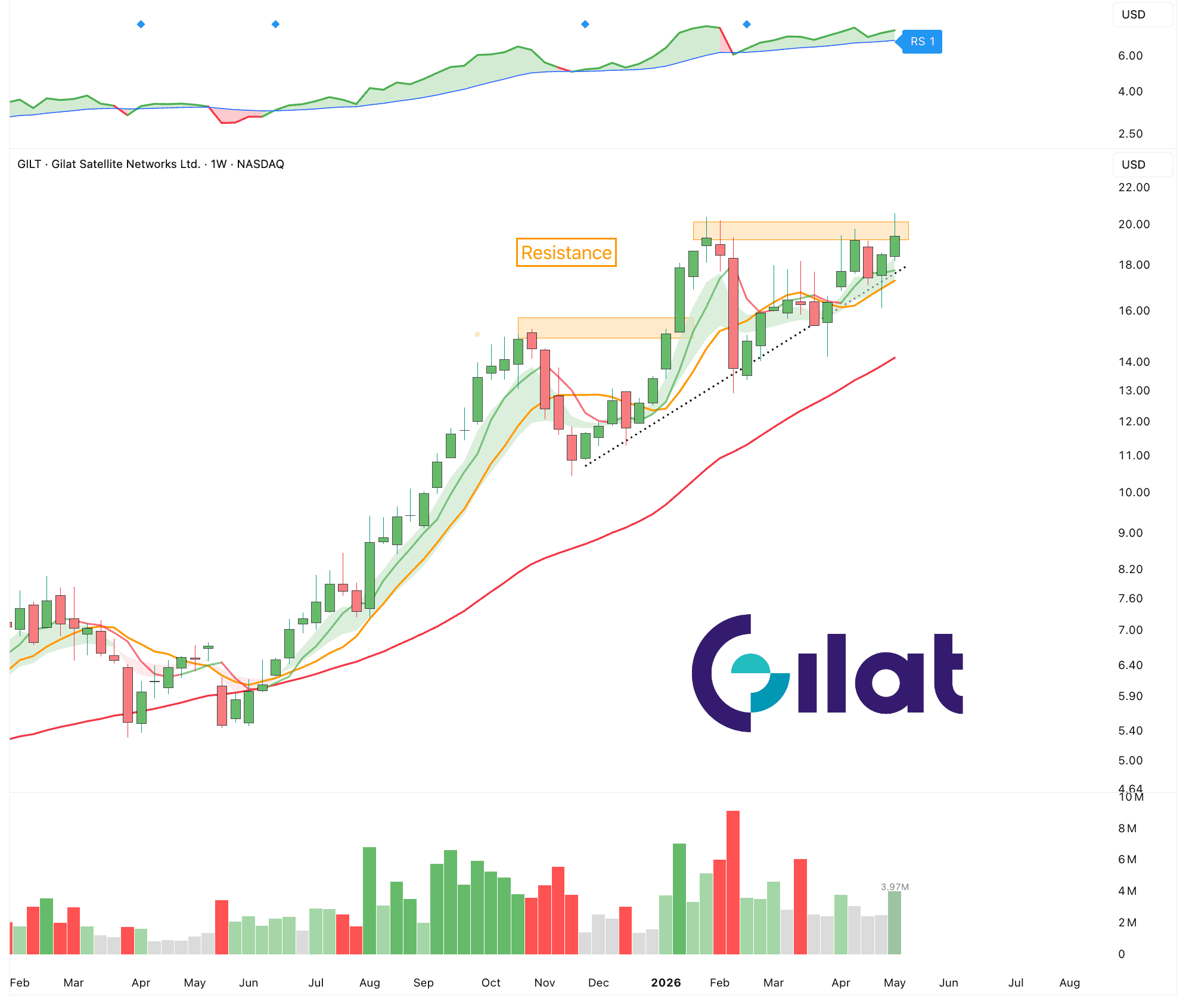
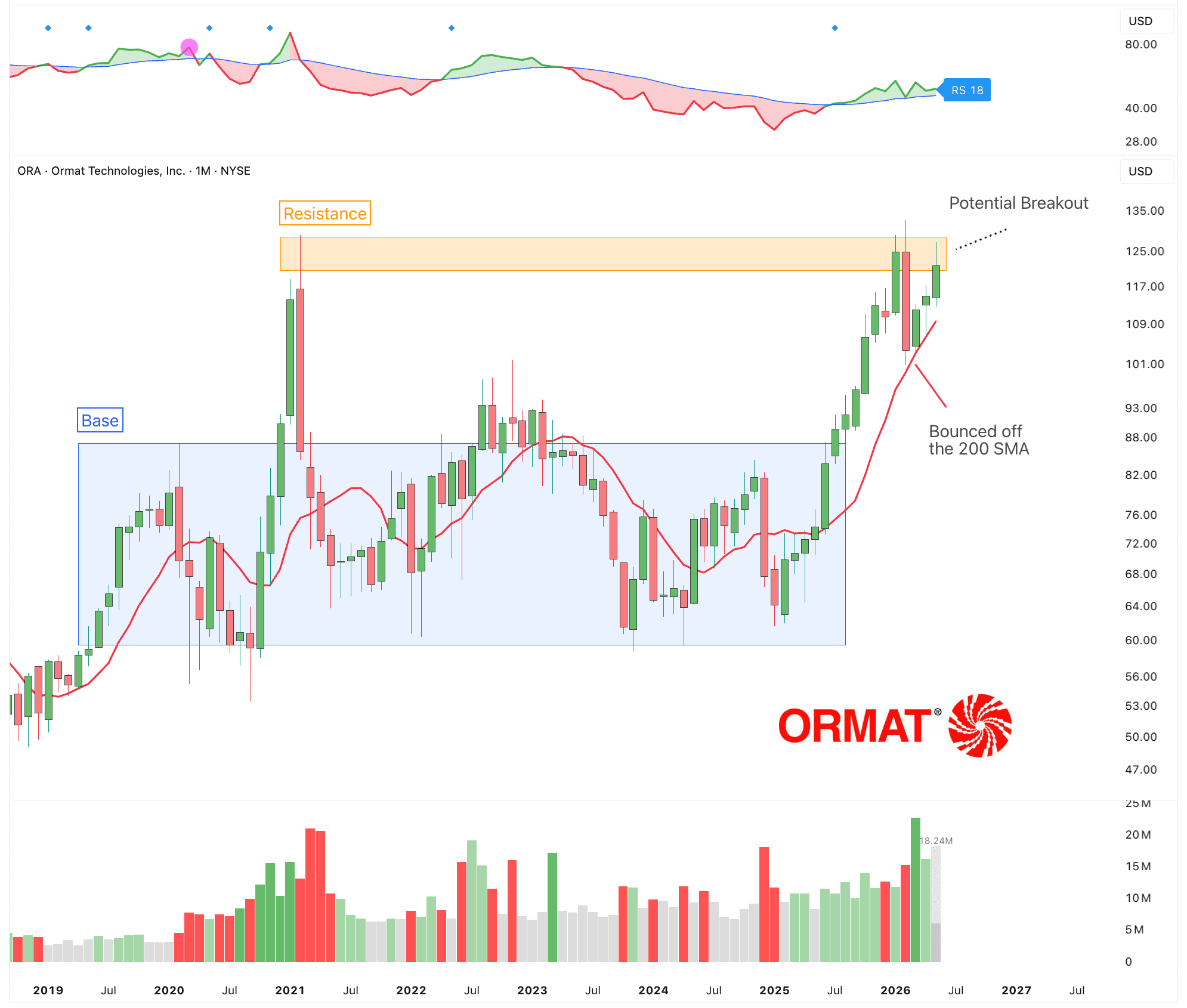
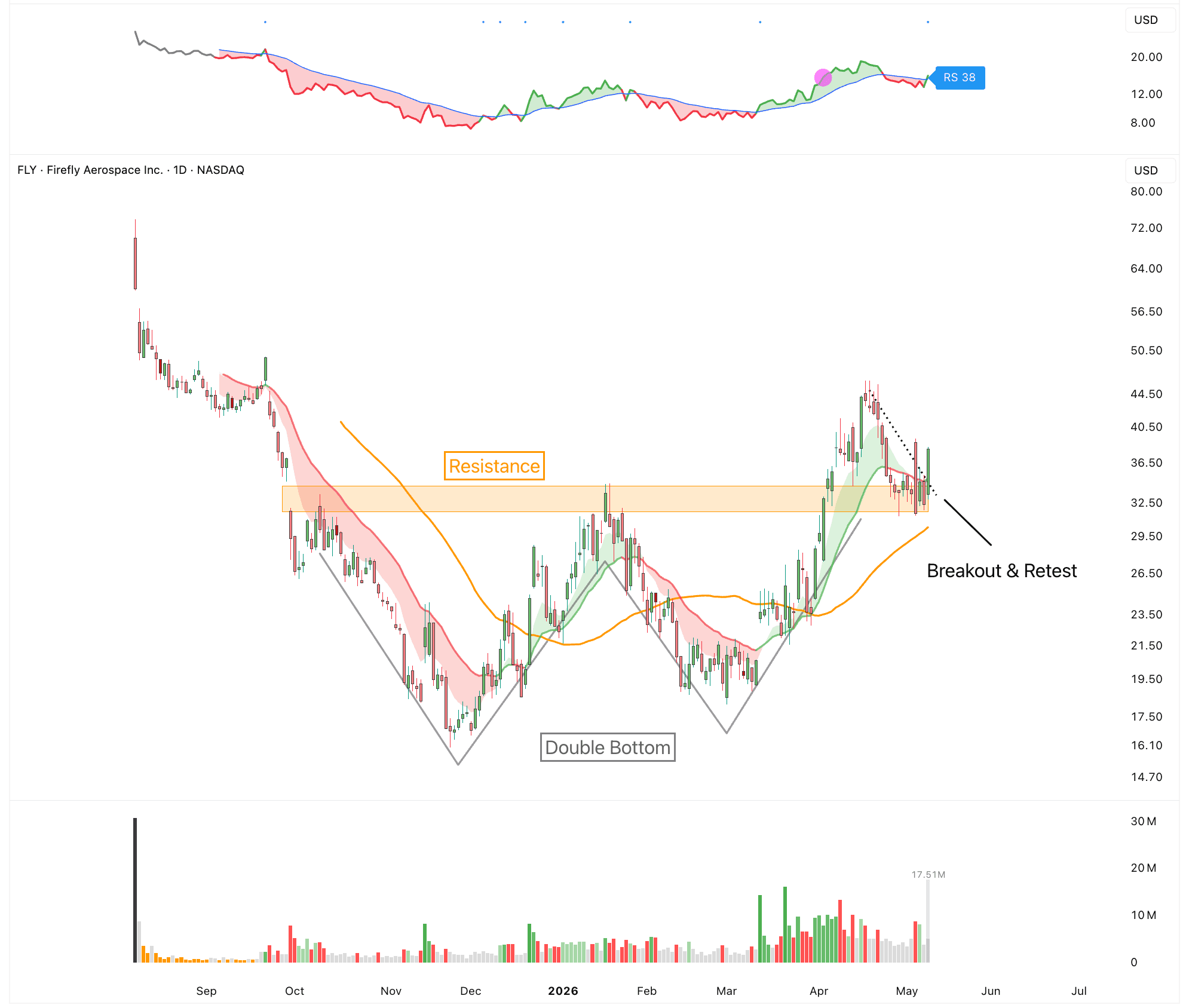
This could be a very compelling long-term opportunity. And right it's setting up for a perfect low risk entry after a breakout and retest of its previous highs.

























Lin
AAPL
Robinhood $HOOD
Robinhood $HOOD
.Robinhood is starting to form a bottom
Lin
AAPL
Dave $DAVE
Dave $DAVE
I’ve had a position a while ago because the technical thesis didn’t play out.
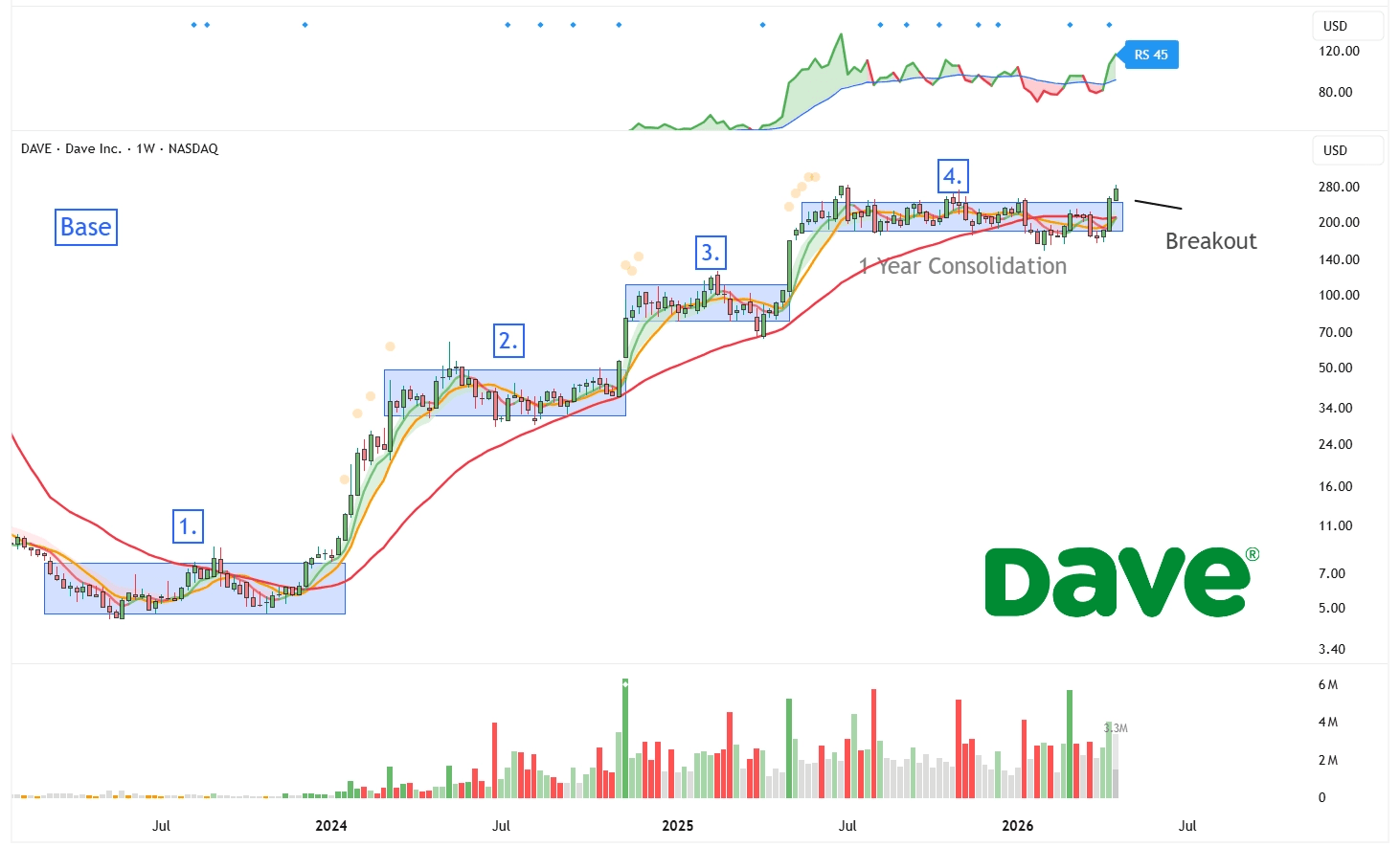
But now it’s back on the radar and honestly it looks a lot more interesting this time around. It is finally starting to break out after almost a full year of going sideways. That said, this is still a volatile name, so it’s important to size positions accordingly.
If you go back and look at the price action, there’s a pretty clear pattern that keeps repeating. It tends to spend months consolidating and building a base, then breaks out and moves quickly just to repeat the process again. The key thing to note is that the actual breakout phases are usually short and sharp.
The Setup:
Breakout of a year-long consolidation
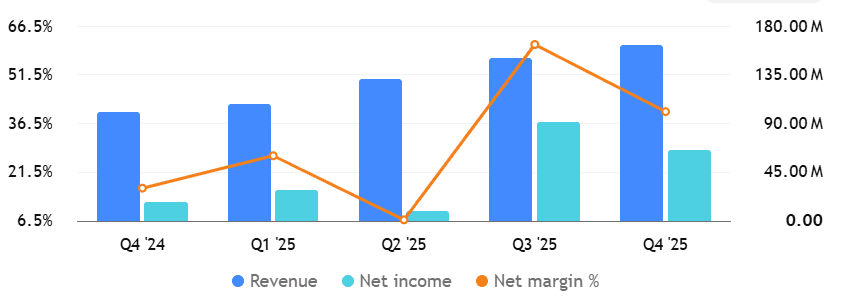
Operating leverage is kicking in leading to revenue acceleration
Dave’s business benefits from a harder macro setup and rising inflation
Steady compounder growing every year and every quarter
Lin
AAPL
Nvidia $NVDA
Nvidia $NVDA
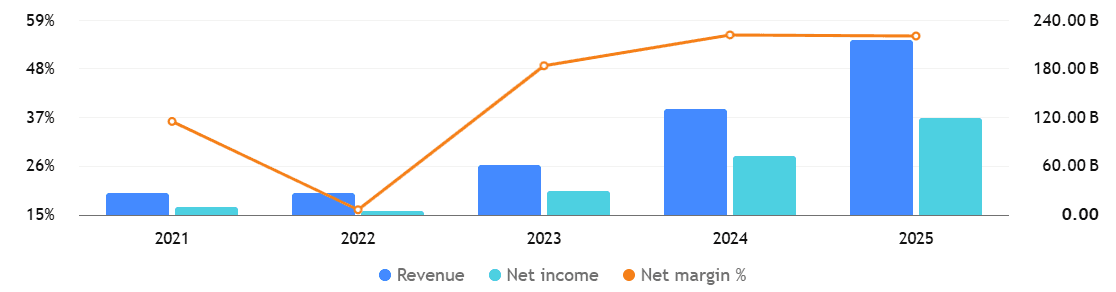
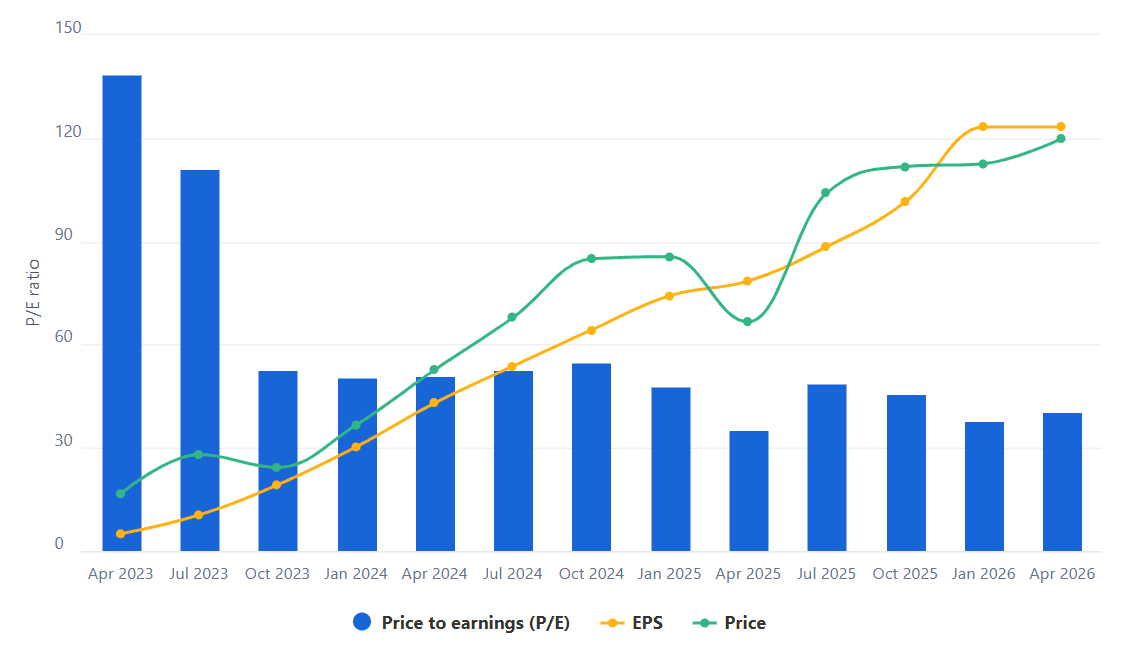
There is not much more to say about Nvidia.
I’ve been bullish for over 10 years and still am. It remains the most important company in the world and the leader in AI.
The Setup:
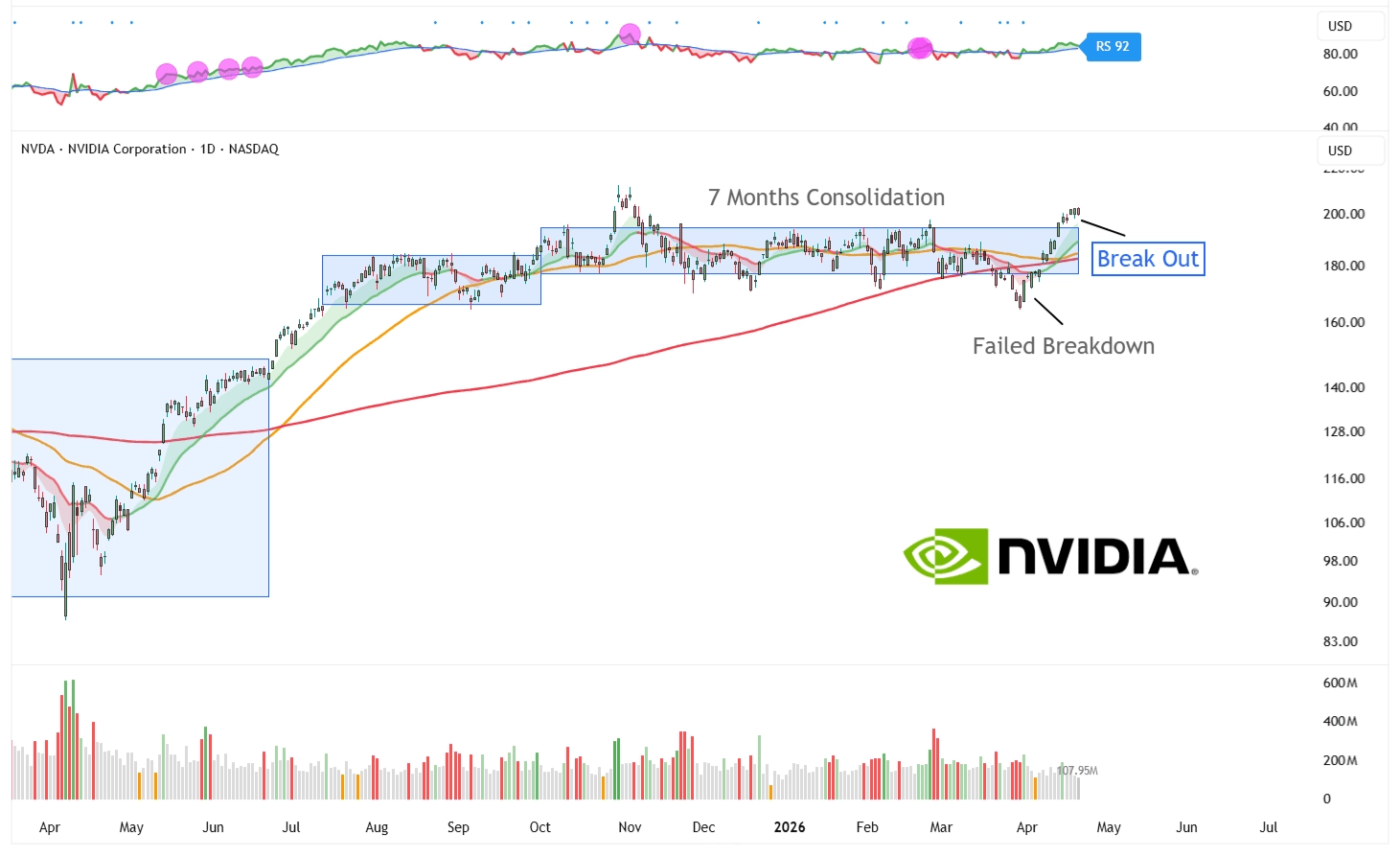
Breakout of a 7 months-long consolidation
AI developments continue to accelerate
Unprecedented revenue and earnings growth
Valuation has come down while fundamentals have improved
Semiconductor sector is hitting new all-time highs alongside $AVGO, $AMD, $TSM etc.
Lin
AAPL
Bitcoin $BTC
Bitcoin $BTC
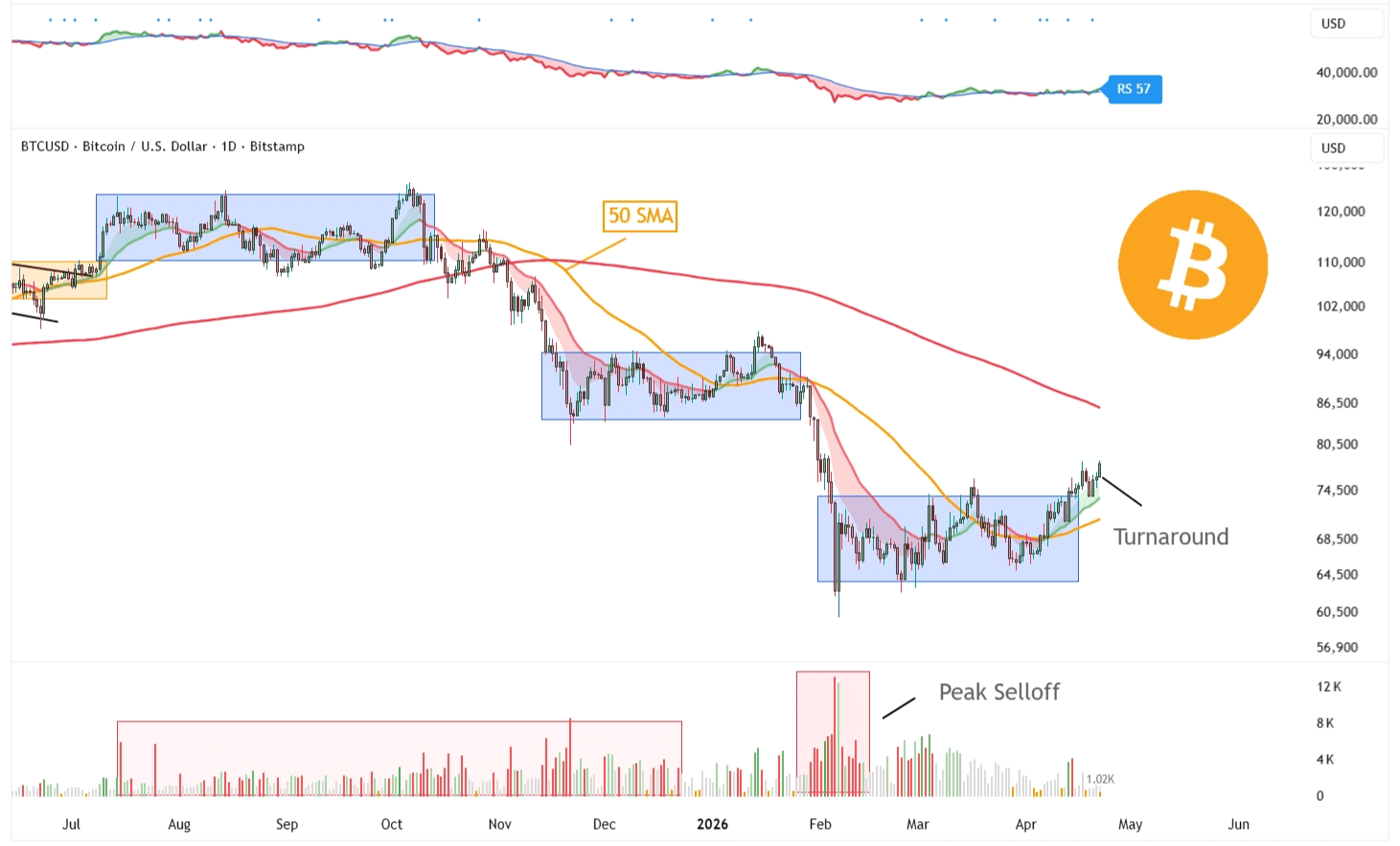
This is the first time in over a year that Bitcoin is starting to set up.
It’s not the cleanest setup, especially in this market, but it’s worth keeping an eye on and could make sense if you’re looking to start or add to a long-term position or as a short-term trading opportunity. And if this is the turning point, it will also likely start the rally in all the crypto adjacent names. But there will also be plenty of opportunities to add more.
The Setup:
Peak selloff volume in February
Breaking out of a bottom base
Building higher highs
Improving sentiment
Lin
AAPL
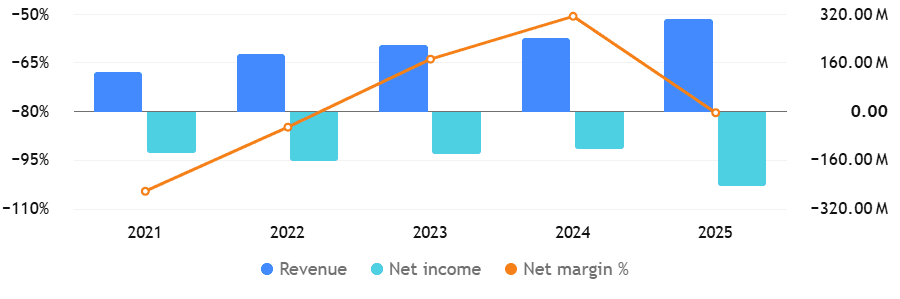
Planet Labs $PL
Planet Labs $PL
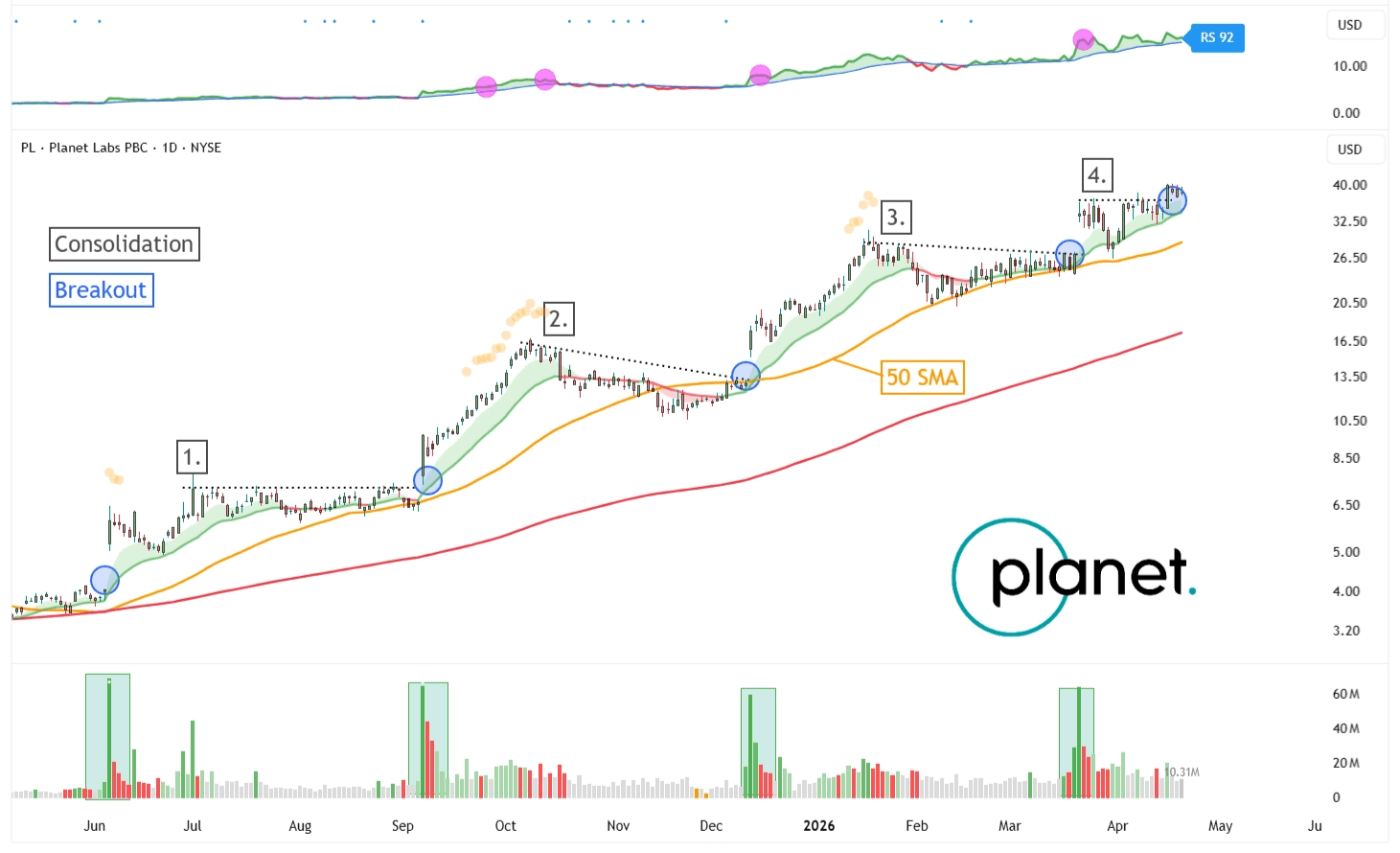
The SpaceX IPO is coming closer and closer. That will create a ripple effect through out the entire sector.
And Planet Labs is one of the more interesting names in this space. Planet Labs operates a fleet of small satellites that capture daily images of the Earth and turn them into data used to track changes.
The stock has been on a picture perfect advance. This is one to bookmark. The moves have been pretty linear. Every breakout is followed by a tight consolidation. It rallies, then pauses, then ralliesagain. This is exactly what leading stocks do.
The Setup:
Breakout of tight consolidation
Satellite data demand is exploding with massive backlogs
Lin
AAPL
Tesla $TSLA
Tesla $TSLA
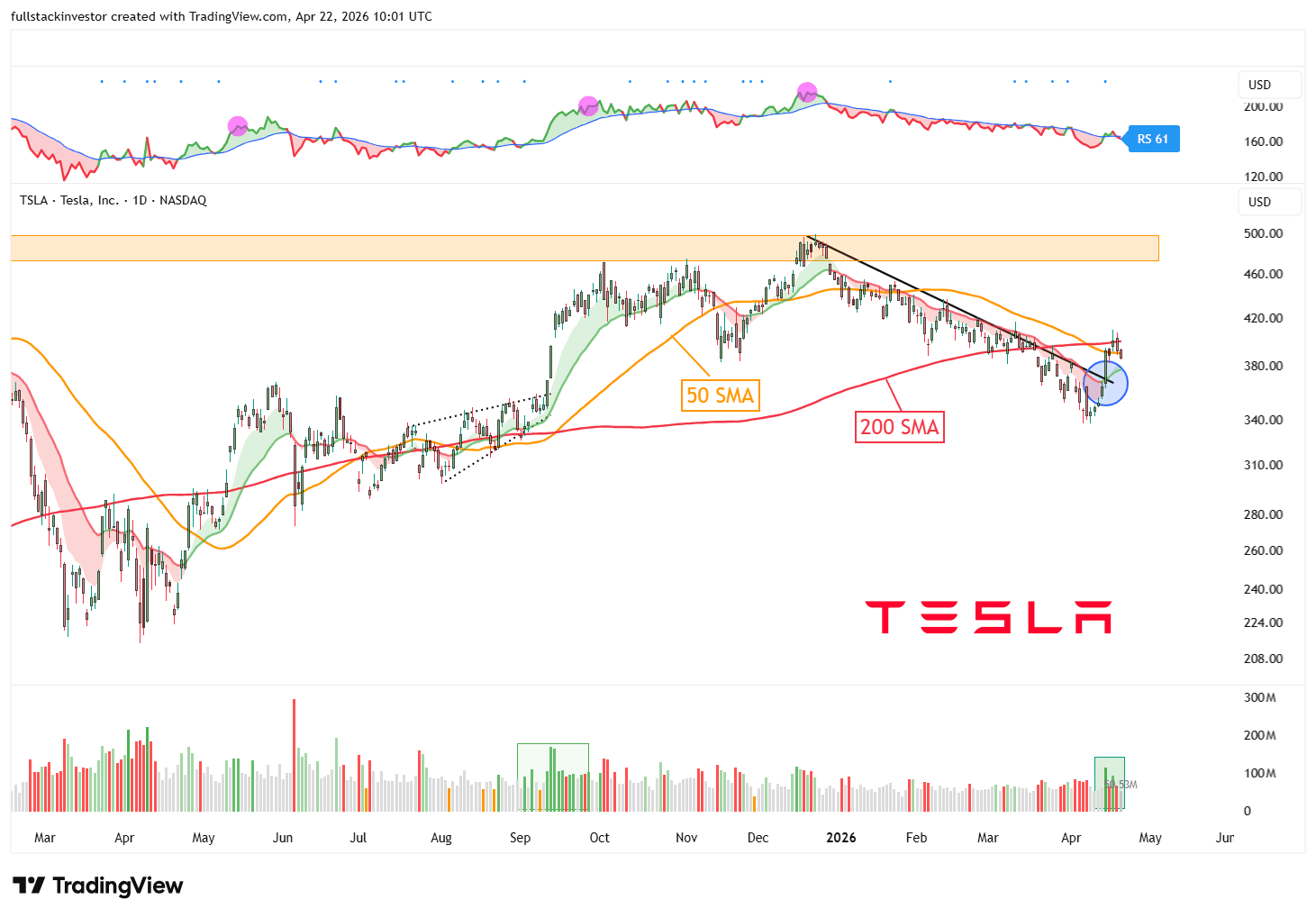
Tesla is setting up again after a 4 month long correction.
It’s still the best play on physical AI and the key driver will be FSD and robotaxis expanding globally. That will unlock trillions of value but there is still a long way ahead. It’s a big bet. But few people are capable of achieving that and one of that is Elon.
Tesla is not a car company anymore. It is an AI, robotics, autonomy, and energy infrastructure company wrapped inside an EV company.
And keep in mind that earnings are tonight afterhours.
The Setup:
Breakout of a downtrend and sitting right at key moving averages
Robotaxis starting to expand into new cities
Investing aggressively in the AI buildout and Terrafab
Energy business is growing rapidly
Announced new chip AI5
Lin
AAPL
Syntex Optics $OPTX
Syntex Optics $OPTX
Photonics and optics have been one of the hottest sectors lately.
Syntec Optics designs and manufactures very precise optical components. Think lenses, mirrors, and optical assemblies that control and guide light. These parts are used in things like semiconductors, medical devices, defense systems, and laser-based equipment.
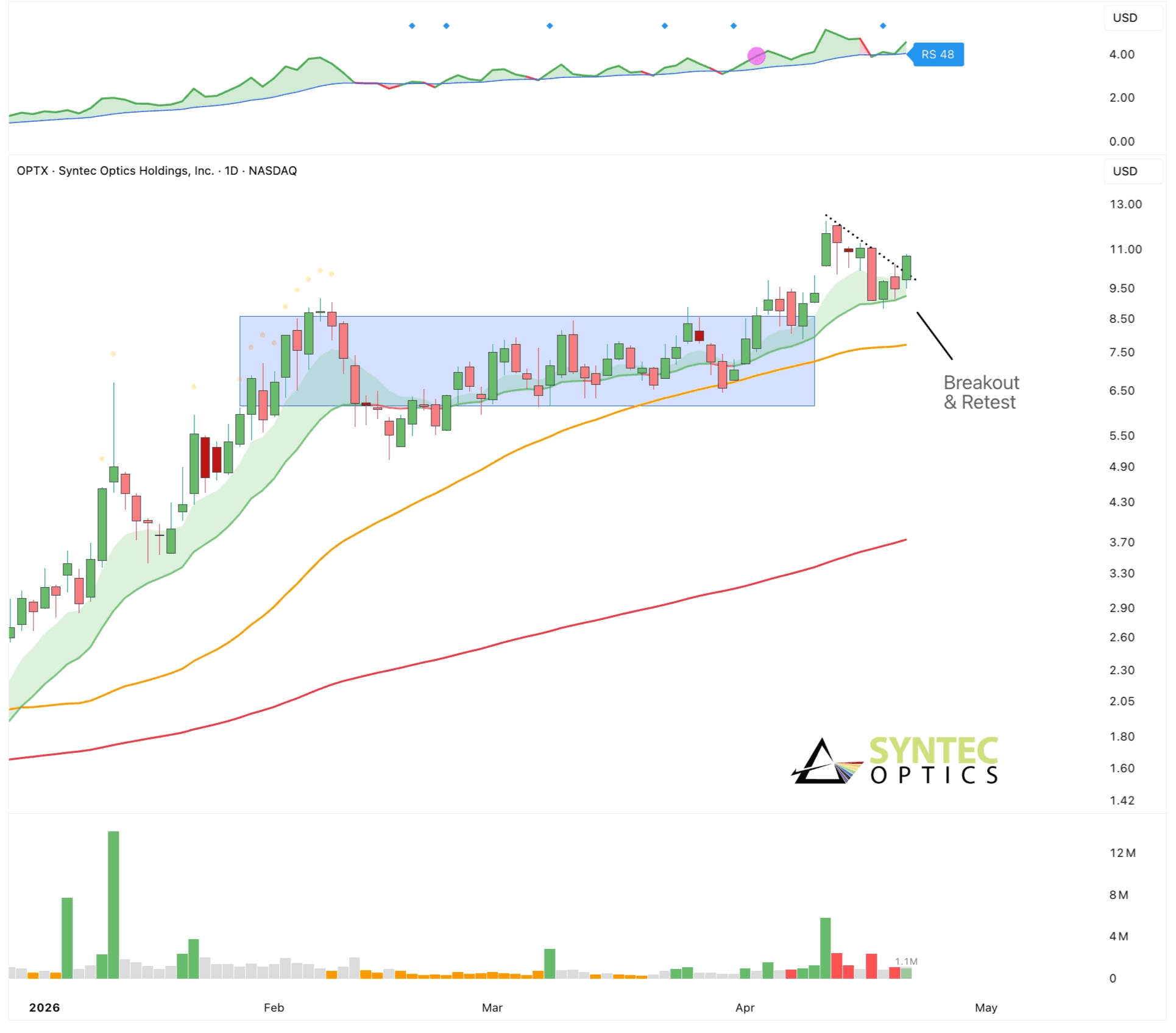
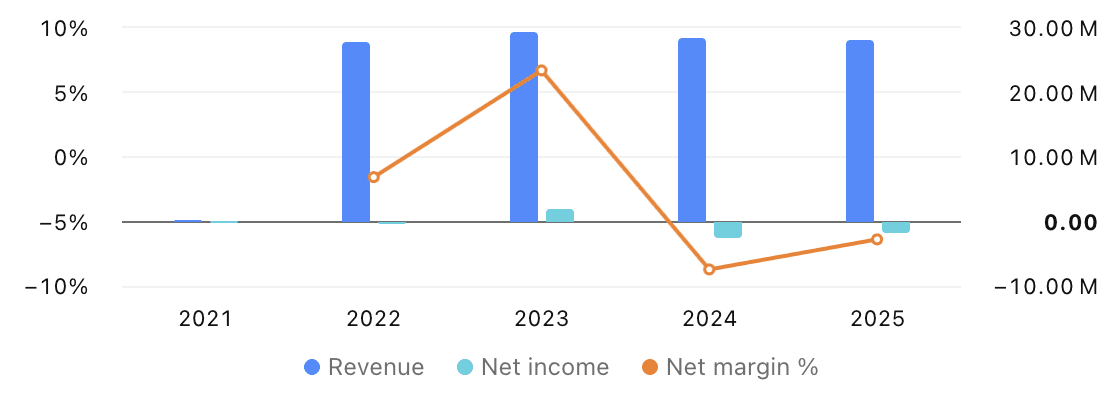
Fundamentally, not much has changed. The business has been fairly stagnant, so this is more of a short-term play taking advantage of the current market sentiment. It’s a small cap stock that is very volatile, so keep that in mind.
The Setup:
Part of the leading theme
Just broke out of a base and retested the breakout area
Capitalizing on short-term trend
Lin
AAPL
United States Antimony $UAMY
United States Antimony $UAMY
One of the interesting sectors setting up are rare earths.
US rare earths supply is the #1 national security priority right now.
The United States owns almost none of the upstream capacity/refineries for AI, Robotics, to Space, they rely on other countries from Canada to China.
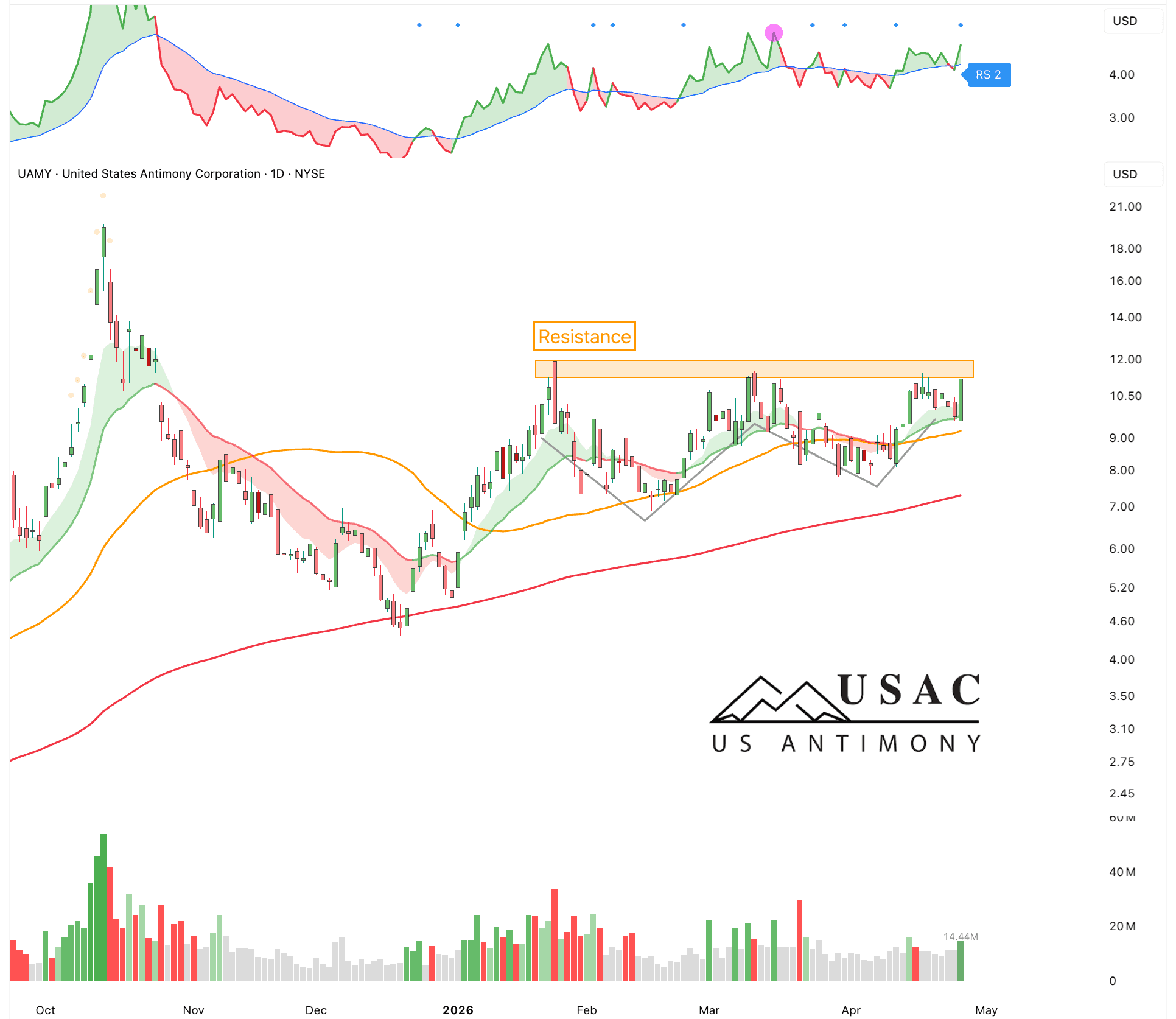
One of the more interesting setups right now is $UAMY, with others like $MP and $USAR looking compelling as well.
Keep in mind that this is a highly speculative sector.
The Setup:
Policy support for critical minerals has accelerated
New long-term strategic agreements as catalyst
Classic VCP (volatility contraction pattern)
Lin
AAPL
RocketLab $RKLB
RocketLab $RKLB
The space race is on.
There are rumors that SpaceX could IPO at a $1.75T valuation. If true, it would be the largest and most expensive IPO in history. Whether that valuation is justified is a separate debate. But one thing is clear: it would likely be a major positive catalyst for the rest of the space sector. Investors will likely re-rate the whole sector.
And one of the companies that is somewhere close to SpaceX is RocketLab - as I’ve written about at various points. It is one of the few public names with real launch capability.
The Setup:
Re-rating of the whole sector
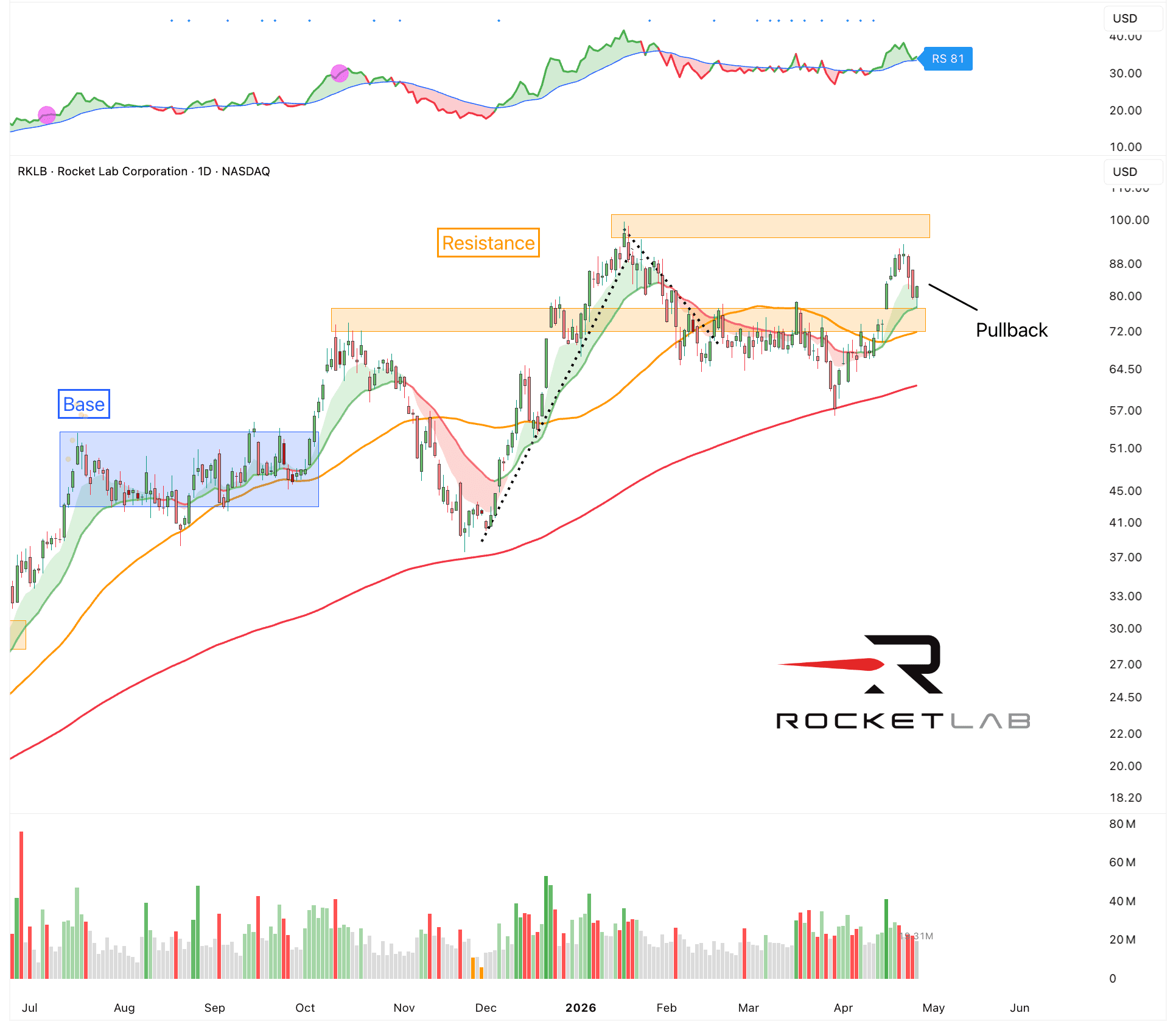
SpaceX likely in June or July
Potential pullback buy point
Lin
AAPL
Google $GOOGL
Google $GOOGL
My favorite names of the Mag 7 right now are:
$NVDA, $AMZN, and $GOOGL.
I’ve talked about Nvidia last week and since then it’s up close to 10% and back to new all-time highs.
And like Nvidia, Google continues to be underrated.
It’s the only company in the AI era with a serious AI-chip play + model play + consumer-facing applications.
It has >8 products each serving >1B active users (think Maps, Gmail, Search, YouTube, others).
TPUs are the only at-scale AI-chip deployment besides Nvidia.
Hence, I’m definitely looking to increase my position.
The Setup:
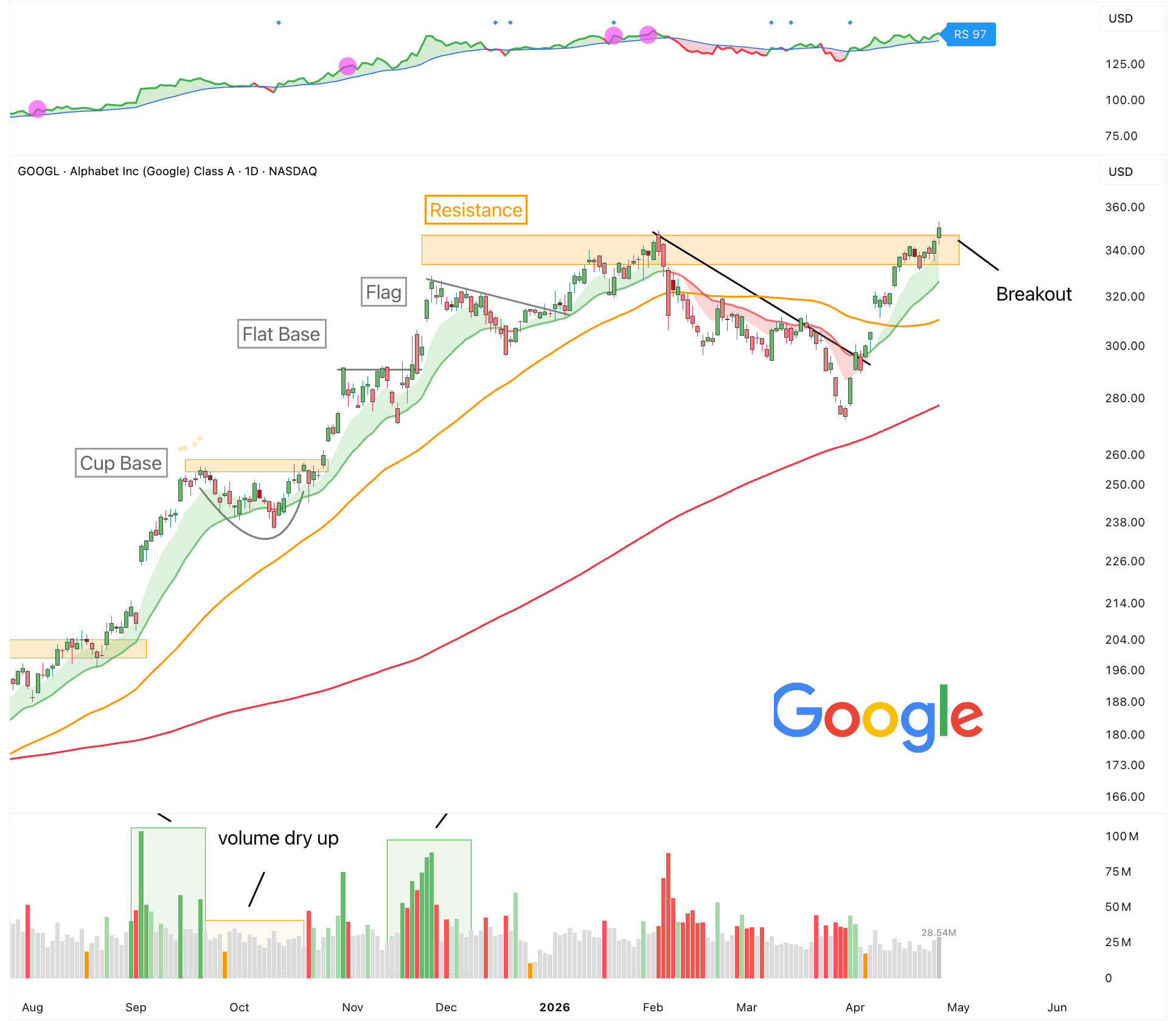
Breakout to new all-time highs
Earnings could the catalyst for the next move higher
Exposure Level
Guidance:
Neutral
0%
100%
Trend Indicator
Long-Term:
Up
Intermediate-Term:
Sideways
Short-Term:
Down
Risk Indicators
Volatility:
High
Sentiment:
Neutral
Momentum:
Neutral
Leading Sectors
View All
Biotech
AI Health
Software
Cybersecurity
Energy