Go Back

Lin
Market Update: The Space Race
For decades, space was mostly driven by governments. It was expensive, slow, and limited to a handful of giant defense contractors. But over the last few years, that changed. Space is becoming commercialized, industrialized, and strategically important all at once. This is why I believe we are still in the very early innings of a massive long-term trend.
The biggest reason is simple: launch costs collapsed.
Companies like SpaceX dramatically reduced the cost of getting payloads into orbit through reusable rockets. Lower launch costs change everything because they make entirely new business models economically possible.
In past technology revolutions, the biggest gains often happened after infrastructure became commercially viable. Railroads, the internet, cloud computing, smartphones, and AI all followed a similar pattern. First the infrastructure gets built. Then entirely new industries emerge on top of it.
Space may be approaching that stage now.
And entirely new layers are starting to emerge on top:
Satellite internet
Earth observation and geospatial AI
Space-based defense systems
Orbital manufacturing
Space energy infrastructure
Lunar logistics
Autonomous satellite networks
In-space data processing and computing
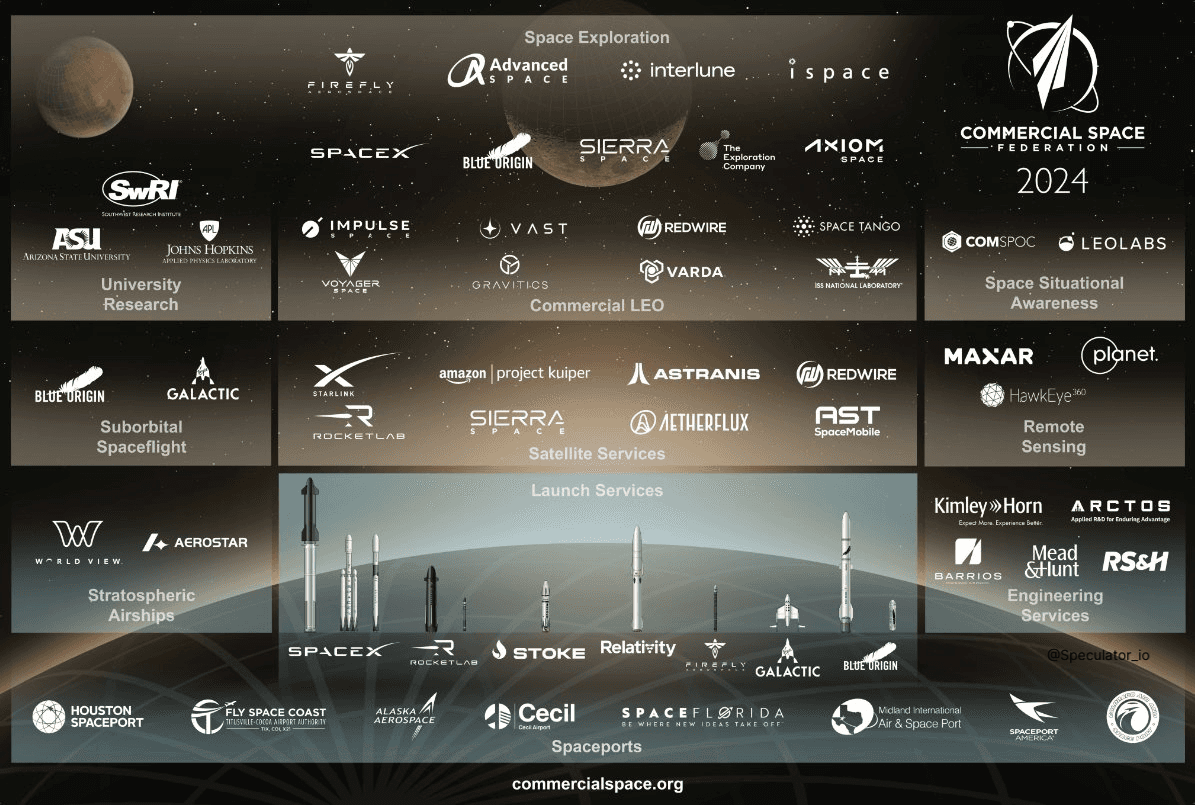
Governments around the world increasingly see space as a national security priority. Satellites are no longer just tools for communication. They are becoming critical infrastructure for defense, navigation, intelligence, weather tracking, internet connectivity, and military operations. The war in Ukraine showed how strategically important satellite systems can be in real time.
And the entire supply chain is expanding.
Most people think about rockets first, but the real opportunity is much broader. Space touches semiconductors, optics, AI chips, communications hardware, satellite manufacturing, power systems, robotics, sensors, rare materials, defense systems, and launch infrastructure. It creates ripple effects across multiple industries.
That means there are different ways to invest in the theme.
And if SpaceX eventually goes public at anywhere close to the rumored valuations, it could become a major catalyst for the entire sector. A massive IPO would likely pull far more institutional capital into space-related companies and force investors to rethink how large the market opportunity could evolve.
Make sure to check out the thematic space portfolio.
I’ve highlighted RocketLab and PlanetLabs recently.
RocketLab just reported another massive quarter and the numbers continue to show why many investors see it as the highest-quality public pure-play space company right now.
Q1 2026 revenue came in at about $200M, up roughly 64% year-over-year and ahead of expectations. Backlog also jumped to a record $2.2B as the company signed dozens of new launch and defense contracts
Now Firefly Aerospace looks promising.
Previous Updates
View All
- Weekly Market Update: AI is Not Slowing Down
- Market Update: Has AGI Arrived?
- Weekly Market Update: Consolidation
- Weekly Market Update: September is Here
- Market Update: Nvidia Crushes Earnings
- Weekly Market Update: Yields
- Market Update: The Future of Biotech
- Weekly Market Update: Earnings Acceleration
- Market Update: The Next Generation of AI Infrastructure
- Weekly Market Update: New Highs
- Market Update: Nvidia’s Way Around Memory
- Weekly Market Update: LTCM 2.0
- Market Update: The Trajectory of AI Compute