Cyclical Trend
Solar Energy
Harvesting the Sun
In A Nutshell
Solar is one of the fastest growing energy sources in the world.
It will only be a matter of time once it becomes the world's leading energy source.
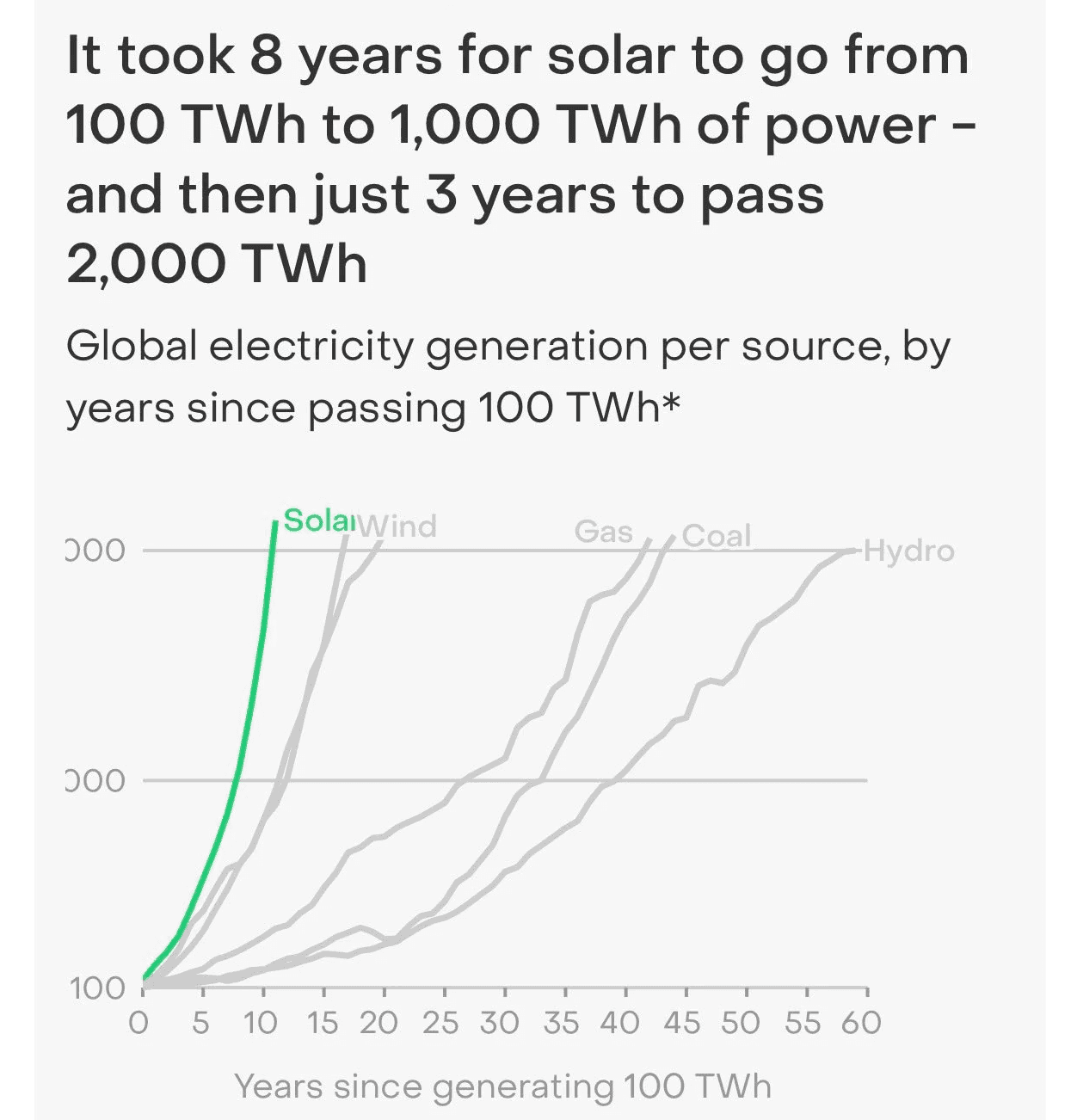
It is one of the cleanest and most abundant energy sources we have. And over the last 10 years, the cost of solar power has dropped by more than 90%. That huge cost drop made solar one of the most competitive sources of electricity in many regions.
Each solar panel is made of many solar cells, usually built from silicon. Sunlight reaches the cell as tiny energy packets called photons. When photons hit the silicon, they knock electrons loose. The cell is designed so these electrons flow in one direction. This movement creates direct current (DC) electricity. This process is called the photovoltaic effect.
These individual cells are then connected to form a module. Modules grouped together form a panel. Panels are wired in series to create strings, which increase voltage. Several strings are then connected in parallel to form the photovoltaic generator of the plant.
The electricity produced by panels is DC, but homes and power grids use alternating current (AC). An inverter converts DC into AC so the electricity can be used and transported easily. A control system monitors the entire plant and manages its connection to the grid to make sure all produced power is delivered safely and reliably.
Panels are mounted on support structures that aim them toward the sun. Some systems are fixed and stay in one position. Others use trackers that move during the day. Monoaxial trackers rotate on one axis, usually from east to west. Biaxial trackers move on two axes and follow the sun more closely. Tracking systems can produce more energy, but they also cost more and have moving parts.
Electricity demand in the United States is rising fast after years of stagnation. The main drivers are obviously AI, rapid data center expansion, new manufacturing, and electrification across the economy. For data centers that need large amounts of power quickly, solar is one of the easiest ways to add new generation capacity without long development timelines. However, solar cannot power data centers on its own. Solar only produces electricity when the sun is shining, while data centers must run 24 hours a day with almost no downtime. Because of this, solar is typically used alongside grid power rather than as a direct, standalone supply. So, it works best as part of a broader mix of energy sources.
Table of Content
Sector Map












Materials & Equipment

The Leading Solar Energy Stocks
Ticker
M. Cap
PS
PE
YTD
10MA
20MA
50MA
200MA

ENLT
30.7B
56.5
n/a
47.75%

VECO
2.6B
4.0
115.7
44.52%

AEP
71.0B
3.2
23
12.92%

SEDG
2.0B
1.5
n/a
7.16%

BEP
11.9B
1.4
n/a
5.80%
NEE
170.2B
5.7
17.7
1.37%
