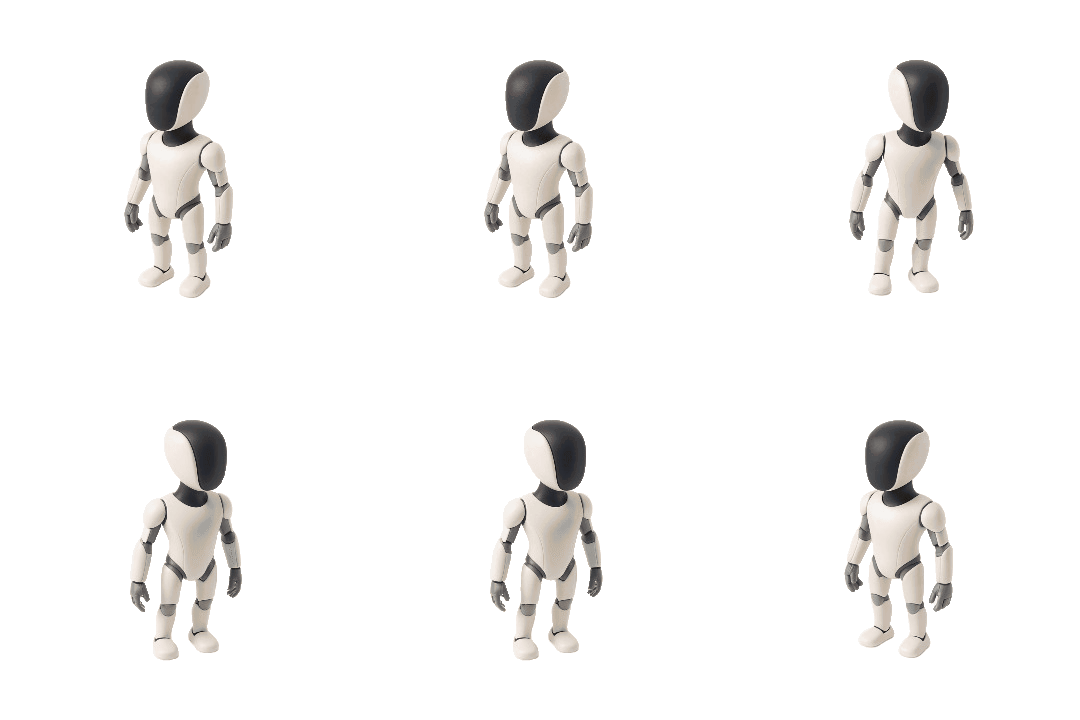
Secular Trend
Humanoid Robots
The Future of Labor
In A Nutshell
Humanoid robots are the next multi-trillion-dollar opportunity.
This is because they introduce a new labor class: physical labor that is software-defined, infinitely scalable, and always available.
For the first time in history, tasks that require human shape, mobility, and dexterity can be automated. Industrial robots have existed for decades, but they are fixed, single-purpose machines.
Humanoids are general-purpose labor: they can move through buildings, use existing tools, drive forklifts, carry materials, load shelves, install components, and operate in environments built for humans. No redesign of factories, warehouses, or workflows is required. The robot just steps in and works.
The world is entering the era of physical AI. Just as software automated knowledge work, humanoids automate real-world physical work.
The addressable market is enormous. Over $100 trillion of global GDP is linked to physical labor. Even partial automation of this market is transformative. Elon Musk thinks that Tesla’s humanoid robot Optimus could eventually be more valuable than the entire automotive business, because humanoids unlock an effectively unlimited labor market.
This moment is possible because the enabling technologies have converged at the same time:
AI perception (vision-language models that understand scenes and objects)
Real-time control (large-scale robot training in simulation)
Actuator miniaturization (lightweight motors with human-level joint torque)
Battery density and power management
Mass-manufacturing supply chains repurposed from EVs (motors, sensors, gears)
Once a humanoid robot learns to perform a task, the skill is copied instantly to every robot in the fleet before they ever touch the physical world. You do not train one worker at a time. You train the network. This breaks the traditional relationship between labor and time.
We’re at the inflection point.
The prototypes are working, but the fleets are not yet deployed. The inflection happens when humanoid robots reach $15–$25 per hour operating cost. At that point adoption accelerates exponentially, similar to the curve of industrial automation, PCs, smartphones, and cloud computing.
We are on the edge of the first global labor abundance in history. A world where labor is abundant. Where the limiting factor in building, producing, and creating is no longer the availability of people, but the ambition of ideas.
And like every major technological revolution, the biggest returns accrue to those who position before the scale curve bends.
Table of Content
Sector Map
Humanoid Maker














The Leading Humanoid Robots Stocks
Ticker
M. Cap
PS
PE
YTD
10MA
20MA
50MA
200MA

MU
972.8B
7.6
11.9
192.28%

INTC
454.0B
8.1
n/a
127.46%

ARM
224.1B
45.8
226.1
85.99%
AMBQ
1.2B
12.4
n/a
63.67%

STM
40.7B
3.2
512
62.25%

TXN
257.3B
13.0
41.9
61.96%

TER
48.7B
11.8
45.8
56.96%

SYNA
4.7B
3.8
n/a
55.08%

CGNX
9.2B
8.7
54.1
49.96%

ADI
188.8B
13.9
46.8
41.68%
